0
0
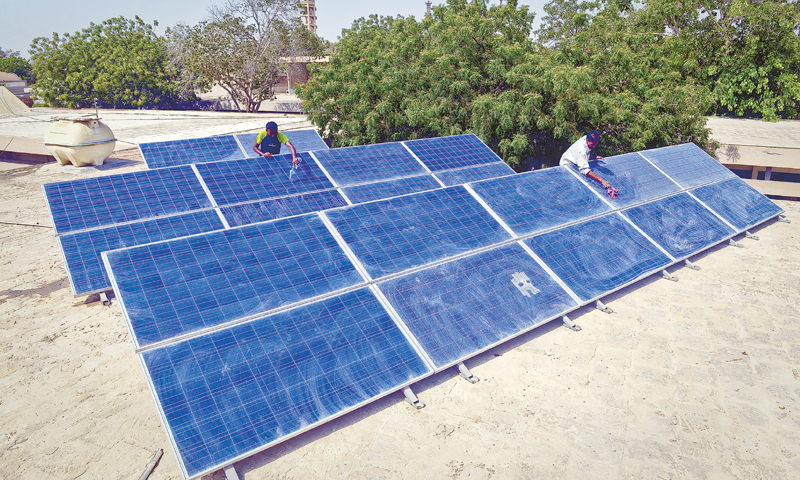
KARACHI: Lack of funding is holding back a major public sector university project that, if implemented, would be the first ‘green campus’ of the country, it emerged on Wednesday.
Sources said the Rs300 million green campus project of the NED University of Engineering and Technology has been waiting for financial support for the past three years.
“Seeing is believing; I think the major reason why solar energy has not been popularised is the fact that the country lacks an example that demonstrates that it is very much viable to run an institution as big as a large public sector university on solar energy,” said dean of the faculty of civil engineering and architecture Prof Sarosh Hashmat Lodi.
He said the university had the potential to become a role model to motivate energy conservation and could be the best place to spread a positive image to all sections of society for “mass awareness” on resource efficiency.
“We have taken small initiatives to introduce resource efficiency and sustainability. For instance, electricity consumption on the campus has been reduced after carrying out an energy audit of the university with the help of K-Electric. Also, the civil engineering department building and a street within the campus have been running on solar energy for a year. This was done with the financial support of NED alumni in the US,” he said.
The idea of the green campus project, according to department teachers, was developed a few years ago and a proposal was subsequently submitted to the provincial government.
Unfortunately, the university did not receive any funding from the government. Later, the plan was shared with foreign experts following an agreement between the governments of Pakistan and South Korea on knowledge sharing.
“The university had submitted two proposals – establishment of a centre of innovation and incubation, and a green campus – both of which were accepted and experts from both countries visited institutions of higher learning and exchanged dialogue,” said Dr Mohammad Ali Memon, chairman of the electrical engineering department and part of the two-member team which toured South Korea.
Sharing his experiences from his visit, dean of the faculty of electrical and computer engineering Prof Saad Ahmed Qazi said: “The country has made tremendous progress in technology. The visits facilitated by the Korea Development Institute helped us greatly to improve our project proposal.”
Since the accord didn’t involve any possibility for financial support, the university approached foreign donor agencies such as the Green Climate Fund last year but without success. The NED University faculty, however, has its fingers crossed and the rejection has not dampened their spirits.
“It is only because another Pakistani project related to glacier melting got the approval. We are hoping that our proposal will get the nod next year,” said Prof Qazi.
Voicing their concerns over the serious energy constraints hampering the national economic growth and the delay in popularising alternative energy resources, the teachers believe that it is time that Pakistan joins the list of countries making progress in the sector.
Published in Dawn, May 12th, 2016