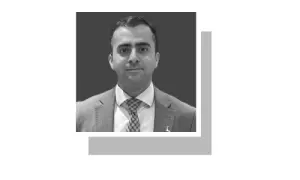
On my visit to the US this month, I had the privilege of meeting Dr Adil Akhtar, a leading oncologist cum dedicated artist in Michigan, who is soon to visit to his hometown Karachi after three years to exhibit his work.
Last time, he brought with him huge paintings on religious themes, but on this occasion, he is displaying more than 50 drawings in ink, pencil and charcoal on paper.
The choice of colours, or shall I say the absence of colours, is in keeping with a rather morbid theme. He portrays the grim realities, mainly the disparities and inequalities that he had seen in Pakistan where he grew up; the title of his upcoming exhibition E-31 harks back to those days.
Why E-31, I wondered?
That was the number of the humble two-room house on the University of Karachi campus, where he spent his formative years. While his two elder sisters can recall better days, Adil simply cannot.
 |
| One of the sketches that will be on display in Karachi this month. —Photo by author |
He was only two and a half years old when his father, a government officer, passed away. His mother was barely 21 and had studied up to grade eight but she took up the challenge by sewing to make ends meet, at the same improving her educational qualifications.
She was determined to live on her own, though her brother-in-law, a professor in the department of political science at the university, had opened his doors to his late brother’s family.
Adil Akhtar and his family were somehow accommodated in the lowest category of housing – E type of houses, ranking fifth from A to E. The number was 31, hence E-31. Their neighbours were the families of peons and sweepers. The categorisation of housing made him conscious of inequalities pervading in the society.
It was a nagging feeling which strengthened as he moved ahead in life. He matriculated and then after a couple of years in college earned admission in the prestigious Dow Medical College in Karachi from where he ultimately graduated.
The 1961-born Adil Akhtar completed his house job in 1987 and somehow managed to make it to the US to study medicine the following year. He was in Baltimore, which is an hour’s drive from Washington DC, a city studded with several art museums. Visits to those treasure troves of art aroused the latent artist in him.
He became inspired by what is known as Modern Art. When the self-taught artist picked up the brush he started working on canvas in the same genre.
During my visit to his house earlier this month, I was seated opposite a large abstract painting that shows pollution in the environment that merges with killings the world over – in Afghanistan, Iraq and on 9/11, which explains why the colour red dominates this work, displayed prominently in the sitting room.
‘The killings are quite often results of the lust for resources,’ he declares.
 |
| Adil Akhtar portraying chaos in the world today. —Photo by author |
A large room in his spacious house in the outskirts of Detroit serves as his studio, where he works sitting on the floor. His day begins at 4am with some painting before leaving for the hospital, where he is until 7pm.
Back home, he spends sometime with the family before heading off to his studio where he remains until midnight. He is lucky in the sense that a four hour sleep appears to be more than enough for him! He uses brushes, crayons, charcoal, pencil, his index finger and at times, also his palms and feet. It is a sight worth watching.
Behind his calm and cool exterior, Dr Adil Akhtar is a tireless fighter.
He has successfully coped with the economic and social challenges in life during his time in Pakistan and now, as a top ranking oncologist, he fights relentlessly against cancer.
Dr Adil Akhtar’s exhibition will open on March 28 at Karachi’s Commune Gallery.