KARACHI: There is, and will always be, one hero in writer Anwar Maqsood’s stage offerings: his script. When you go to watch his plays, you are not looking for top-notch acting performances or awe-inspiring sets and lighting gimmickries.
You are there with a preset mind that the witty exchange of dialogues and stinging one-liners will take our political system in general and politicians in particular to the cleaners — and in the process make you laugh like crazy.
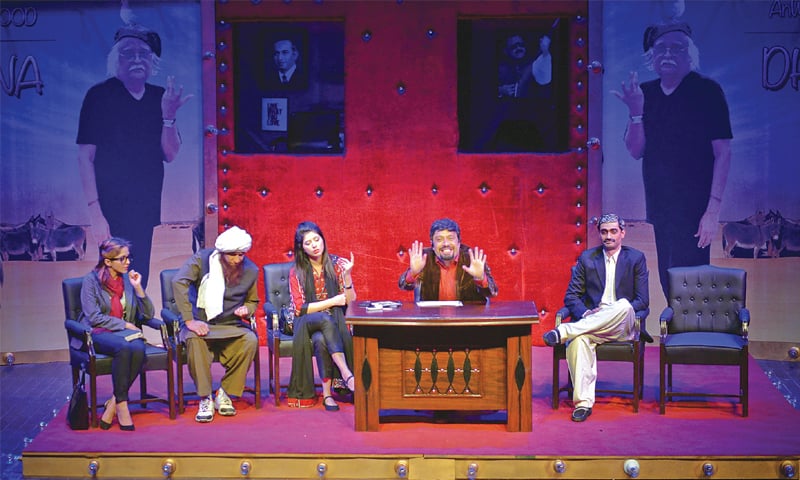
That’s exactly what happened on Thursday night at the premiere of the play Anwar Maqsood ka dharna, directed by Dawar and Yasir, in the Arts Council’s auditorium. Thankfully, the actors also did a decent job.
As can be understood from the title of the play, it revolves around the dharna (sit-in) politics that has lately enveloped the country. The difference is, this time round it is Anwar Maqsood, with the Quaid-i-Azam, who has staged a sit-in at the latter’s mausoleum to press for animals rights. This takes the media by the storm and known anchor Noorani (Noorul Hasan) decides to do his talk show on the issue by inviting the (political) guests that every Pakistani is familiar with.
They include an N-League minister (Ishtiaq Rasool), JUI member Nizam Deen (Saqib Sameer), PPP choreographer Surmai (Sana), Pakistan-loving analyst with Canadian nationality Suzanne (Amna Mawaz), Bilawal Bhutto (Mubashir), an MQM supporter (Yasir) and PTI chief Imran Khan (Dawar).
The discussion between the anchor and his guests unleashes hilarious banter and tit-for-tat comments, revealing the difference of opinion between them as well as baring inner selves they tend to hide at public places. Nizam Deen’s fondness for technology and a roving eye, fooling Surmai into taking a selfie with him, and the N-League minister’s fear of Imran’s arrival in the programme are smartly done.
The taking of live calls on the show breaks the verbal monotony and adds colour to the scheme of things, and the play hits a high when someone from Okara phones pretending to be MQM chief Altaf Hussain. This alerts all the participants, including the MQM supporter who is part of the show from another city. That moment had the entire auditorium in stitches.
The one-liners that the script contained had gems like when the N-league minister whistles and the anchor tries to stop him, he says ‘railway ka wazir hun seeti nikalti rehti hai’ (I have the Railways portfolio, I tend to whistle). To which Noorani responds ‘agar Imran aa gaey to aap dhuan nikalna shuro kerdein gey’ (if Imran arrives, you will emit smoke).
At one point, referring to Shahbaz Sharif, the N-League minister mentions his favourite song is ‘main pull dau pull ka shaer hun’ hinting at the chief minister Punjab’s penchant for constructing bridges. And when Imran Khan makes his appearance in the chat show, he tries to exploit the opportunity in his favour by delivering spiels as he does at the dharnas to earn political mileage.
The clever thing about the whole play is the way it unmasks the role of the broadcast media. The anchor’s desire to get high ratings by inviting big controversial names and his two-faced personality, sheepish and wolfish, is a poignant reminder of what our media has morphed into. Noorul Hasan’s performance as Noorani stands out because he appears to know the character he’s playing inside out.
Dawar as Imran Khan is very impressive. He speaks in a voice with two pitches, one going up to state a point and the other fading into almost whispers to stress it further. Saqib Sameer as Nizam Deen and Isthiaq Rasool as the minister are also very good.
Now something that the producers of Anwar Maqsood’s plays, Kopykats, should think about. They have found, and perhaps want to stick to it, an easy way to do a successful stage production –– to have a powerful script, and there’s nothing wrong with it. But for them to develop as theatre persons they should learn the art of stage-manoeuvring, set design, footwork and expanding the horizon of a great piece of writing.
For example, the placement of Bilawal Bhutto and the MQM representative a floor up, behind the backs of the in-studio guests is visually jarring and dilutes the effect of some of the meaningful lines that the two characters say. Consulting with a crafty art director would have solved that issue.
Then they never try to visually enhance the impact of a witty line. A character utters a sentence the other character replies, the audience laughs, end of sequence. Some lines demand more than that, which the young directors need to discover. That’s where the understanding of symbolism comes in handy.
Published in Dawn, January 16th, 2015
On a mobile phone? Get the Dawn Mobile App: Apple Store | Google Play