0
0
Need for credible polls
SHOULD the nation go to the polls on Jan 8? It may be premature to ask this question so soon after a grave national tragedy. But it is agitating many minds. The violence is there but the peak of anger seems to be edging off. The sense of loss will remain for much, much longer. It will take time for the people in general and the PPP leadership in particular to be able to focus on the task at hand. Only then will they be able to take stock of the situation and think in terms of chalking out the way forward. As we write these lines, road, air and rail traffic has been disrupted. Medical services are not normal. Homes are short of food stocks and catering services have broken down because urban and inter-city transport is off the streets. The three-day mourning period announced by the government ends tomorrow, and then alone can one hope that the nation will limp back to a semblance of normality. The government too has been paralysed, with the banks having been closed for three days.
The PPP leaders have announced a 40-day period of mourning, and it is on them that the responsibility rests for crucial decisions that could affect the country’s fortunes. One hopes they will exercise the highest sense of responsibility and statesmanship, so their leader’s sacrifice will not have been in vain. They have not only to overcome the grief of their party leader’s assassination, they have to assess whether their workers will be in a position emotionally to resume campaigning for the Jan 8 vote. An even greater task before the PPP high command is the choice of a leader. While we cannot at this stage go into the details of this issue, choosing a leader and maintaining and reinforcing party unity are the leadership’s first task. Hints are emerging from Larkana that Ms Bhutto left a will for her political legatees and it will be read out later today. If this happens, greater clarity will emerge about the PPP’s position on matters such as the January elections.
The caretaker prime minister, Mohammedmian Soomro, has meanwhile decided to call an all-party conference to seek a consensus on the issue of elections. Nawaz Sharif has decided to boycott the polls while Qazi Hussain Ahmad — having earlier opted out of the electoral process — has refused to attend the APC. This should surprise no one. The government’s credibility is low and thus the cause of many misgivings. The conflicting versions about the precise cause of Benazir Bhutto’s death are an example. Against this backdrop, it is not difficult to see the grave challenges facing Pakistan. No matter how well-meaning, Mr Soomro lacks the political stature to lead a meaningful initiative. If President Musharraf is the enlightened moderate he says he is, he needs to reach out to all political forces personally and offer a concrete reassurance. Militancy is threatening the existence of the country and only a national consensus provides some hope for the future. If this consensus calls for a government of national unity, a neutral entity, to guarantee free, fair and impartial elections, so be it. This is not the time for cemented positions.
Rioting is not the way
WHILE the tremendous countrywide grief resulting from Benazir Bhutto’s assassination is understandable, it is tragic that it should have led to destructive acts of firing, attacks on property and arson in which more than 30 people have died. Over 20 died in Karachi alone. Their numbers included seven garment workers who were trapped inside a factory set alight by angry rioters. Even a charitable concern like the Edhi Foundation was targeted. Besides losing several ambulances to arson attacks, the charity witnessed an attack on one of its children’s shelters which was ransacked and whose inmates, including handicapped children, were beaten by armed men. In such circumstances, it becomes difficult to distinguish between actual mourners and those who exploit the situation to indulge in criminal activity. The onus is then on the grief-stricken to show restraint and express their sorrow in a more dignified manner. What would help them in this task — perhaps even more than appeals for patience by Benazir’s family or the party leadership — is the memory of Benazir herself. She never stood for violence, and images of her after the Oct 18 rally comforting the women of families who had lost their sons, brothers and fathers to the blasts are particularly poignant in this regard.
Indeed, it would be a celebration of the principles she stood for — of harmony, democracy and a progressive Pakistan — if not only PPP supporters but all those who share her vision were to find peaceful avenues of making her dream come true. Surely the energies that are at the moment being spent on venting emotions in a manner that is bringing hardship to others, among them the poor who are struggling to exist and whose uplift is one of the primary goals of the PPP, can be better channelled. In the reaction to Benazir’s assassination, we have proof that the political spirit is not dead in the people of this country and that they can show their anger against those who dare to destroy their dreams and hopes. But it is only when they pass that crucial test of political maturity, by demonstrating that their response to the current state of upheaval in the country is measured and reflective of a desire to put Pakistan on the right track, that they can embark on the journey to translate the vision into reality.
Islamabad’s VIP culture
ISLAMABAD’S traffic police have always prided themselves on their efforts to eliminate VIP culture on the federal capital’s roads. But as evident from a recent incident, VIP culture is not only still alive it is also hurting the common man. A taxi driver, who disobeyed a traffic policeman’s order to keep off the road sealed off temporarily for VIP movement because he was rushing his wife to hospital for delivery, was later arrested, produced in court and sentenced to 14 days in jail, for obstructing the work of a police functionary. In any civilised society, a traffic policeman faced with such a case of medical emergency would have either let the couple move off quickly to the hospital or better still provided them police escort to their destination. In our case, much to our dismay the husband was denied his right and then punished for insisting on his right.
When the Islamabad traffic police (ITP) was inaugurated nearly two years ago, the then prime minister had told its officers to put an end to the VIP culture, treat all as equal citizens, and observe zero tolerance in the enforcement of traffic laws in the capital “whether it is a cabinet member, a legislator or a diplomat”. The ITP did to some extent follow these instructions by slapping traffic fines on some influential offenders, instances of which were often publicised in the press. But it is evident that the ITP has apparently not been told to employ the same zero tolerance in minimising inconvenience and delays caused to the general public on the roads during VIP movement. Unless the ITP manages to maintain some form of balance between ensuring security for VIPs and ensuring the right of way of the general public on the capital’s roads, especially in cases of medical emergencies, it cannot become the icon of excellence in traffic management for the country, an objective that was outlined when the force was first inaugurated in January 2006.
Reinstatement of the deposed judges
MR Aitzaz Ahsan said recently that if the deposed judges were not reinstated by the end of January the lawyers would once again launch an agitation. The judges were dismissed under the Provisional Constitution Order (PCO) issued on Nov 3. Gen Musharraf later made it a part of the Constitution and all measures taken under its authority got protection.
Some observers suggest that with the restoration of the Constitution, the PCO and the resulting measures, including the dismissal of judges, stand repudiated and annulled. Mr Aitzaz Ahsan thinks that since the proclamation of emergency and the PCO were promulgated by the army chief, the new chief (rather than the president) can and should revoke them. The reasoning in support of these views has not been spelled out.
In still another interpretation, which I share, the next parliament will have to pass a constitutional amendment, repealing the one that had added the PCO to the Constitution, and only then can the deposed judges be reinstated.
This amendment will require a two-thirds majority in both houses of parliament to pass. We don’t know if such a majority will materialise. The PML-N wants to get the judges reinstated. It may not win even as many as 50 seats in the next assembly. The Jamaat-i-Islami and Tehrik-i-Insaf are of the same mind but, having boycotted the election, will have no presence in parliament. The JUI-F may be persuaded to support the needed amendment. The same might be the case with the ANP and some of the minor parties in Balochistan. As things stand now, the PML-Q, PML-F and possibly the MQM will oppose the amendment in question.
Benazir Bhutto adopted the paradox that while she was all for the judiciary’s independence, she was not concerned with the government’s treatment of individual judges.
Independence of the judiciary as an institution could conceivably be taken away by passing a law that allowed the executive to veto judicial decisions. This recourse is not open to polities that claim to uphold judicial independence. Another way is to make it known that the executive can and will penalise ‘uncooperative’ judges.
In Pakistan this has been done by manipulating their retirement, promotions and placement. Zulfikar Ali Bhutto and Gen Ziaul Haq sponsored constitutional amendments to change the retirement age of judges to retain one of them beyond his prescribed retirement or to get rid of another sooner than his due retirement date. Uncooperative judges can be transferred from one high court to another or to the Federal Shariat Court (where there is little work to do). The judiciary as a whole is intimidated and compromised when judges unwilling to do the executive’s bidding are chastised. Ms Bhutto’s indifference to the future of deposed judges may have gratified Mr Musharraf but it was untenable.
If the post-election arrangements of governance bring Musharraf’s present supremacy to an end, the PPP may change its stance and there may then be a chance that the amendment under reference will pass. But it may not even come to a vote if the party retains its original position.
Let us now try to figure out what kind of a president Mr Musharraf is going to be. In a recent article in this newspaper (Dec 21), Kuldip Nayar said that elections in Pakistan did not make sense because Musharraf would continue to be as powerful a president as he is now. Many Pakistani observers hold the same view. They believe he is invested with an enormous amount of authority and power. When pressed, they will refer to Article 58-2(b) and to his role as chairman of the National Security Council as the sources of his power. In my reckoning this interpretation is not valid.
It is true that he ran the government as a one-man show, as his personal fiefdom, even after the elections of October 2002 had brought forth a new National Assembly, a prime minister and his cabinet. It should be understood that he exercised the powers he did not because they belonged to him under the law but because he had usurped them, and those whom he robbed of their rightful authority did not have the will or the political capacity to rebuff him and put him in his place. He got away with this lawlessness because he was the army chief at the same time that he was president.
That is no longer the case. Having resigned his post in the army, he does not control its manpower and, more importantly, its intelligence agencies that have been making life miserable for those who would not do his will. The next prime minister will not be his creature. He will have his own support base, and he should be able to limit the president to the role the Constitution allows him.
That role is fairly limited and inconsequential. He can require reconsideration by the cabinet of a decision that the prime minister has made, but he must go along with the decision resulting from such reconsideration. He can appoint the chief election commissioner and chairman of the Federal Public Service Commission in his discretion. He is to make all other appointments (provincial governors, chairman of the Joint Chiefs of Staff Committee, chiefs of the army, navy and the air force) after consultation with the prime minister. He appoints the Chief Justice of Pakistan, presumably after consulting the prime minister, and judges of the Supreme Court and the high courts after consulting the chief justice and others named in the Constitution. The advice of the chief justice is virtually binding on him.
Contrary to the widespread but mistaken belief, the National Security Council, being merely an advisory body with no executive authority whatever, cannot confer upon either the president or the military commanders a directing role in governance. Note also that the majority of its members consists of politicians (prime minister, leader of the opposition in the National Assembly, four provincial chief ministers), and not officers.
Article 58-2(b) of the Constitution does indeed authorise the president to dismiss the National Assembly (and with it the prime minister and his cabinet), but he may take this action only if there is reason to conclude that the government of the federation cannot be carried on in accordance with the Constitution. The president will most likely fail to establish to the satisfaction of discerning and reasonable men that such a situation (and the ‘necessity’ to meet it) had in fact arisen. In that event the courts may well find his act to have been unwarranted and annul it. This is what the Supreme Court did when President Ghulam Ishaq Khan dismissed the assembly in 1993. If the court regains its ‘independence’, it will probably do the same thing the next time the president dismisses the assembly. It may be safe to say that in the years to come a president will not be able to exercise his authority under Article 58-2(b) arbitrarily.
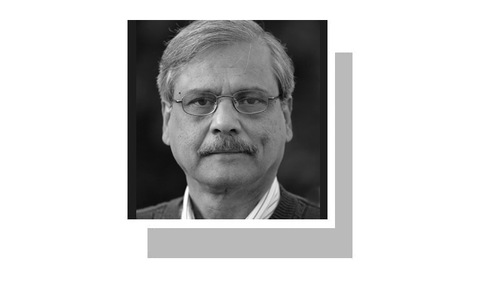
The writer, professor emeritus at the University of Massachusetts, is currently a visiting professor at the Lahore School of Economics.
anwars@lahoreschool.edu.pk
OTHER VOICES - Indian Press
Pakistan at the edge
“I AM not afraid,” Benazir Bhutto declaimed at her father’s mausoleum two months ago, “of anyone but Allah.” In the last weeks of her life, Benazir demonstrated that she possessed a depth of conviction that was, beyond dispute, exceptional. When she returned to Pakistan earlier this year after long exile, she made clear to family and confidantes that she was well aware of the great dangers lying ahead. She was undeterred by the murderous bombing that greeted her on her return home. During her two tenures as prime minister of Pakistan, she was charged by adversaries and critics with corruption, with sponsoring Islamist terrorism directed at India, with dilettantism. Whatever be the truth in relation to these accusations, the Pakistan People’s Party chief showed, in word and deed, that she possessed the raw courage needed to set past wrongs right. In his last interview before his execution by the military regime of General Mohammad Ziaul Haq, Zulfikar Ali Bhutto said: “I am not afraid of death. I am a man of history and you cannot silence history.” Democrats across Pakistan will recall these words as they ponder how best to respond to a despicable act by terrorists who made no secret of their loathing at the prospect of a progressive, secular woman emerging as Pakistan’s ruler.
With this body blow to democracy in Pakistan, what is clear is that epic struggles lie ahead for its hard-pressed people. Some analysts fear the assassination will spell the end of the tentative movement towards democracy witnessed in recent months. While such an outcome will suit the military establishment as well as the Islamists, it will have dangerously destabilising consequences. As Benazir pointed out movingly in a recent interview, “people are just being butchered and it has to stop, somebody has to find a solution and my solution is, let’s restore democracy.” It was this combination of extraordinary courage and well-reasoned commitment to democracy that made Benazir stand out among Pakistan’s political leaders. Her death illustrates in stark relief the failure of Pervez Musharraf’s regime, which continues to be underwritten by the United States, to confront Al Qaeda- and Taliban-linked religious neo-conservatives who are working to obliterate the last traces of democracy in Pakistan. It is one of the grimmer ironies of history that Benazir was killed at the gates of Rawalpindi’s Liaquat Bagh — the very location where a gunman shot dead Prime Minister Liaquat Ali Khan in 1951, an action some believe was provoked by his opposition to clerics’ calls for Pakistan to be declared an Islamic state. In the decades since, the country has lurched ever closer towards the abyss. All those who care for its future — and for the future of our shared region — must join hands to ensure it is pulled back from the edge. The Hindu shares the deep grief of the people of Pakistan over this terrible loss during a time of troubles. — (Dec 28)
| © DAWN Group of Newspapers, 2007 |