0
0

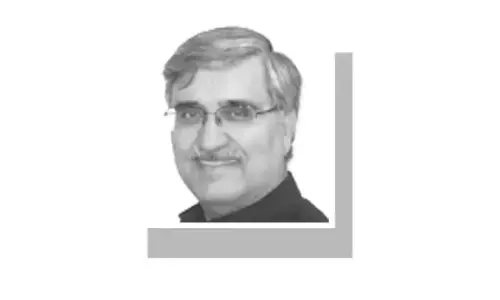
KARACHI, June 4: The audience at the Aga Khan University auditorium on Wednesday broke into peals of uncontrollable laughter as Mushtaq Ahmed Yousufi read out excerpts from his books and miscellaneous writings, displaying his scintillating wit and humour.
The title of Mr Yousufi’s talk was “Dialogue on humour”.
Speaking with characteristic charm and elegance, the leading humorist admitted that he was at a loss for words in front of an audience largely consisting of professionals from the field of medicine. “I am as clueless as that priest who was called upon to speak at a mess of servicemen. The priest said that he was like a mosquito who had winged its way to a nudist club and had known exactly how to go about doing his job, but had no idea where to start from.”
Mr Yousufi said his knowledge of medical science was limited to those ailments with which he had been afflicted over the years. “I have borne all kinds of pains, except obviously for labour pains. I never studied science. In those days only those who could not read and appreciate Persian literature studied science and became doctors. Moreover, my knowledge of biology is also drawn from the invectives and abuses that I have heard over the years from elders. As a rule, even polyglots abuse, sing and count in their mother tongue.”
Mr Yousufi said that in the age of the electronic media, the written word had lost its effect and impact. He recalled that in Houston some people wanted to hold an evening with him but they did not have the money to organize the function. “The organizers approached a well-healed Urdu-speaking person. The sponsor asked the organizers what I did. They told him that I wrote. He asked them about the nature of my writings. The organizers told him that I generally wrote light-hearted stuff. Then he asked them if I was better than Moin Akhtar. Sheepishly, the organizers had to concede that I was not as good a humorist as Moin Akhtar.”
He said that he had belonged to a profession whose practitioners looked down upon intellectuals and writers. “For years, I wrote as Mushtaq Ahmed only, fearing that if it came to light that I was a writer I would be victimized. A high-ranking official once asked me to use simple language at work, pointing out that my appointment had not yet been confirmed.”
To illustrate his point, Mr Yousufi said that one day a Seth (a moneyed but usually an unlettered person) called him at his bank and asked for him. “I very politely said: Khadim, bol raha hai. Unaccustomed to such decent behaviour, the Seth replied, ‘Okay, but get Mr Yousufi on the phone.’ Since that day, I have not used the word Khadim in my telephonic conversation.”
Mr Yousufi said he was often accused of writing opaque language. “Once at a wedding, a student of Grammar School walked up to me and said, ‘Uncle, do you have really great difficulty in writing simple Urdu?’ When I asked him why, he said that at his school his class fellows had a hard time understanding my prose. I am aware that those writers who write light-hearted stuff for television are more widely appreciated than me, but I recognize my reader.”
Earlier, the president of Aga Khan University, Shamsh Kassim Lakha, introduced the speaker.