0
0
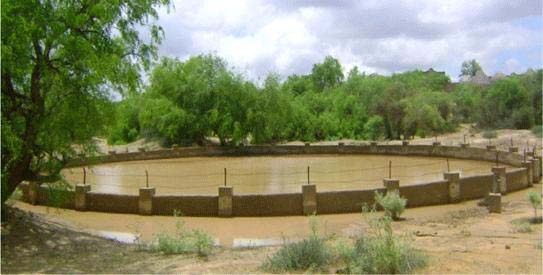
KARACHI: Tharparkar in Pakistani’s Sindh Province relies heavily on underground water sources because it has no rivers, but fluoride contamination is proving a major source of illness, experts say. “The worst affected villages are Samoon Rind, Kalario, Narovari and Sukhani," Iftikhar Ahmed, a researcher from Dow University of Health Sciences (DUHS) said. "In Samoon Rind alone, of the 950 residents, over 300 are suffering from dental and skeletal fluorosis.
"We carried out multiple tests on them to rule out any genetic disorder," he added. "Combined with poor nutrition and hygiene, the population is very vulnerable.”A high fluoride intake causes dental and skeletal fluorosis, osteosclerosis, thyroid and kidney problems. It also leads to irreversible chronic bone and joint deformations.
A joint study in 2010 by DUHS, the Pakistan Council for Scientific and Industrial Research (PCSIR) and a local NGO Association for Water, Applied Education & Renewable Energy (AWARE) - found over 80 percent of groundwater in the district unfit for human consumption.
“Over the course of research carried out here in Thar [Tharparkar], we mapped all over the district," said Ahmed, who has been studying the problem for the last few years. "While the normal fluoride level in water is supposed to be 1ppm, in many locations here it is as high as 13ppm, making it unfit for human consumption.”
Another study conducted by AWARE entitled Underground Water Quality of Thar: A Detailed Analysis 2003-08, found more than 50 percent of the population using water with total dissolved solvents of over 5,000 mg per litre (mg/l). In one village in Naroowari, that figure rose to 20,000 mg/l, well over the World Health Organization's maximum limit of 1,500 mg/l.
Tharparkar District had an estimated population of 1.23 million in 2008. It receives an average annual rainfall of only 100-300mm, hence the dependence on underground water.
Poverty
Ali Akbar Rahimoo, executive director of AWARE, called for desalination projects and awareness-raising.
“What we need here are desalination/fluoride ion removal plants," he said. "AWARE has installed windmills to get water from deep underground, and small plants for desalination and removal of fluoride in different villages, but that is still not sufficient.”
However, two desalination plants set up by AWARE in Sajai and Samoo Rind lie abandoned for lack of money to buy the fuel to run them.
“The communities here are poor and cannot pool enough money to run these facilities," Rahimoo told IRIN. "The federal and provincial governments must take the problems here into account.”
He added: “The 'talukas' [sub-districts] of Umarkot, Chachroo and Mithi are severely affected by fluoride contamination. Although deeper wells are a possible solution, the people lack the resources for digging and maintaining these installations.
"Furthermore, it would add to the burden of women as they are the ones who have to fetch water as they have to pull the rope over a long distance and will have to wait for longer to get the water out. Solar pumps can be very helpful in this regard but again, cost is an issue. We are working on a project of rainwater harvesting but again, that is very much dependent on the amount of rain received.”
Deformities
Locals say cases of deformities are affecting families. “My daughters are beautiful girls but they have been rejected multiple times for marriage because they look ill and have bad teeth," said Mohan,* a middle-aged schoolteacher from Malo Bheel, a town 55km from Mithi. "I am ready to give good dowry but before that I wish I could do something about the yellow teeth and weak bones...
"My eldest daughter has given birth to sons both of whom are deformed."
The daughters and grandsons, a local doctor said, suffer from arthritis and are either victims of fluorosis or a genetic disorder. “No one in my family had such weak bones and hunched shoulders," Mohan explained. "When the doctors told me that it is the water in our wells that is responsible, I realized it could be something in the water. Over the years, the water has turned more brackish and muddy, and I feel that we are consuming poison knowingly.
"I just hope and pray that no child in my family is ever born with this deformity (again).”
(*not a real name)