Fresh inspection belies earlier findings on train accident

• Officials who examined Shalimar Express at Rohri had reported faulty brakes in nine carriages
• Eyebrows raised as drivers blamed for failure to stop train in time
LAHORE: A train “is seen as safe for operation” when more than 80 per cent of its braking system is functional, a spokesperson for the Pakistan Railways (PR) said on Tuesday.
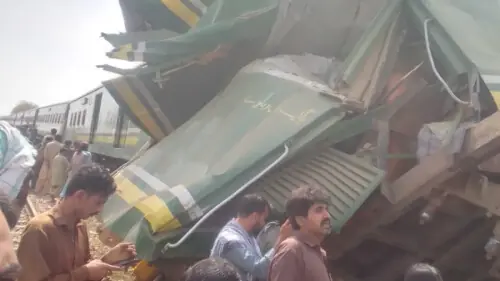
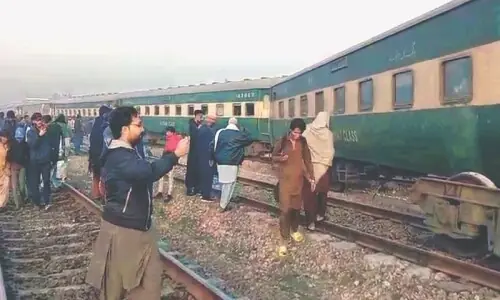
In a statement regarding the Shalimar Express, which suffered an accident over the weekend, the department seemingly contradicted its own officials’ earlier report, who had found that nine carriages of the train that collided with a goods train near Naushahro Feroze on Sunday, had faulty brake cylinders.
The initial inspection carried out by the officials at Rohri station found that 10, out of a total of 18 carriages of the Shalimar Express, were operating as “dummy coaches”. Nine of these were being run “without brakes and required urgent maintenance”, the inspectors concluded.
According to the spokesperson, however, the rake was subsequently examined on Monday (March 16) and its braking system was “found to be intact and working with 95pc efficiency”.
The statement said that when the carriages of Shalimar Express were examined in Lahore after the accident, they were found to be “equipped with fully functional braking system, with 95pc braking power”.
He said an inquiry had been initiated by the Federal Government Inspector for Railways (FGIR) to determine the “actual causes of the accident and to recommend corrective measures”.
“Pakistan Railways adheres to strict inspection and safety protocols, and no train is permitted to operate unless it meets prescribed safety requirements,” he said. “Railways remains fully committed to ensuring passenger safety, operational excellence and transparency.”
A report signed by five officials, known in railway parlance as a ‘joint certificate’, stated that the interlocking system (Kanta) for the passage of the train was not set for the main line.
It further said the pointman and station master showed a red signal to the driver, but since he could not control the train and overshot, it collided with the goods train that was on Main Line-1.
“The collision resulted in the derailment and capsizing of the engine and the derailment of two carriages next to it. Three wagons loaded with containers of the goods train also derailed, leading to the blocking of both the up and down main lines as well as the loop line,” the certificate stated. “After checking all aspects, we came to the conclusion that the accident took place due to negligence of the Shalimar Express crew. “Hence, the driver and the assistant driver are held responsible for the accident.”
One of the officials who inspected the train at Rohri, speaking on condition of anonymity, expressed surprise over reports that an initial investigation by Pakistan Railways had held the “driver and the assistant driver responsible for the accident”.
“When the brake system is not working, why are the driver and the assistant driver being declared guilty. Even if the driver knew it, why was a faulty train handed over to him,” he wondered.
He appealed to the railways minister, the PR’s chief executive officer and the FGIR to punish those responsible for the maintenance of trains and the safety of passengers.
Last year, the train drivers’ union protested a series of reports which held them responsible for derailments and accidents, warning of a countrywide strike if Railways continued to use “faulty carriages and wagons”.
Published in Dawn, March 18th, 2026