132
132
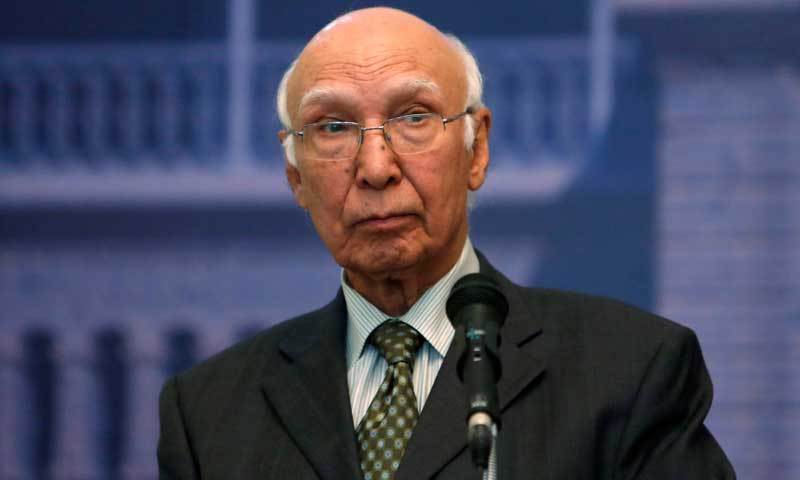
NEW YORK: Responding to the recent breakdown of a scheduled meeting between Indo-Pak foreign secretaries, Adviser to Prime Minister on National Security and Foreign Affairs Sartaj Aziz said that the timing of Pakistani High Commissioner Abdul Basit’s meeting with Hurriyat leader Shabir Shah was ‘perhaps not right’.
At the same time, Aziz said the timing of India's message expressing reservations against the meeting was 'not right' either.
While talking about the meeting between Basit and the Hurriyat Leader, in an interview given to an Indian news channel, Aziz said that, “This has been a regular practice for the last 30 years and there was nothing new in it.”
He added that “in this case perhaps the timing was not totally right because substantial discussions on Kashmir were yet to start. This meeting on August 24 (Foreign Secretary level meeting between India and Pakistan) was to declare the agenda and so on so forth.”
Aziz further said “I think if the request (from India) had come earlier, about the timing not being right, probably it could have been considered. But, in this case the message came at a time when one Hurriyat leader was already in Pakistan's high commission (in New Delhi); hence there was nothing to respond."
The PM's adviser also called Indian Prime Minister Narendra Modi’s move to express willingness to hold bilateral talks with Pakistan during his maiden United Nations General Assembly (UNGA) address as ‘encouraging’.
A week prior to the scheduled meeting between Indo-Pak foreign secretaries, India called off the bilateral talks following criticism of Pakistani High Commissioner Abdul Basit meeting with Hurriyat leader Shabir Shah.
Congress had hit out at the centre for allowing the envoy to meet the Hurriyat leader.
The Congress had accused the government of doublespeak, questioning why the talks had not been called off and warned that it could be a "major security risk in the days to come".
The BJP had maintained it had taken the decision after much thought.
In Nov 2013, ties between the two countries had strained over pro-forma meeting between Sartaj Aziz and the Hurriyat leaders.
Modi to blame
Narendra Modi has been faulted for cancelling a high level meeting with Pakistan`s top foreign affairs official irked by a meeting of a Kashmiri leader with Pakistan`s High Commission in New Delhi.
`There are no two countries in the world that need to talk, and talk regularly, more than these nuclear-armed South Asian neighbours whose tensions must be carefully managed`, the New York Times editorial board said in a lead article.
Noting the significance of talks, the NYT said that `cancelling the meeting was an over-reaction on India`s part, especially when it could have served as an opportunity to discuss grievances and press for a solution.
Editorial: A disappointing move by India
The editorial extract below originally appeared in Dawn, August 20th, 2014
The Pakistan-India foreign secretary-level talks to have been held next week were supposed to mark the first meaningful engagement in the normalisation process between the two countries since Indian Prime Minister Narendra Modi won power.
Now, the cancelled meeting has instantly become a symbol of the difficulty to even talk about talks when it comes to the two rivals.
To be sure, this time the blame must lie firmly on the Indian side. The suggestion that the Pakistan high commissioner to India, Abdul Basit, committed a grave diplomatic error by meeting a Kashmir Hurriyat leader is simply preposterous.
Leave aside that such meetings ahead of high-level talks between Pakistan and India have occurred in the past and are standard diplomatic fare, if Mr Modi’s government is really keen on starting over with Pakistan, then would it not make sense to bring on board as many stakeholders as possible when it comes to the Kashmir dispute?