0
0
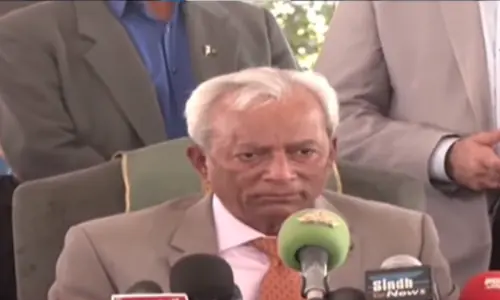
KARACHI: Fewer politicians in the subcontinent have manifested such an instant charisma to attain the zenith in one’s field and vanish abruptly leaving a lasting impact that still inspires generations as Allah Bakhsh Soomro had. “He was just 43 when he was assassinated on a tonga in a little known village of Shikarpur in abstruse circumstances. He spent just six invigorating years of active politics that earned him the first leader of the opposition in the Sindh Assembly and made him twice premier of the province before he was sacked by the British governor,” said Illahi Bakhsh Soomro, a veteran politician and a nephew of the late Soomro, on Wednesday.
It was the third day of the Sufi conference, dedicated to the Sindhi politician, organised by the Sindh Sufi Institute at the Arts Council of Pakistan.
The speaker discussed the circumstances developed after the late Soomro while heading the province renounced the Khanbahadur and Order of the British Empire (OBE) title.
“I feel I cannot retain the honours I hold from the British government, which in the circumstances that have arisen I cannot but regard as tokens of British imperialism,” Mr Soomro stated in a letter written on Sept 19, 1942 while renouncing the honours and resigning from the Defence Council during the World War II.
Discussing the events at length, speakers told the audience that when the press later asked whether he wanted to extend the hand of friendship with the Nazis and Fascists, he replied: “I believe in two things — to defeat British imperialism and fight against Nazism and Fascism at the same time. It is my birthright to fight against both evils.”
Mr Bakhsh said Governor Sir Hugh Dow on Oct 10, 1942 sent a letter to the premier, intimating him that he had lost confidence and thus was dismissed from office. The governor had such powers under the Government of India Act, 1935.
“He was too naïve a politician. He did not protest against his sacking and promptly headed to Shikarpur to resume a low-key living for the next seven months before he had been assassinated.”
Mr Bakhsh said: “G.M. Syed and my uncle were staunch opponents in the assembly. But after uncle’s death when I accompanied G.M. Syed to the graveyard, I heard him crying ‘forgive me Allah Bakhsh I could not understand you in time’”.
The audience was informed about late Syed’s words that he had uttered once saying, “Today he (Soomro) is sleeping in his grave in the Panjpir graveyard. We can’t say whether he would be laughing at our condition or weeping”.
Mazharul Haq Siddiqui, a former vice chancellor of the University of Sindh, said the late Soomro was the torch-bearer of secularism and a strong opponent to the British occupation.
Rochi Ram, a rights activist and political analyst, said neither Pir Sibghatullah Shah-II Pir Pagaro, nor Allah Bakhsh Soomro joined Indian Congress or the All India Muslim League.
“He (Soomro) and G.M. Syed were poles apart at the Manzilgah dispute that spawned Hindu-Muslim tensions, but even strong allies of Syed in Jamshed Nusservanjee, Pir Pagaro and Dr I.I. Kazi sided with Soomro’s stance,” he said.
Mr Ram said the late Soomro presaged the future that he pronounced in 1940 conference of nationalist Muslims in Delhi and later to the late Syed privately when the latter invited him to join the Muslim League. He met Mohammad Ali Jinnah many times, but never deviated from his stance. “He remained stick to his own version of politics based on secularism and provincial autonomy. He was neither a leaguer nor a congressman,” said the political analyst.
Barrister Umer Soomro, a grandson of the late leader, called for steps to safeguard against the ‘intended balkanisation of Sindh by certain communal forces’ by following the secular footprints of the late Soomro.
Hameer Soomro, another grandson of the late Soomro, said it was time ‘our heroes’ be celebrated and made part of curriculum.
G.M. Syed and Pir Pagaro Soorhiyah Badshah had been discussed during the previous two days sessions of the conference.