0
0
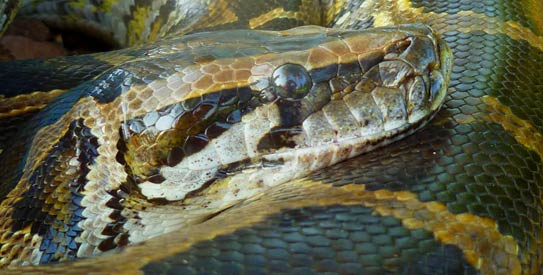
WASHINGTON: Pythons are not thought of as big-hearted toward their fellow creatures. They are better known for the bulge in their bodies after swallowing one of those critters whole.
But the snakes’ hearts balloon in size, too, as they’re digesting – and now scientists are studying them for clues about human heart health.
The expanded python heart appears remarkably similar to the larger-than-normal hearts of Olympic-caliber athletes. Colorado researchers report they’ve figured out how the snakes make it happen.
‘‘It’s this amazing biology,’’ said Leslie Leinwand, a molecular biologist at the University of Colorado Boulder, whose team reports the findings in Friday’s edition of the journal Science. ‘‘They’re not swelling up. They’re building (heart) muscle.’’
Reptile biologists have long studied the weird digestion of these snakes, especially the huge Burmese pythons that can go nearly a year between meals with no apparent ill effects. When they swallow that next rat or bird _ or in some cases deer _ something extraordinary happens. Their metabolism ratchets up more than 40-fold, and their organs immediately start growing in size to get the digesting done. The heart alone grows a startling 40 per cent or more within three days.
Leinwand, who studies human heart disease, stumbled across that description and saw implications for people. An enlarged human heart usually is caused by chronic high blood pressure or other ailments that leave it flabby and unable to pump well. But months and years of vigorous exercise give some well-conditioned athletes larger, muscular hearts, similar to how python hearts are during digestion.
So Leinwand’s team _ led by a graduate student who initially was frightened of snakes _ ordered a box of pythons and began testing what happens to their hearts.
The first surprise: A digesting python’s blood gets so full of fat it looks milky. A type of fat called triglycerides increased 50-fold within a day. In people, high triglyceride levels are very dangerous. But the python heart was burning those fats so rapidly for fuel that they didn’t have time to clog anything up, Leinwand said.
The second surprise: A key enzyme that protects the heart from damage increased in python blood right after it ate, while a heart-damaging compound was repressed.
Then the team found that a specific combination of three fatty acids in the blood helped promote the healthy heart growth. If they injected fasting pythons with that mixture, those snakes’ hearts grew the same way that a fed python’s does.
But did it only work for snakes? Lead researcher Cecilia Riquelme dropped some plasma from a fed python into a lab dish containing the heart cells of rats _ and they grew bigger, too. Sure enough, injecting living mice made their hearts grow in an apparently healthy way as well.
Now the question is whether that kind of growth could be spurred in a mammal with heart disease, something Leinwand’s team is starting to test in mice with human-like heart trouble. They also want to know how the python heart quickly shrinks back to its original size when digestion’s done.
The experiments are ‘‘very, very cool indeed,’’ said James Hicks, a biologist at the University of California, Irvine, who has long studied pythons’ extreme metabolism and wants to see more such comparisons.
If the same underlying heart signals work in animals as divergent as snakes and mice, ‘‘this may reveal a common universal mechanism that can be used for improving cardiac function in all vertebrates, including humans,’’ Hicks wrote in an email. ‘‘Only further studies and time will tell, but this paper is very exciting.’’
The study was funded by the National Institutes of Health and a Boulder biotechnology company that Leinwand co-founded, Hiberna Corp., that aims to develop drugs based on extreme animal biology.