0
0
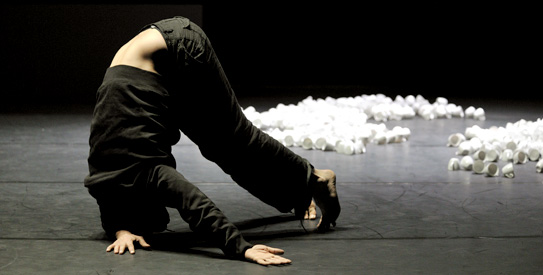
BEIRUT: Contemporary dancers are finding their feet in the Arab world, as the art form renowned for freedom of expression blossoms at a time of regional upheaval.
“Over the past few years, Arab contemporary dance has been blossoming,” said Omar Rajeh, organiser of the just-ended Beirut International Platform of Dance (BIPOD), which hosted over 20 choreographers in the Lebanese capital.
The just-ended, two-week festival included performances by dance heavyweights such as the United States' William Forsythe, Belgian Alain Platel and British-born Akram Khan.
It also featured around 20 choreographers from Lebanon, Syria, Iraq, Egypt, Jordan, Tunisia, and Morocco, Egypt and the occupied Palestinian territory of the West Bank.
In a region where traditional group folk dances or oriental belly-dancing remain wildly popular – and where the word “raqqasa” (dancer) can carry pejorative connotations in Arabic – more and more people are turning to contemporary dance for its freedom of movement and expression.
Since 2009, BIPOD has also hosted the Arab Dance Platform, which allows contemporary choreographers from this largely conservative part of the world to showcase their work.
And this year, Arab choreographers had already echoed the spirit of the revolutions that erupted well into their preparations for the seventh edition of the festival.
“This year's performances... echo issues that are at the heart of the lives of Arab citizens, such as freedom,” said Rajeh, who did a masters in dance studies at Britain's University of Surrey and heads Lebanon's Maqamat Dance Theatre.
“Contemporary dance has a lot to do with the individual, with the rejection of existing systems and structures, the rejection of regimes,” he added.
Most shows touched on themes specific to Arab societies while remaining mindful to avoid cliches about the region.
Mohammed Shafik of Egypt captured the spirit of Arab cities before the time of the revolution – once apathetic, but also hopeful – in a piece called “The Smell of the City.”And in “The Sleepers” by Iraq's Anmar Taha, victims of conflict and torture are blindfolded as they squat and move about the stage with minimal body gestures, evoking images of the silent suffering of the body.
Taha's dance troupe, Iraqi Bodies, is based in Sweden as violence in his homeland prevents him from working there.
But perhaps the most sensitive theme the dances tackle at this crucial time in Arab history is identity.
“Am I Moroccan? Am I African? Am I Mediterranean? Am I an Arab?” questions Toufiq Izzediou of Morocco in his dance performance “Aleef,” which stands for the letter “A” in Arabic.
The up-and-coming wave of contemporary dancers has paid close attention to issues of identity as they seek to break away from definitions of dance set by icons such as Martha Graham and Merce Cunningham.
For them, contemporary dance is the only true universal language.
Rosemary Martin, former dancer with the Royal New Zealand Ballet, says the link between dance and identity is an ongoing debate among the new generation of contemporary dancers.
“Some feel that identity is very much connected to their own location, that they almost have a social responsibility to speak (about) issues and express ideas about their own environment,” said Martin, who is preparing a PhD at the University of Auckland in New Zealand.
“Others feel that there is no need to wave a flag, that their sheer presence, performance and choreography will in itself say 'I am Tunisian,' 'I am Palestinian',” she told AFP at a dance seminar held in conjunction with the festival.
For Mahmud Rabii, an Egyptian freelance dancer, emphasising dance as a universal language risks effacing individual identities.
“By renouncing our identities under the pretence of an international language, we lose our own languages,” he said, adding he hoped schools and even governments around the region would begin to support the budding art form.
Like many of his compatriots, for Rabii, the popular uprising of Egypt as well as countries around it can be an endless source of inspiration.
“After the revolution in Egypt, I saw that things could change, but I do not delude myself, it will take time,” said fellow choreographer Shafik.
“The revolutions must flow through our veins, in our blood. Tomorrow, one day soon, something will come of it.” – AFP