0
0

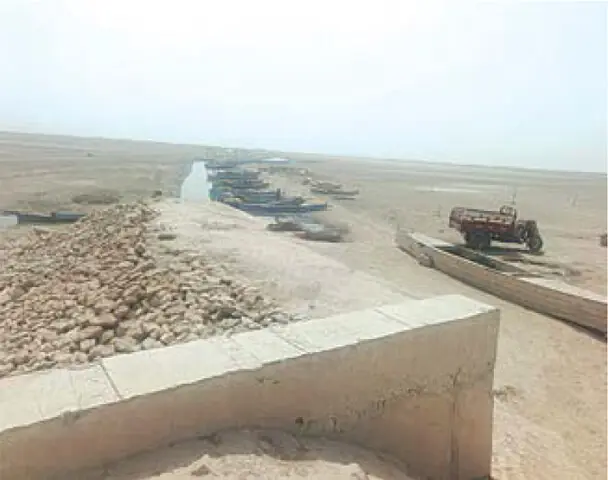
An elderly fisherman, Maula Bux Mallah, looks out over Manchhar Lake from his small grocery shop at RD-62 on the lake’s dyke.
Beyond that point, a considerable stretch of the sprawling lake bed lies bonedry this summer. The lake has received little to no inflows from its usual sources — natural waterways and streams, as well as the Main Nara Valley Drain (MNVD), now known as the Right Bank Outfall Drain-I (RBOD-I).
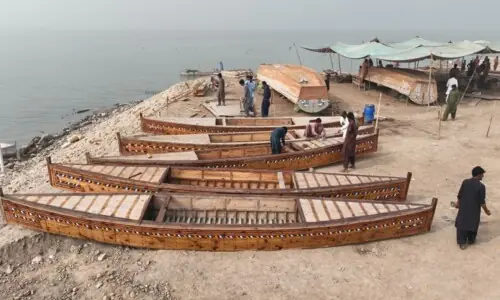
“The lake bed has remained dry for several months. You can see it from other points along the embankment, where fishermen’s wooden boats now line the banks,” regrets Mr Bux, who is striving for the revival of Manchhar Lake through his “Manchhar Bachao Ittehad.” According to him, the wastewater brought by RBOD-I/MNVD allows fishermen to catch some fish and eke out a living.
“Even the MNVD wastewater is not entering the lake, as rice transplantation is underway in upper Sindh’s Larkana and Qambar- Shahdadkot districts, upstream of Manchhar.
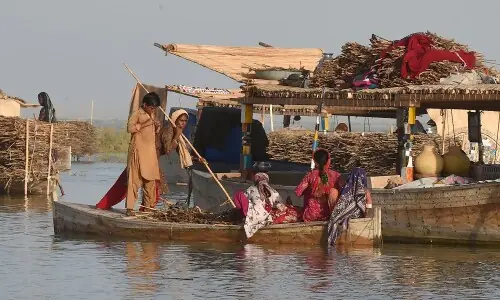
Deprived of its once-thriving economy and biodiversity, fishing communities migrate in search of livelihoods
The lake rarely receives the Indus flows that were once regular — before the drains were built — as well as water from Balochistan through the Khirthar range. That is history now,” he says, noting that wastewater generated during rice transplantation eventually enters MNVD and ends up in the lake.
“Fishermen are now catching the kind of fish that sells for Rs100 to Rs200 per kg — a means of subsistence for them nowadays,” he adds.
While the irrigation department puts the lake’s level at 108.4ft, Mr Bux insists it is no more than 105ft. The level could rise to 123ft if the lake receives flows similar to the 2022 floods, according to official records.
As a major freshwater lake, Manchhar has lost its ecosystem over the years due to declining Indus River flows, which once replenished it during every flood season through the Aral Wah. It was only in 2024 that the lake was fortunately fed by the Indus River, raising its levels within its banks.
Manchhar now stands deprived of its once-thriving economy and biodiversity, forcing fishing communities to migrate to different parts of Sindh and Balochistan in search of livelihoods.
The lake once received large flocks of migratory birds in winter; fewer arrive now.
It continues to receive wastewater from MNVD, built by Wapda and linked with Balochistan’s drainage project, RBOD-III .
Depending on water availability, the lake still irrigates agricultural land through its natural system.
RBOD-II was designed by Wapda in the early 2000s to bypass Manchhar Lake and connect with RBOD-III . The project, to be built downstream of the lake near Deh Karampur, Sehwan, was intended to carry 3,525 cusecs of effluent to a creek in Thatta, in Sindh’s littoral region.
Started in 2001 at an estimated cost of Rs14bn, it was scheduled for completion in 2006. Two decades later, the project remains incomplete and in disarray, with Manchhar and communities whose livelihoods depend on the lake’s biodiversity continuing to bear the cost.
The RBOD project has a tripartite dimension, involving Sindh, Balochistan and Wapda. Wapda wants Sindh to take over RBOD-I/MNVD, having already handed over the RBOD-III component to Balochistan.
Sindh, however, has refused to take over RBOD-II in its present form, effectively rendering the project a dead horse.
The Sindh government insists on a new alignment, but the project has already seen billions of rupees spent and its cost revised from Rs29.2 billion to Rs62bn. Allegations of embezzlement in these expenditures led to criminal proceedings against Sindh irrigation officials. After a two-decade delay, the project would now require a third revision, potentially pushing its cost towards Rs1 trillion if work is resumed.
Work on RBOD-II has remained suspended since 2015, with Rs40bn spent out of the revised Rs62bn cost, according to a briefing given by irrigation officials at the July 8 meeting of the Public Accounts Committee (PAC) of the Sindh Assembly. The PAC has called for the hiring of consultants to resolve issues related to RBOD-II ’s alignment.
Meanwhile, a Federal Constitutional Court (FCC) bench on July 13 set aside Sindh High Court (SHC) orders in the long-delayed Nai Gaj Dam project — also linked with Manchhar — on an appeal filed by Wapda. The FCC directed the contractor to complete the remaining work strictly in accordance with the original contract, the arbitral award and the memorandum of understanding (MoU) signed on Sept 21, 2021, involving Wapda.
The dam is being built on a natural waterway, or stream, called Gaj Nai, to store its water. Nai Gaj Dam has a gross storage capacity of 0.30 MAF and includes a component to supply 50 cusecs of freshwater to Manchhar through a 52km-long pipeline to help revive its ecology. It is, however, too early to assess how effective this intervention will be. The dam is also designed to irrigate 28,000 acres of land and support a 4.2MW powerhouse.
Started in 2012, the project has remained incomplete due to litigation in superior courts.
Its last completion deadline was June 2025.
Sindh Irrigation Minister Jam Khan Shoro on July 16 led a 13-member delegation to meet Wapda Chairman Lt Gen (retd) Mohammad Saeed in Lahore to discuss future challenges to Pakistan’s water, food and energy security.
The two sides deliberated on options to address operational and maintenance issues related to Wapda projects in Sindh, particularly the drainage infrastructure.
There is hope that the day-long meeting could yield some progress for communities dependent on Manchhar Lake’s waters.
Published in Dawn, The Business and Finance Weekly, July 20th, 2026