• New measures to improve long-term planning, pilgrim facilities and operational efficiency
• Pilgrims can register anytime until 2030 instead of annual registration
• PM orders formulation of SME financing strategy
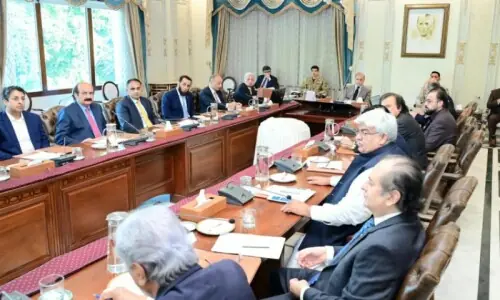
ISLAMABAD: The federal cabinet on Monday approved a comprehensive Haj Policy for 2027–2030, aimed at providing more facilities to pilgrims and improving operational efficiency.
The cabinet commended Federal Minister for Religious Affairs Sardar Muhammad Yousaf and his ministry’s team for the excellent Haj arrangements made this year.
A detailed briefing on the new Haj policy was presented to the cabinet. The meeting was informed that, unlike previous one-year policies, the new framework is the country’s first comprehensive four-year plan aimed at ensuring long-term planning, improving operational efficiency and providing better facilities to pilgrims.
Standard operating procedures (SOPs) and other regulations will be formulated, and they may also be amended whenever necessary to remain aligned with the laws and regulations of the Kingdom of Saudi Arabia.
The cabinet was informed that, under the new policy, prospective pilgrims will no longer need to register annually. Instead, they will be able to register at any time for Haj in any year until 2030, enabling uninterrupted registration according to their preference. This will facilitate the preparation of a priority waiting list.
Additionally, a Shariah-compliant Haj savings scheme will be introduced, allowing people to save in advance for their future pilgrimage.
The cabinet was also informed that the entire Haj management system is being digitised, including digital payment mechanisms, a digital complaints management system and digital monitoring mechanisms.
Under the policy, separate quotas have been allocated for government and private Haj schemes, as well as long- and short-duration Haj packages, mandatory training for pilgrims, and provisions for Takaful (Islamic insurance) and emergency response services.
The cabinet also directed that Haj assistants be appointed through a transparent, merit-based process and that third-party validation of both government and private operators be ensured.
Meanwhile, Prime Minister Shehbaz Sharif directed that a comprehensive strategy be formulated to improve small and medium-sized enterprises’ (SMEs) access to financing.
He made these remarks while chairing a review meeting of the Small and Medium Enterprises Development Authority (Smeda).
According to the Prime Minister’s Office (PMO), the premier directed the authority to formulate a comprehensive strategy, in coordination with the State Bank of Pakistan and commercial banks, to improve SMEs’ access to financing.
He stressed that greater facilitation should be provided for extending loans to SMEs to boost the country’s exports. He also directed that they be supported in enhancing their productive capacity, particularly by providing awareness and access to financing for farmers processing agricultural produce.
The prime minister further directed that commercial banks be encouraged to develop dedicated financial products tailored to the needs of SMEs.
PM Shehbaz instructed that SMEs should be provided assistance in preparing feasibility studies and completing other essential stages required for establishing and expanding businesses. He emphasised that urgent measures were required to remove the obstacles hindering the growth of the sector.
The premier directed Smeda to assist young entrepreneurs, including women entrepreneurs, in establishing small and medium-sized enterprises.
Published in Dawn, July 8th, 2026