0
0

ISLAMABAD: Having missed the growth target by half a percentage point, recording growth of 3.7 per cent this year, the government has set an economic growth target of 4pc and inflation at 8.2pc for the next fiscal year.
The macroeconomic framework for 2026-27 was cleared on Monday at a meeting of the Annual Plan Coordination Committee (APCC) for formal approval by the National Economic Council (NEC) on June 3.
The NEC — considered as the country’s highest national economic policymaking body — is led by the prime minister and represented by all four provincial chief ministers besides as many federal ministers.
The daylong APCC meeting is being presided over by Planning Minister Ahsan Iqbal and is being attended by provincial development ministers, along with senior federal and provincial bureaucrats.
APCC projects inflation at 8.2pc, agri growth at 3.8pc and LSM expansion at 4.5pc
“For 2026-27, Pakistan’s economy is targeted to grow by 4pc, signalling a continued growth trajectory,” the APCC working paper noted, while stating that GDP growth stood at 3.7pc in 2025-26 against a target of 4.2pc.
Growth rate for 2024-25 had finally settled at 3.2pc.
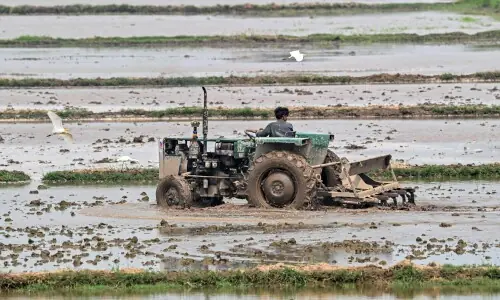
The commodity-producing sectors are targeted to expand by 3.9pc next year, driven by 3.8pc growth in agriculture and 4.5pc growth in large-scale manufacturing (LSM).
Agricultural growth will be supported by a recovery in important crops (3.6pc) and cotton ginning (2.5pc), as well as robust performance in livestock (3.9pc).
The industrial sector is targeted to grow by 4pc in 2026-27 mainly due to a revival in Large-Scale Manufacturuing (LSM), alongside growth momentum in mining and quarrying, construction and energy (gas and water supply).
The services sector is targeted to grow at 4.2pc, underpinned by stronger performance in wholesale and retail trade (4.2pc); transport, storage and communications (3.7pc); and financial services (4.5pc) as well as information and communication (7.7pc).
“These targets are contingent on effective macroeconomic management and stable external conditions,” the Planning Commission warned as the macroeconomic framework moves to the NEC.
Under the macroeconomic outlook for 2026-27, national savings are targeted to grow by 14.3pc of GDP compared to 14.1pc in the current fiscal year (CFY), while investment is targeted to reach 15pc of GDP, against 14.4pc in CFY.
The Planning Commission added that this reflects a narrowing savings-investment gap to be financed through modest external inflows.
Public investment is targeted to remain at 3pc of GDP next fiscal year instead of 3pc in CFY, while private investment is targeted to rise to 10.3pc of GDP from 9.6pc in CFY.
Inflation has been targeted at 8.2pc due to anticipated supportive fiscal consolidation and improved macroeconomic stability.
Highlighting a risk, the Planning Commission said the external sector may face pressures as easing import controls and debt repayments are likely to widen the current account deficit next year.
However, strong remittance inflows, export recovery and anticipated external financing are expected to help cushion these pressures and support external sustainability, it said.
The APCC also targeted an increase in employment of two million in 2026–27 through higher investment and improved economic growth.
This is based on the premise that public investment crowds in private investment, thereby expanding employment opportunities across all sectors.
The Planning Commission said ongoing federal and provincial employment generation programmes are further strengthening labour market participation, entrepreneurship, technical skills and job-matching mechanisms.
These efforts are expected to create 1.1 million jobs in the services sector, 0.5m in the industrial sector and 0.4m in the agriculture sector in 2026-27.
“Thus, the increasing trend of employment creation is expected to support broad-based, inclusive, and employment-intensive economic growth,” it said.
Referring to the current fiscal year, the Annual Plan document said Pakistan’s economy had demonstrated ‘notable stabilisation’ in the first eight months, despite flash floods and the impact of the US-Iran war.
Pakistan’s GDP growth in 2025-26 rose to 3.7pc from 3.2pc in the previous fiscal year, reflecting broad-based improvements across agriculture, industry and services, although several targets were missed.
LSM showed a notable turnaround, posting growth of 6.1pc in 2025-26 compared to a contraction of 0.7pc in 2024-25.
On the external side, weakening exports and a recovery in import demand led to a widening of the trade deficit.
However, robust remittance inflows and growing services exports helped contain pressures on the external account, supporting the balance of payments. The resulting improvement in foreign exchange reserves contributed to exchange rate stability, while continued fiscal discipline and prudent macroeconomic management reinforced overall economic stability.
Published in Dawn, June 2nd, 2026