In Spectrum: Memory, migration and making of Lahore’s urban soul (Part-I)


 0
0
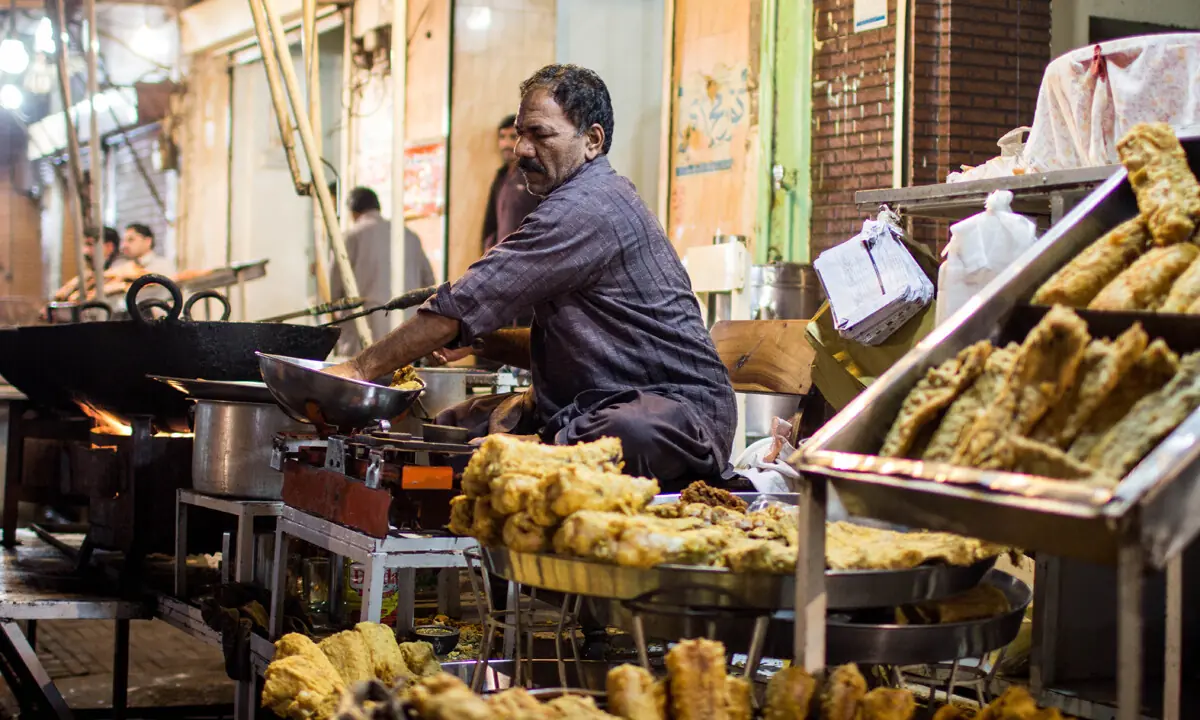

In Lahore, food is never merely food. It is memory, migration, performance, class, longing and history carried on the tongue. Few places embody this truth more vividly than Gawalmandi, the dense and storied neighbourhood in central Lahore whose narrow streets, smoky grills, old facades and crowded eateries became inseparable from the cultural imagination of the city. To speak of Gawalmandi is to speak of Lahore itself: a city built through displacement, improvisation, coexistence and reinvention.
Until recently, Gawalmandi has been celebrated primarily for its famous Food Street, for sizzling kebabs, fragrant hareesa, fried fish, doodh-jalebi and late-night crowds that gather under strings of lights. Yet reducing Gawalmandi to a culinary destination alone would flatten its layered historical significance. The neighbourhood is also a site through which one can understand urban modernity in South Asia, the social consequences of Partition, and the transformation of everyday life in postcolonial cities. Through the writings of historians and theorists such as Gyan Prakash, Ash Amin and Arjun Appadurai, Gawalmandi can be read not simply as a neighborhood but as an urban text — a space where memory, mobility, intimacy and commerce converge. The literary recollections of A. Hameed, Ahmad Shuja Pasha and Pran Neville further illuminate how Lahore’s cultural worlds were built through ordinary people, shared spaces and everyday encounters.
The name “Gawalmandi” itself reveals much about its origins. Derived from the wordsgawala (milkman) andmandi (market), the locality emerged as one of the largest buffalo milk production and distribution hubs in Punjab. Before it became associated with restaurants and food culture, it was a working neighbourhood shaped by cattle, dairy trade and the rhythms of everyday commerce. The area developed substantially after 1911, during the late colonial period, when Lahore was expanding beyond the Walled City. Its roads — Nisbet Road, Chamberlain Road and McLeod Road — reflected the imprint of British colonial urban planning, while its architecture retained distinctly subcontinental sensibilities. Buildings such as the 19th century Bajaj House and the 1914 Amrit Dhara structure demonstrate this hybrid aesthetic: colonial facades adapted to local climate, craft traditions and social life.
Unlike the grand imperial spaces of colonial Lahore, however, Gawalmandi evolved through dense habitation and informal economies. It was a neighbourhood of wrestlers, traders, craftsmen and working families. It possessed a rough vitality that distinguished it from elite colonial enclaves. Over time, it also became associated with the Gujjar community, many of whom trace their ancestry and social roots to the area. Yet the decisive transformation of Gawalmandi came after 1947.
The Indian Partition altered Lahore irreversibly. Entire populations moved across borders in conditions of trauma and uncertainty. Muslims from Amritsar, Jalandhar and other cities migrated into Lahore, while many Hindu and Sikh residents departed. Gawalmandi became one of the first major post-Partition residential settlements outside the Walled City. The neighbourhood’s post-Partition story reflects what Gyan Prakash describes as the making of the “modern city” through rupture, improvisation and uneven urban experience. In Mumbai Fables, Prakash argues that South Asian cities are not merely planned spaces but are continuously produced through the aspirations and survival strategies of ordinary people. Gawalmandi embodies this process perfectly.
Many of the migrants who settled there arrived with little capital but considerable skill. Craftsmen opened workshops in front of their homes. Small vendors transformed domestic thresholds into commercial spaces. Families carried recipes, techniques and food traditions from their ancestral cities and adapted them to the new urban environment. As local accounts suggest, the food stalls gradually multiplied until every lane offered something distinctive. The migrants from Amritsar popularised gram flour-coated fried fish that eventually became known throughout Lahore as “Lahore fish.” Kashmiri families introduced hareesa. Wrestler families brought specialised barbecue techniques and falooda traditions. Doodh-jalebi emerged as another iconic local specialty. Thus, it offered a perfect ambience for politician like Nawaz Sharif to spend his impressionable years at Gawalmandi which remained his political support base throughout.
This culinary evolution was not accidental. It was a social response to displacement. Partition migrants reconstructed belonging through food. In doing so, they transformed Gawalmandi into a sensory archive of memory. Recipes became repositories of lost homes, vanished cities and inherited skills. Arjun Appadurai’s influential work on globalisation and everyday life helps illuminate this phenomenon. Appadurai argues that locality is not fixed geographically but is continually produced through social practice, memory and performance. Food, in this sense, is one of the most powerful ways communities reproduce identity. Gawalmandi’s cuisine thus became more than commerce. It became a way of rebuilding the self after historical rupture.
One of the most striking aspects of Gawalmandi is the way public life unfolds in the street itself. The neighbourhood’s food culture depends on density, proximity and collective presence. Families eat outdoors late into the night. Vendors cook in open view. Children move through crowds. Strangers share tables. Ash Amin’s writings on “urban conviviality” are especially useful here. Amin argues that cities create forms of everyday coexistence that are not necessarily based on formal political unity but on repeated encounters, shared spaces and practical negotiation. Gawalmandi exemplifies such convivial urbanism.
Historically, the area brought together Hindu, Sikh and Muslim communities. Even after Partition altered its demographic structure, the neighbourhood retained traces of plural cultural memory. The architecture, culinary practices and urban rhythms continued to carry echoes of mixed histories. This coexistence was not utopian. Like many dense urban neighbourhoods, Gawalmandi also experienced conflict, class tensions and political contestation. Yet its streets enabled forms of interaction rarely found in segregated modern urban developments. In contemporary Lahore, where gated communities increasingly dominate elite aspirations, Gawalmandi offers a radically different model of urban life. It remains noisy, porous, crowded and unpredictable. Its vitality depends precisely on this openness. The neighbourhood therefore challenges sanitised notions of urban modernity.
For Gyan Prakash, South Asian cities are often marked by contradiction: aspiration exists alongside decay; modernity coexists with informality. Gawalmandi reflects these tensions vividly. It has long been described simultaneously as chaotic and authentic, deteriorating and alive. Much of its emotional resonance emerges through literary and nostalgic writing about Lahore. A. Hameed often portrayed Lahore not as a monumental city but as a lived emotional landscape built through tea houses, conversations, alleyways, smells and fleeting encounters. In his recollections, old Lahore possessed a human intimacy increasingly threatened by modern development. Gawalmandi belongs precisely to this disappearing urban sensibility.
Similarly, Ahmad Shuja Pasha’s writings on Lahore captured the social texture of the city’s neighborhoods — the humour, eccentricity and performative culture of ordinary Lahoris. Pasha understood that Lahore’s identity resided less in official histories than in everyday public life. Gawalmandi’s crowded streets, wrestling culture, food traditions and neighbourhood politics all reflect this performative urban ethos. Pran Neville also provides crucial insight into the city’s cosmopolitan past. Neville repeatedly emphasised Lahore’s composite culture, where Hindus, Muslims and Sikhs participated in overlapping social worlds. Thus Gawalmandi is not merely a site of consumption. It is a repository of layered memory.
Walking through Gawalmandi today reveals another dimension of its significance: its fragile architectural heritage. Many structures in the area still retain pre-Partition features — wooden balconies, carved facades, ornamental windows and mixed colonial-subcontinental designs. Yet these structures exist under immense pressure from commercialisation, neglect and unregulated development. The transformation of Gawalmandi into an official Food Street around 2000 reflected both preservation and commodification. Local activists, food enthusiasts and government authorities attempted to conserve historical structures while branding the area as a tourist destination.
Residents were initially hesitant. The idea of converting everyday streets into curated cultural space was unfamiliar. Eventually, however, buildings were restored, commercial signage regulated and restaurants expanded into formerly residential spaces. The initiative gained international attention after visits by diplomats and foreign officials who viewed the street as evidence of Lahore’s cultural richness and public vibrancy. Yet heritage-making in South Asia is always political. In 2011, the Punjab government shut down the Food Street, arguing that it obstructed roads and created inconvenience. Historic gates associated with pre-Partition families were demolished. Thousands connected to the local food economy reportedly lost livelihoods. The closure revealed the uneasy relationship between bureaucracy and organic urban culture.
(to be continued)
Published in Dawn, May 24th, 2026