At the Midlands Arts Centre (MAC) in Birmingham, ‘Riverless Water’, London-based Pakistani artist Saba Khan’s debut solo exhibition in the United Kingdom (UK), explores the human and environmental legacies of the Mangla Dam in Azad Kashmir. Built in the 1960s on the Jhelum River, its construction submerged large parts of the Mirpur hamlets and triggered one of the largest migrations from Pakistan to the UK, significantly shaping the cultural landscape of England’s north and midlands.
Through a curated sequence of 12 paintings, drawings, archival material and video interviews with Birmingham elders, Khan traces a journey from the political spectacle of the Indus Waters Treaty (IWT) to the lived realities of Mirpuri migrants in post-industrial Britain, highlighting histories of loss, trauma and marginalisation often absent from official narratives. The curator, Roma Piotrowska, emphasises the exhibition’s importance for local communities with Pakistani roots, viewing it as a reflection on technological ‘progress’, climate justice and postcolonial identity.
Khan explains she did not go directly to Mangla Dam. Her interest and investigation started during her time in France, where she studied water bodies as part of her research and drew some drawings of French dams in the Alps. It was there that she first saw the enormous scale of human-made structures designed to contain millions of tonnes of water — monumental interventions transforming entire landscapes.
Furthermore, she was inspired by Beijing-based artist Liu Chuang, who documented the socio-technical impacts of big dams in China, and Khan shifted her focus to her homeland. Her research led her to the Water and Power Development Authority (Wapda) archives, where she found a 1951 article by the David E Lilienthal, an American public administrator, titled ‘Another ‘Korea’ in the Making?’
Saba Khan’s deeply poignant exhibition in Birmingham explores how the Mangla Dam’s construction triggered one of the largest migrations from Pakistan to the UK
Lilienthal, former head of the Tennessee Valley Authority, visited the subcontinent in 1951 and warned that India and Pakistan were on the brink of war over Kashmir. He proposed that joint, technocratic development of the Indus Basin was the only route to peace and prosperity. This approach directly influenced the World Bank-led mediations that culminated in the 1960 IWT. Some hydropower experts note that the treaty, negotiated in a Cold War climate partly to curb Soviet influence, controversially allocated the west-flowing rivers to Pakistan as the lower riparian.
Pakistan’s water access was not inherently at risk even without the treaty. The agreement, signed by Indian Prime Minister Jawaharlal Nehru and Pakistani President Field Marshal Ayub Khan, effectively partitioned the Indus system. Pakistan received the western rivers — the Indus, Chenab and Jhelum — and, to compensate for the loss of the eastern rivers, embarked on the Indus Basin Project, supervised by the British firm Binnie & Partners.
Although hailed as a triumph, the treaty has remained a flashpoint ever since. In 2025, following militant attacks in Kashmir, Indian Prime Minister Narendra Modi unilaterally suspended the treaty, asserting India’s right to its water, triggering a potential war scenario. International mediation secured a ceasefire soon after, preventing escalation between the nuclear-armed neighbours.
Correspondingly, in the 1960s, Britain experienced significant labour shortages in its industrial centres. By chance, many displaced by the dam were granted work permits to migrate to the UK, transporting an entire social fabric from Mirpur’s submerged valleys to the foundries and mills of the West Midlands and northern England.
Cities such as Birmingham, Bradford and Manchester, key hubs of the steel and textile industries, became new homes for this community. As factories and mills declined in the 1980s, the Kashmiri labouring class adapted itself.
In the latter part of the exhibition, Khan highlights the sociological framework of the Indian-British sociologist Virinder S. Kalra’s book From Textile Mills to Taxi Ranks. Khan’s paintings shift focus to contemporary urban life and economic activities: from car manufacturing plants to neon-lit halal restaurants, independent small shops and beyond.
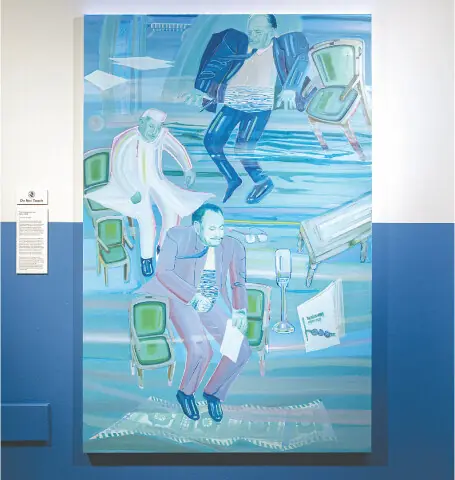
Khan’s new body of work acts as a ghostly chronicle in neon greys, greens and blues. She depicts the transcendence of technocratic brutality with the metallic lines of maps and bulldozers physically erasing the intimate cartography of Mirpur’s hamlets, transforming ancestral homes into sites of mechanical intervention. For the Mirpur diaspora, urban progress has been built on their homelessness, on the many graveyards where their forebears are buried, and these sites can no longer be visited.
‘Riverless Water’ is on display at the Midlands Arts Centre (MAC) in Birmingham, England from January 10-April 6, 2026
The writer is an art critic who spends his time in Birmingham and Lahore. He can be reached at aarish.sardar@gmail.com
Published in Dawn, EOS, March 29th, 2026