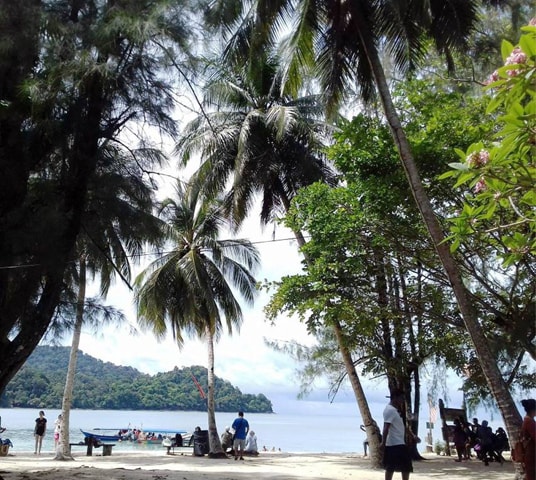
Some of my earliest memories revolve around my family’s relocation to Karachi. The first image that returns to me is the view from my house in one of the city’s oldest localities: an abundance of coconut trees.
Later, I would learn that, until a few decades earlier, a lake was a stone’s throw from that place. Coconuts that fell from the trees would float on the water surface, drift to the other side of the lake and begin growing into trees. The lake is now under sand and concrete, but the coconut trees remain. Over the years, with the proliferation of houses, the number of coconut trees has diminished significantly. Many of them, however, still stand, bearing fruit.
Scientifically known as Cocos nucifera L, the coconut belongs to the Arecaceae family of palm trees. While coco is a Spanish word, meaning “monkey-faced” or “grinning face”, the nucifera in Latin means “nut-bearing”. Even though the fruit is named coconut, it is technically not a nut, but a drupe. Drupes are fruits that develop from a single flower ovary and have a single seed enclosed within a hard, stony endocarp.
The coconut fruit also serves as a seed. Since it is hollow inside, it floats on water. Hence, it primarily spreads through water dispersal, or hydrochory. Many coastal areas, peninsulas and islands are full of coconut trees. This also explains how coconuts spread naturally across tropical coastlines in regions such as South Asia, Southeast Asia, the Pacific Islands and parts of East Africa — long before modern human transport.
The coconut is technically a drupe, botanically a seed and practically a vessel — built by nature to survive months at sea and sprout wherever it lands
The coconut fruit has three layers. The exocarp is the outermost layer — thin, smooth and usually green when young, turning brown as it matures. The middle layer is the mesocarp, consisting of thick and fibrous coir. The inner hard, woody shell is called the endocarp, a brown “stone” that encloses the seed. The middle layer has air pockets, which provide the coconut the buoyancy it needs to stay afloat. Meanwhile, the endocarp protects the seed from saltwater. Once the coconut reaches shore, it begins to germinate and grow into a tree. A coconut fruit can survive up to four months while floating on water.

The best temperature range for a coconut to start germination is between 25 and 30 degrees Celsius. It can take between two to six months for a coconut to germinate. In home settings, pre-sprouting a coconut can be done by soaking it in water for a week. The coconut can also be placed on wet sand to mimic its natural germination process.
Coconut fruits and trees are classified into different varieties, based on multiple factors such as the size of the fruit, the size of the tree, the region or country where it is being grown and the intended use of the fruit. Many varieties are crossed to produce specific traits.
Although coconuts grow from seeds, trees cultivated from market-bought fruit do not always produce reliably, especially in urban environments where soil, salinity and temperature conditions may not be ideal. Coconuts available in large cities such as Karachi are often hybrids, and their viability can be uncertain. It is rare for a viable coconut to wash ashore along the city’s increasingly crowded coastline.
For those wishing to grow a coconut palm at home, obtaining a healthy, already-germinated seedling from a reputable nursery is usually a safer option. Equally important is selecting a variety suited to the prevailing climate and space available, as not all coconut palms thrive under the same conditions.
Please send your queries and emails to doctree101@hotmail.com. The writer is a physician and a host for the YouTube channel ‘DocTree Gardening’ promoting organic kitchen gardening
Published in Dawn, EOS, March 8th, 2026