In the long arc of South Asian history, few figures capture the tragic dignity of a frontier king like Raja Jaipal of Lahore.
Standing at the crossroads of Central Asia and the Indian Subcontinent, Jaipal ruled a fragile kingdom whose fate was shaped by geography. To his north and west lay the turbulent passes of Afghanistan; beyond them, the rising tide of Turkic powers. To his east and south stretched the rich plains of Hindustan, coveted by every conqueror who saw the Indus as a gateway.
In the late 10th century, the man emerging from those shadowed passes was Mahmud of Ghazni, the ambitious young ruler of Ghazni who sought glory, wealth and legitimacy. Raja Jaipal — honourable, proud and bound by a warrior’s code — would become the first major Indian ruler to confront this new power. It was a clash not merely of armies but of worlds: old federations of north-western Hindu kingdoms pitted against the swiftly expanding Turkic military state.
A KING IN CHAINS
Jaipal inherited a legacy of protecting the frontier — his dominions included Lahore, Bathinda and regions of the Salt Range. In 986 CE, when Mahmud’s father, Sabuktigin, began exerting influence over Kabul and the frontier tribes, Jaipal attempted to push back. He gathered a confederation of Hindu rulers from the North Indian kingdoms of Delhi, Ajmer, Kanauj and Kalinjar to check the Ghaznavid advance.
For decades, the Hindu Shahis held the line between Central Asia and Hindustan. Their struggle against Mahmud of Ghazni was the last effort of an older world to hold its ground against a new kind of power
The ensuing battle in the hills of Laghman was disastrous for Jaipal. Facing skilled Turkish cavalry, mountain guerrillas and a terrain favourable to the Ghaznavids, his forces collapsed. Worse, Jaipal himself was captured alive — a humiliation for a kshatriya [warrior] king. Yet Sabuktigin, calculating and eager for political advantage, released him after securing a large indemnity.
Upon being freed, however, Jaipal could not reconcile his honour with the shame of captivity. Chroniclers note that he felt “no king of Hind had ever suffered such disgrace.” Though he paid part of the ransom, he could not pay the rest — providing Sabuktigin a fresh pretext for renewed war. When Jaipal mustered his confederacy again, the Ghaznavid armies broke it decisively, forcing the frontier into vassalage.
MAHMUD’S ASCENSION
In 997 CE, Mahmud succeeded his father and inherited not only the Ghaznavid throne but also Sabuktigin’s ambitions across the Indus. He viewed Jaipal’s earlier resistance as unfinished business. For Mahmud, Hindustan represented both opportunity and legitimacy: to wage jihad, acquire wealth to build a Persianised court in Ghazni and cement his name in history.
Jaipal assembled one of the largest armies seen in the region — estimates from chronicles like Tarikh-i-Yamini claim tens of thousands in cavalry, infantry and war elephants, though mediaeval numbers are always exaggerated. The two forces met near Peshawar in 1001 CE.
The battle was decisive and brutal. Mahmud’s highly mobile cavalry, equipped with composite bows, outflanked the slower Indian elephants and infantry. The Hindu confederacy broke under sustained assault. Once again, Jaipal was defeated — but this time, he was not captured. He retreated to Lahore with the remnants of his honour intact.
For a proud warrior king, the defeat was unbearable. Feeling that he had “outlived his honour”, Jaipal abdicated in favour of his son Anandpal and performed self-immolation, climbing on to a funeral pyre — an act described by both Persian and Indian sources with a mixture of awe and melancholy. It marked the end of an era: the frontier had lost its last great guardian.
THE LAST CONFEDERACY
Anandpal inherited not only his father’s throne but also the responsibility of facing Mahmud, who was now the most formidable warlord in Central Asia. Yet Anandpal was neither reckless nor weak; he sought diplomacy and stability. Initially, he maintained an uneasy peace with Mahmud, agreeing to pay tribute and avoid provocation.
But the frontier would not remain quiet. When rebellions broke out in the Ghaznavid territories of Multan and Laghman, Anandpal saw an opportunity. Aligning again with his broader Hindu Shahi network — which ruled what is now northwest Pakistan and parts of Afghanistan from around 865 CE to 1026 CE — he broke from Ghazni’s orbit and began building a coalition to repel Mahmud once and for all.
The decisive moment came in 1008 CE at the famous Battle of Waihind, near present-day Peshawar. It was a grand coalition of north-western kings — Anandpal of Lahore, the rulers of Delhi, Ajmer and Kanauj, and the Bhatti Rajputs of the Salt Range. Chroniclers describe a massive army, its ranks lined with war elephants, its banners reflecting a rare moment of unity among the Rajput and Hindu Shahi houses.
Mahmud, for his part, arrived with seasoned cavalry, Turkic mamluks and mountain auxiliaries.
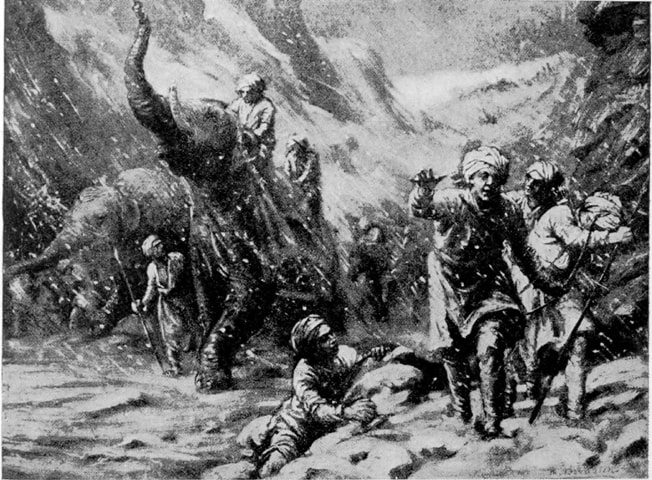
In the opening stages, the Indian coalition nearly overwhelmed Mahmud’s forces. But fate turned on a moment of chaos: Anandpal’s war elephant, struck by an arrow or frightened by fire (accounts differ), panicked and bolted. The king’s flight — though involuntary — was interpreted as retreat. Confusion spread rapidly through the ranks.
What had begun as a promising stand became a rout.
Mahmud seized the moment, rallying his cavalry and counterattacking. The coalition collapsed and the frontier kingdoms never again managed to unite at that scale. Anandpal survived but was forced into vassalage. His sons Trilochanpal and Bhimapal continued resistance in the hills but were gradually pushed into Kashmir and eventually extinguished.
This battle — Waihind — marks, in many ways, the end of the Hindu Shahis as a political force.
A CIVILISATION CONFRONTED
The tale of Raja Jaipal and Anandpal is not merely one of defeat but of a civilisation confronted with new forms of warfare and political organisation. The Ghaznavids brought mounted archery, militarised slavery and a state structure built for expansion. Against them stood frontier monarchies bound by honour, alliances and slower military traditions.
Jaipal, in particular, embodies a tragic nobility. His decision to immolate himself after defeat has often been framed as an act of a proud warrior unwilling to live without honour. For later chroniclers — Persian, Hindu and even Sikh — he became a symbol of resistance, the last sentinel guarding the gateway of the Subcontinent.
Anandpal’s legacy is one of valiant but doomed coalition-building. He tried to forge unity among kingdoms often divided by rivalry. His near-victory at Waihind stands as a reminder of how narrowly history sometimes turns.
Their dynasty, the Hindu Shahis, left behind temples, relics and inscriptions from Hund to Katas Raj, from Kabul to the Salt Range — echoes of a frontier world erased by time and conquest.
REMEMBERING AN ENDING
Mahmud of Ghazni’s victories over Jaipal and Anandpal opened the corridor that would, in centuries to come, bring the Delhi Sultanate and eventually the Mughal Empire. The fall of the Hindu Shahis was thus more than the defeat of a single dynasty — it marked a profound civilisational shift.
Yet, in the memory of the Punjab and the frontier, Jaipal and Anandpal remain symbols of courage. Their battles — fought on dusty plains and mountain passes — represent the last great effort of the old north-western kingdoms to hold the line against the coming tide.
History remembers conquerors, but it also honours those who stood their ground when standing meant losing everything.
The writer is a researcher with a focus on history and anthropology. He is also the founder of the Clifton Urban Forest, Karachi.
X: @masoodlohar
Published in Dawn, EOS, March 8th, 2026