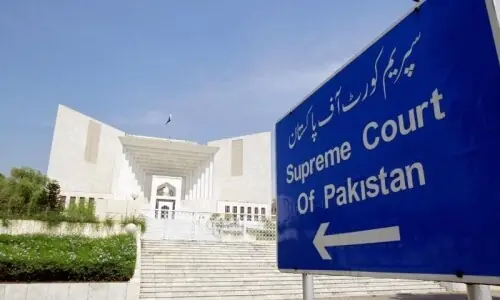
ISLAMABAD: The Shariat Appellate Bench of the Supreme Court on Wednesday remanded a 33-year-old death penalty case back to the trial court to determine whether a compromise reached between the surviving heirs of the victim could be considered compoundable.
The convict has been languishing in District Jail Mianwali while repeatedly seeking commutation of his sentence.
The five-judge bench, headed by Justice Jamal Khan Mandokhail, observed that the mere pendency of a Sharia appeal should not delay pardoning proceedings if the compromise between the living heirs of the deceased is voluntary and made of free will.
During the hearing, convict Khan Muhammad, represented by Zulfikar Khalid Maluka, argued that he had challenged the vires of the law before the Shariat Appellate Bench and that the trial court should proceed with the application for compounding his sentence without treating the appeal as pending.
Deputy Attorney General Raja Shafqat Abbasi and Additional Prosecutor General Punjab Ahmad Raza Gillani raised no objections to referring the matter back to the trial court.
Earlier, Khan Muhammad’s efforts to seek the reduction of his sentence were unsuccessful because the parents of the victim, Ghulam Ahmed and Kafayat Khatoon, had refused to join any compromise. Both parents have passed away five years ago.
The Shariat Appellate Bench, which had stayed the convict’s death sentence in 2005, is examining whether a partial forgiveness or acceptance of Diyat by some legal heirs, which suspends Qisas (retributive punishment), can also apply to a Ta’zir (discretionary) death sentence imposed by the court.
The appellate bench is tasked with determining whether the death penalty and its compounding principles differ from Qisas provisions and whether Islamic injunctions require all legal heirs to agree to compound capital punishment.
Khan Muhammad was convicted under Section 302(b) of the Pakistan Penal Code by the Sessions Judge Khushab on July 13, 1993, for the murder of Muhammad Khan. He was sentenced to death, fined Rs25,000, and ordered to pay Rs25,000 in compensation to the deceased’s legal heirs under Section 544-A of the CrPC.
The convict’s appeal before the Lahore High Court was dismissed on September 24, 1998, confirming the death sentence. Subsequent appeals to the Supreme Court, including a review petition, were also rejected in 2001.
On November 29, 2001, Khan Muhammad filed an application in the Sessions Court claiming that, except for the deceased’s parents, all other heirs had waived their right to Qisas and Diyat, and requested acquittal based on this compromise. The sessions judge dismissed the application, citing the non-participation of the parents.
Subsequent petitions to the Lahore High Court seeking acquittal or commutation to life imprisonment were also dismissed.
The convict then filed a Sharia petition arguing that Section 345(2) of the CrPC, which does not allow partial compromise by some heirs, was repugnant to Islamic injunctions. The petition was withdrawn in June 2005 without approval of the partial compromise.
Now, the Sharia Appellate Bench has revived the appeal and referred it back to the trial court for reconsideration.
Published in Dawn, March 5th, 2026