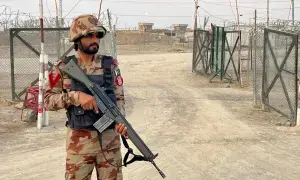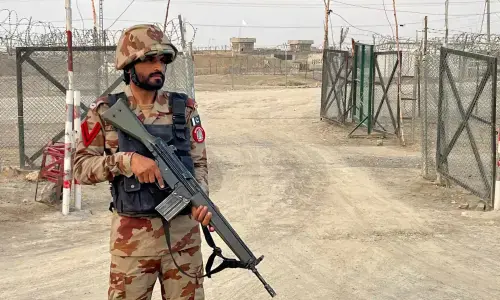


FOR many decades now, Pakistan has been investing in a large and expensive military apparatus to fend off external threats to the country. Today, that apparatus faces its supreme test.
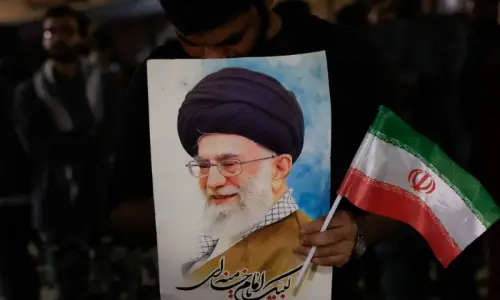
With the near simultaneous start of conflict in Afghanistan and Iran, the country’s entire western border is now a war zone. Moreover, neither war looks like it will be over soon. With the prospect of protracted conflict on the entire western flank, Pakistan must now take sober stock of its resource position to be able to sustain the burdens that conflict will inevitably bring.
These burdens will come in different forms. First and foremost will be the requirements of the war itself, especially mobilisation if more ground forces become necessary, and the rate at which armaments need to be replenished. Second will be the aftershocks from the fighting: rising oil prices in international markets, distracted allies on whom Pakistan relies to get the rollovers it needs for its external obligations, disruption of foreign trade due to rising shipping costs (already insurance cost on foreign shipments has risen massively) as well as port closures in the Gulf countries through which all Pakistan’s west-bound exports transit. Add to this the impact on remittances since the Gulf countries under fire are sources of a significant share of Pakistan’s remittance flows.
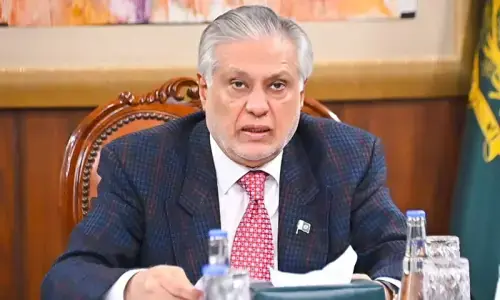
This is only the beginning. The list of second-order impacts will grow more and more complicated as the war in Iran drags on, which all indications suggest it will. The fate of the UAE rollover, for example, remains uncertain. The last we heard from the finance minister on the issue was this sunny statement: “We are in communication with the UAE authorities and there is absolutely no issue in the rollover of the $2 billion debt.” That’s reassuring. The only issue with the rollover, however, is that it has not yet happened. And one wonders whether the UAE authorities are in any mood to discuss our rollover at this time, when their emirates are absorbing the brunt of Iran’s missile and drone fire in the Gulf.
With the prospect of protracted conflict on the entire western flank, Pakistan must now take sober stock of its resource position.
Our finance minister assured us all is well, that external financing requirements are sorted for the remaining fiscal year, while an IMF review is underway. Presumably, he means the financing requirements are sorted even without the UAE rollover. But even then, Pakistan rolls over around $6bn of bilateral debt every year, which is subject to geopolitical risk in various forms. Last year, a slight delay in one such rollover from China nearly sent key external sector ratios into crisis territory for a brief period. Fortunately, the blip was too short to have any real impact but it exposed an important vulnerability. Now we have the UAE rollover stuck and wait to see how this situation resolves itself.
Qatar has called force majeure on its LNG supply contracts with all countries, including Pakistan. Both LNG supply contracts have an exit ramp in 2026, and perhaps this is a good time to exercise that option. Last reported figures suggested that up to 40 LNG cargoes in 2026, equal in value to $1.5bn approximately, are surplus. So far it seems the petroleum ministry has been trying to renegotiate the price rather than seeking to terminate the contracts altogether. Given the mounting surpluses of LNG in the country, perhaps the moment presents a good opportunity to exit these deals altogether considering they have served the purpose for which they were signed.
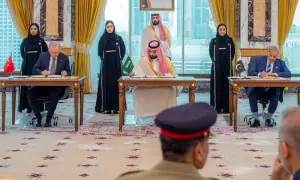
The upside here is that Pakistan’s stock and importance for many countries around the world has just shot up. The foreign minister explained that Pakistan has mediated between Saudi Arabia and Iran, reminding the latter of the security pact that his country has with the kingdom. He claims this is one reason why the kingdom has been spared (mostly) by Iran’s retaliatory strikes, though Tehran maintained that if it is struck by assets from the kingdom’s territory, retaliating against those assets remains its right.
A large, growing and ruinous war is gathering pace, and the situation in the weeks and months ahead threatens to become more and more fluid. America has started a war at Israel’s behest and cannot clearly articulate its own reasons for why this attack was necessary, and what objective they are pursuing. As a result, they have no concept of the endgame, and the assumptions under which they went in seem to be collapsing. Just like they invaded Iraq in 2003 thinking the local population would welcome the invaders with flowers, they have gone into this war believing that the local population will rise up and finish the job by overthrowing the regime.
That is not happening and now they seem to be falling back on Plan B, which is to arm Kurdish and Baloch populations on the periphery of Iran, in the hopes that they will provide the ground component to the aerial bombardment. This idea risks the spread of the war since neighbouring countries such as Turkiye and Pakistan will both view this attempt with great concern.
Having launched a ruinous war with no clear endgame in sight, America is now stuck in an untenable situation. The regime in Iran is taking a very serious battering, but the bombing cannot bring about its end without the commitment of ground forces, and even then, the question of who will manage the aftermath has obviously not been given any attention. If the bombing drags on, the war devolves down to the arithmetic of Iranian projectiles minus interceptor stocks in Israel and the Gulf countries. And in this arithmetic it is far from clear who has the upper hand.
Meanwhile, the burdens of war will increase, for the aggressors as well as the victims, the neighbours as well as the wider world. For Pakistan, the supreme test of its armed forces has arrived, as the war and its burdens land with increasing ferocity on our borders.
The writer is a business and economy journalist.
Published in Dawn, March 5th, 2026