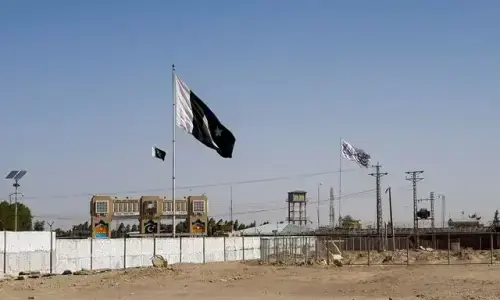
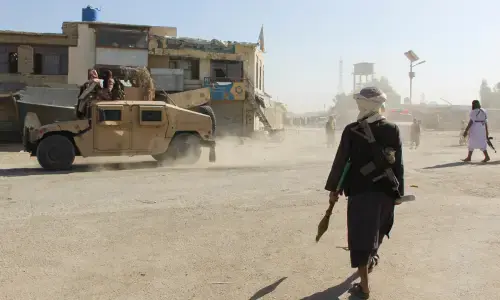
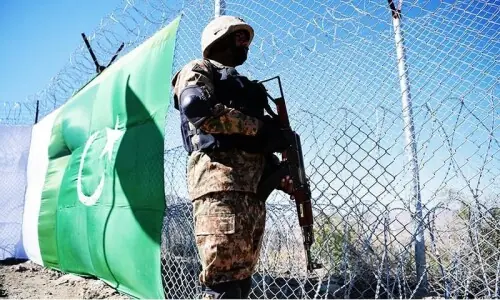
PAKISTAN’S troubled relationship with Afghanistan now forms the centre of its security crisis. The International Crisis Group notes the irony that Pakistan has been the country most affected by the Taliban’s return to power.
What once looked like a manageable neighbour has become the source of growing instability along our western border. The problem is not a lack of engagement. Pakistan invested early in contact with the Taliban, hoping that dialogue and familiarity would translate into restraint. That expectation has not been met.
The Afghan Taliban have failed to curb the banned TTP operating on their soil, whose attacks have martyred hundreds of Pakistani soldiers and police in recent years. This has become a sustained security threat for Pakistan — one which the Taliban are not willing to help eliminate.
On account of the Taliban’s myopic approach, Islamabad has had no option but to lean increasingly on force, knowing that air strikes, border closures and deportations also carry risks. Unfortunately, it is lost on the Taliban that escalation only reduces room for diplomacy and that repeated confrontations raise the danger of miscalculation, civilian harm and regional fallout.
While the Taliban fail to see reason at their end, different quarters within Pakistan have pointed out that better governance and policing in this country as well as an end to political divisiveness can support military action. The Pakistani state, therefore, must work towards a clearly defined political and security strategy that factors in input from all stakeholders in the country.
Expectations from Kabul must also be grounded in reality. The Taliban’s reluctance to act against the TTP and other groups they have permitted to operate from their territory is driven not just by defiance but also by fear of internal backlash and fragmentation. Putting pressure on them alone may not result in compliance. Pakistan must pair pressure with incentives, using trade access, transit facilities and humanitarian coordination as bargaining tools rather than blunt instruments.
Engagement with Afghanistan should continue, but it must be firm, structured and coordinated with regional partners such as China, the Gulf states and Central Asian neighbours who retain channels into Kabul. Border controls should improve through technology, intelligence-sharing and regulated crossings, not ad hoc closures that damage livelihoods.
Most importantly, internal reforms — better policing, effective prosecutions, local political inclusion and economic investment in conflict-hit districts — must be treated as core to national security. The choice is not between talking and striking, but between a clear strategy and a costly stalemate that drains lives, resources and political focus year after year. The fight against terrorism demands a united stance.
Published in Dawn, January 10th, 2026