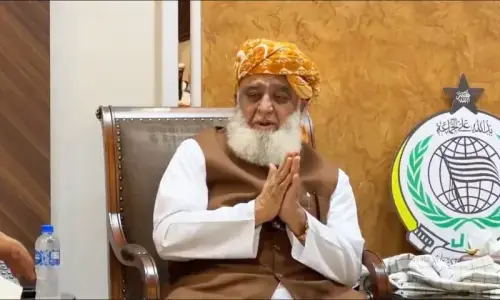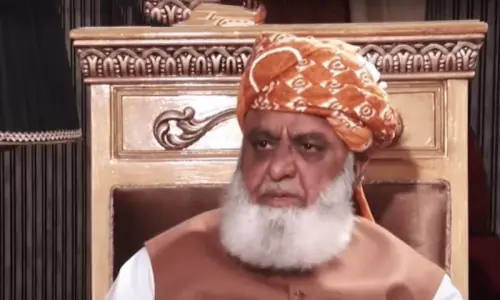
THE recent outcry by Maulana Fazlur Rehman regarding an unspecified state policy to raise private militias for local protection against terrorists has sparked controversy. Many have accused the maulana of disrespecting those who have sacrificed their lives to protect the homeland.
However, the broader context of his remarks deserves scrutiny: why do states encourage local populations in conflict zones to stand up against violent actors? Take the example of Pakistan. Successive governments have used this tactic —from the then East Pakistan to Balochistan and KP. The core question, and perhaps the crux of the maulana’s argument, is why this policy has failed in most cases.
Known for his sharp political timing, the maulana deliberately chose a platform near Lahore, the political heartland of Punjab, to ensure that his message reached key decision-makers. Yet, his objections to local state-backed civilian militias are far from isolated. Across KP and Balochistan, particularly in the southern districts, from Lakki Marwat to Dera Ismail Khan (the maulana’s core constituency), the locals are attempting to form self-defence militias against terrorist groups like the banned TTP and Hafiz Gul Bahadur’s faction. Tribal elders and political leaders have voiced even stronger criticism of security failures by the state — most recently seen in the Quetta sit-ins organised by the families of slain police personnel.
There are certainly instances where local private militias were formed by criminal elements seeking state patronage. Overall, however, the phenomenon of state-backed armed groups, variously termed ‘amn (peace) committees’ and ‘lashkars’, or derogatorily labelled ‘death squads’ and ‘cardholders’, is no longer popular. There are distinct reasons for this shift across both KP and Balochistan.
Why do states encourage local populations in conflict zones to stand up against violent actors?
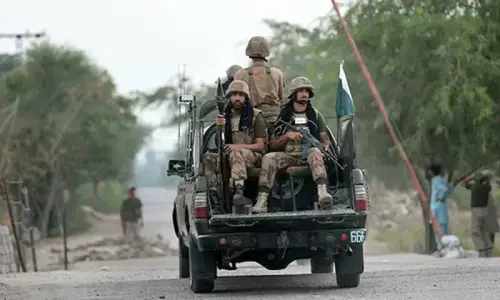
In KP, the reliance on local militias dates back to the British colonial model of collective responsibility. During the peak of counterterrorism operations between 2007 and 2015, the state reactivated this approach. Tens of thousands of anti-Taliban lashkar members were armed, with the civilian and security leadership fully on board.
It was widely believed that President Asif Ali Zardari strongly favoured the strategy; reports during his first presidential tenure suggested a deal for Chinese small arms to equip KP’s peace committees. Many felt personal tragedy also drove this policy, given the assassination of his wife, Benazir Bhutto, by religiously motivated terrorists. Modelled conceptually after the US-backed ‘Sunni awakening’ against Al Qaeda in Iraq, the policy gained initial traction among communities in the former Fata and Pata regions backed by state funding, arms, and institutional cover.
In the early stages, these militias provided crucial local intelligence and served as a protective shield for the state. However, the model quickly exposed its inherent flaws. Some militias abused their authority and committed atrocities, turning the public sentiment against them. More critically, once security forces cleared key areas, the state began viewing these groups as financial and operational burdens and gradually abandoned them. Furthermore, exposing tactical weaknesses to private militias damaged the state’s image, creating a perception that economically and socially weak terrorists were capable of challenging structured security forces without state consent. This has forced security institutions to review their approach towards private militias.
The abandonment left militia members, ‘cardholders’ and local political figures totally vulnerable. The TTP and Baloch terrorist groups marked peace committee members, militia leaders and allied political workers as priority targets, subjecting them to targeted killing, roadside IEDs and grenade attacks. As per a database managed by the Pak Institute for Peace Studies, the terrorists launched 220 attacks against the members of these militias between 2006 and 2015 and killed 507 and injured another 416, while the figure for Balochistan was 77, in which 66 members of private militias were killed. The PPP was at the centre. Its ally, the Awami National Party, ruled KP. Both parties suffered thousands of casualties as well. At the same time, the terrorists tagged them as enemies for being full partners of the establishment, for crushing them and supporting the foreign occupation forces in Afghanistan. According to the data, the terrorists launched 2,007 attacks against political workers mostly belonging to these two parties and killed 4,068 workers and leaders. Maulana Fazl himself survived multiple suicide attacks, while scores of his party members were killed in Bajaur and the surrounding districts.
Apparently, public trust in this strategy eroded long ago. Elders remember how terrorists had killed hundreds of their members and leaders. After state protection evaporated, many refused to volunteer again. Moreover, unresolved issues following the Fata merger, including mass internal displacement, undelivered development funds and a severely underfunded local police force, have deepened the sense of abandonment in tribal communities.
Simultaneously, political and civil actors in Balochistan have raised concerns over rumours regarding the recruitment of former Afghan security operatives for similar purposes for which private militias have been raised. The use of foreign fighters in internal conflicts is not an alien idea, as the recently Russian-made and backed Wagner Group (now Africa Corps) has earned notoriety in the field, and its foreign fighters have been used in several conflicts in Africa, West Asia and even in Ukraine.
If it is true that Afghan fighters are being replaced with local private militias or merged into existing ones, nothing could be worse; it will only empower criminal elements and foreign agents. These criminal elements, alongside private militias and so-called peace committees, were among the primary drivers of mistrust between the state and society in both KP and Balochistan. Even if this is merely a perception among the populace, the state must address it with a clear answer.
The maulana tapped directly into these deep-seated local grievances. By choosing his moment and venue strategically, he ensured that those shaping Pakistan’s national security policy could not ignore the message.
The writer is a security analyst.
Published in Dawn, July 26th, 2026