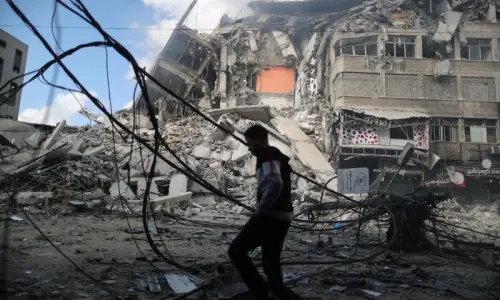
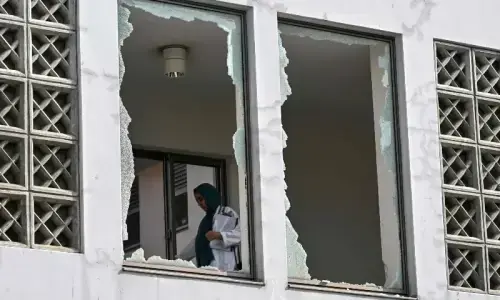
DAMASCUS/ANKARA: Clashes between government personnel and Kurdish-led forces in the north Syrian city of Aleppo killed at least seven people on Tuesday, mostly civilians, with both sides trading blame over who started the fighting.
The implementation of a March deal to merge the Kurds’ semi-autonomous administration and military into Syria’s new Islamist government has stalled, and tensions occasionally erupt into clashes, particularly in Aleppo, which has two Kurdish-majority neighbourhoods.
On Tuesday morning, the Kurdish-led Syrian Democratic Forces said in a statement that groups affiliated with the government “targeted the Sheikh Maqsud neighbourhood with a reconnaissance drone”, resulting in “the death of one resident”.
It later said the toll had risen to three civilians including two women in “indiscriminate artillery and missile shelling carried out by factions of the Damascus government” on the Sheikh Maqsud and Ashrafiyeh districts. “The shelling is still ongoing, with the use of drones... direct sniper fire and heavy-weapon fire,” the SDF statement said.
Turkiye says all Kurdish groups must disarm
Aleppo’s Kurdish-majority Sheikh Maqsud and Ashrafiyeh neighbourhoods have remained under the control of Kurdish units linked to the SDF, despite Kurdish fighters agreeing to withdraw from the areas in April.
In a statement carried by state news agency SANA, the defence ministry said the SDF targeted “a number of neighbourhoods in Aleppo city adjacent to the districts it controls”.
“The ongoing attacks have resulted in three dead and more than 12 wounded among civilians,” it said, also reporting one dead in an attack on an army position.
“The SDF is again proving that it does not recognise the March 10 agreement and is trying to undermine it,” the statement added.
Stalled talks
The SDF controls large swathes of Syria’s oil-rich north and northeast, and with the support of a US-led international coalition, was integral to the territorial defeat of the militant Islamic State group in Syria in 2019.
Its integration into the state following the ouster of longtime ruler Bashar al-Assad a year ago has proven complicated, and the original March agreement was supposed to be implemented by the end of 2025.
The SDF also accused factions affiliated with Syria’s army of attacking the town of Deir Hafer, around 50 kilometres east of Aleppo, and near the strategic Tishreen Dam to the city’s northeast. The Kurdish-led force affirmed its right to “respond legitimately to these attacks”.
On Sunday, SDF chief Mazloum Abdi held further talks with officials in Damascus on integrating the Kurdish-led forces, but state media said no tangible results were achieved.
The Kurds have repeated calls for decentralisation — which Syria’s new Islamist authorities have rejected.
Last month in Aleppo, deadly clashes killed five people, in violence that came after Foreign Minister Hakan Fidan of Turkey — a close ally of the new authorities — urged the SDF during a visit to Damascus not to be an obstacle to Syria’s stability.
Kurds must lay down weapons
Turkiye’s defence minister on Tuesday demanded that all Kurdish armed groups — “including in Syria” — lay down their weapons.
“The PKK (the Kurdistan Workers’ Party) and all affiliated groups must immediately cease all terrorist activity in regions where they are present, including in Syria, and lay down their weapons without condition,” Yasar Guler said in Ankara.
In May, the PKK formally renounced its decades-long armed struggle against the Turkish state, ending a conflict that claimed tens of thousands of lives.
“We will not allow any terrorist organisation — particularly the PKK, the PYD, the YPG, and the SDF — to establish a foothold in the region,” he added, referring to the Kurdish-led Syrian Democratic Forces and its main element, the People’s Protection Units (YPG).
Published in Dawn, January 7th, 2026