China’s ‘flying taxis’ reinventing future of urban air mobility


 0
0
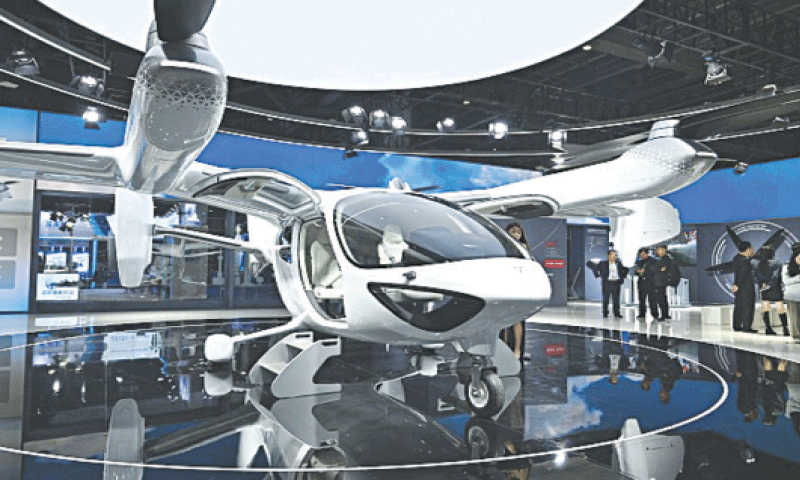

SHANGHAI: Four leading electric vertical take-off and landing (eVTOL) aircraft makers have expressed their confidence in China’s low-altitude economy and demonstrated the approaching future of urban air mobility at the eighth China International Import Expo (CIIE), which concluded last week.
Joining hands with overseas partners, the companies brought their aircraft to the expo, drawing massive attention and crowds from both home and abroad.
VerTaxi, a Shanghai-based eVTOL aircraft maker, attended the CIIE for the third consecutive time this year.
Showcasing its upgraded M1 eVTOL aircraft this year, the company also set up a simulated terminal at the expo, enabling visitors to experience the process of taking a “flying taxi” from ticket buying to boarding.
Terminals are an essential infrastructure, as they are where eVTOL aircraft take off and land
Terminals are an essential infrastructure in the low-altitude economy, as they are where eVTOL aircraft take off and land with passengers. The company simulated the real UAM operation process on site, visually demonstrating its efficiency and convenience of the emerging transport, at the estimated cost equivalent to or even lower than taking a regular or typical taxi.
With a flying taxi, visitors could hypothetically fly from the main venue of the expo to any place in Shanghai in around 10 minutes, to Pudong International Airport in 15 minutes at the price of about 100 yuan ($14.05), and to the West Lake in Hangzhou, Zhejiang province, in 45 minutes for the price of about 260 yuan, according the company.
During the expo, VerTaxi secured intended deals from domestic and international clients, with a total value exceeding 2 billion yuan for 200 units of the M1.
“Back in 2023, we were the only one to bring the real-size aircraft to the CIIE, and this year we saw four. The low-altitude economy in China is flourishing, and we do feel the extensive public attention these days. Each day our booth was packed with visitors asking when the UAM operation would start,” said Yue Tingting, vice-president of VerTaxi.
Similar cases were witnessed at the other three booths. Despite the aircraft from the four makers being in different configurations, they all told visitors about the future of UAM.
TCab Tech, at the CIIE for a second time, showcased its five-seat E20 tilt-rotor eVTOL aircraft, a configuration that the team believes will be the mainstream option for future eVTOL aircraft. Carrying its founder and CEO Yon Wui Ng, it completed its maiden manned flight on Oct 21.
Published in Dawn, November 17th, 2025