Data points


 0
0

Big Tech AI spending
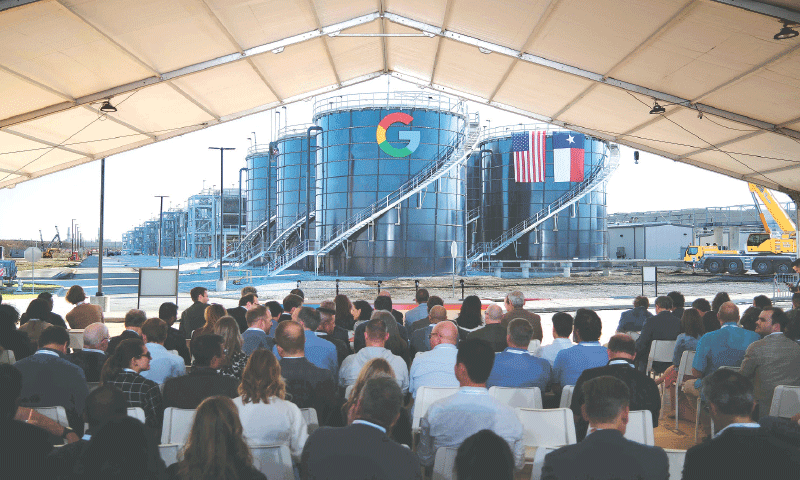
Big Tech is driving big swings in the stock market. The rapid growth, high valuations and outsize influence of major AI players have some on Wall Street worrying about a tech-fueled bubble akin to the dot-com boom and bust. Last month, Meta, Alphabet, Microsoft and Amazon all told investors that they will increase spending in 2026. The concern among some investors is that it is unclear how, and when, all that investment will start to pay off. The size of the boom implies that a massive shift in the economy would be needed to make current spending worthwhile. Recently, Meta issued $30 billion of bonds to fund “general corporate purposes” generally understood to mean AI spending. That came about a month after Oracle issued $18 billion of bonds, while it spends big on AI infrastructure.
(Adapted from “What Investors Learned From Tech Earnings, In Chart,” by Hannah Erin Lang, published on November 1, 2025, by the Wall Street Journal)
India’s IPOs
Mumbai was built on the proceeds of a stock market boom. During the American Civil War, money rushed into the city, then known as Bombay, as merchants sought alternative sources of cotton to the blockaded southern states. The boom spread from textiles to railways, to link cotton-growing districts with the coast, and to land-reclamation companies, to fill the gaps between the city’s seven islands. New land provided newly flush brokers with space for new houses. The frenzy ended, but many of the companies endured. Initial public offerings (IPO) are surging in the country. So far this year, 298 deals have been completed, more than in the whole of 2023, according to Dealogic, a data provider. The rush is likely to last into 2026. About two-thirds of IPOs have been a means for owners to sell out rather than deepen their companies’ capital base. But there are some signs that equity markets are helping to fuel investment.
(Adapted from “India’s IPO boom is good news for its economy,” published on October 29, 2025, by The Economist)
Pasta tariffs
Italy’s biggest pasta exporters say import and antidumping duties totalling 107pc on their pasta brands will make doing business in America too costly and are preparing to pull out of US stores as soon as January. The combined tariffs are among the steepest faced by any product targeted by the Trump administration. “It’s an incredibly important market for us,” said Giuseppe Ferro, La Molisana’s chief executive, whose family-run pasta factory sits on the edge of the southern Italian town of Campobasso. The US Commerce Department has announced a 92pc antidumping duty on pasta made in Italy by La Molisana and 12 other companies, which import the bulk of pasta from Italy to the US. That is on top of the Trump administration’s 15pc tariff on imports from the European Union. The decision has stunned one of Italy’s most iconic industries, escalating into a diplomatic dispute between Washington and Rome.
(Adapted from “Italian Pasta Is Poised To Disappear From American Grocery Shelves,” by Julie Jargon, published on November 10, 2025, by the Wall Street Journal)
Code word protection
Criminals increasingly use generative AI to mimic real people’s voices and con their loved ones out of money. There’s a simple solution to this high-tech problem: a code word. If you receive a call from someone who sounds just like a loved one and says he needs money or a gift card, the best thing to do is hang up and call your loved one. But if the voice is so convincing that you can’t bear to do that, ask for your family code word. If the caller can’t produce it, hang up. Likewise, if you are legitimately in trouble and need to call a loved one for help, say the code word so your relative knows it’s really you. People who haven’t implemented a family code word have been burned by bad actors. Earlier this year, a Colorado woman received a call from a young woman who she said sounded just like her daughter. Only after wiring $2,000 to protect her daughter from danger did she learn the whole thing was a scam.
(Adapted from “Why Every Family Needs a Code Word,” by Julie Jargon, published on November 1, 2025, by the Wall Street Journal)
Published in Dawn, The Business and Finance Weekly, November 17th, 2025