Karachi fishermen share tales of horrific torture in Indian prisons after May flare-up


 0
0

• 42 battered Pakistanis reunite with their families at Edhi Centre
• Six others still await government clearance in Lahore
• Returnees say beatings, burn injuries and forced labour became routine after Pakistan-India conflict
KARACHI: Some 42 of the 48 Pakistani fishermen released from Indian jails and handed over to Pakistani authorities through the Wagah Border reached Karachi on Monday after a long wait of over a month because of the uncertain situation in Lahore. There are still six of them awaiting government clearance in Lahore.
The expected time of arrival of the fishermen reaching the city by road from Lahore, thanks to the Edhi Foundation, was 12 noon, though they reached the Edhi Centre at Kharadar after 2:30pm. Still, the media gathered there already felt like they knew each and every one of them, as they had heard so much about them from their family members waiting for them there since morning.
What’s common is the story of the horrible torture they endured in custody after the May conflict between Pakistan and India. They were routinely subjected to physical abuse just for being Pakistani citizens.
There was Shamsa from Malir waiting for her elder brother Habibullah with his 10-year-old son Faizan. Every now and then her eyes would pool up with tears.
Hanif Katiyar was waiting for his son Sattar and brothers Ahmed, Hassan and Ghulam Hussain. “My brothers’ families cannot wait to see them, just like I cannot wait to see my son,” he said.
Noor-ul-Amin from Machhar Colony was waiting for his brother Noor Hussain with his five-year-old daughter Areeba Noor, wearing pink goggles and a shimmery blue dress. “My brother has been languishing in an Indian jail since 2013. He has several new family members to meet now, starting with my little girl who can’t wait to meet her uncle,” he said.
There was also Mohammed Hussain from Keamari Town waiting for his son-in-law Akhtar Ali, father of four. “His two older sons are already working at Karachi Fisheries. He can find work there too. He doesn’t need to go out to sea again,” the father-in-law said.
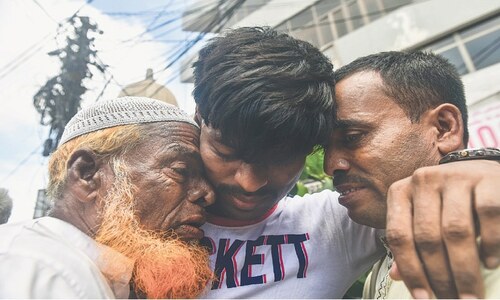
The wait was finally over. Very moving scenes were witnessed all around as the fishermen were reunited with their families.
The returning fishermen also had horrible stories to share. They said they were beaten up and burned with iron plates and rods in Indian jails.
Abdul Rehman’s entire left side was paralysed. He was on a stretcher and could not speak very well as he gestured with his right hand.
Abdul Rasheed said that he was made to do hard labour in the Indian jail. “They made me lift huge rocks. If I faltered, they beat me badly. If I asked for food, they beat me more and only gave me stale food to eat,” he said while picking up his young son Asim, whom he held close to his heart. The rose garland that others had put around his neck, he put around his son’s neck and kissed his cheeks.
Ghulam Hussain also said that he had to lift heavy construction material. “I only lifted heavy rocks and bricks and took heavy beatings and abuses,” he said.
“I was arrested three years ago, and things were not as bad as they got this year. The jail staff told me that I deserved all the beatings I got because I belonged to the enemy country, Pakistan,” he added.
Mujeebur Rehman and Akhtar Ali pointed to their burnt feet and legs. “They had hot iron rods and plates to hit us with if they thought we were being lazy,” said Rehman.
“I was arrested by the Indian coastguards four years ago. Earlier, things were normal, but this year I was told by the jail staff that I deserved a fate worse than death because I was Pakistani,” he shared.
Showing charcoal-coloured scars on his legs, Akhtar Ali said that he will carry the scars he received on his body and his heart in India all his life. “Are they not human beings? They treated us worse than animals. Hurling abuses at us, they would tell us that Pakistanis are worse than animals,” he wept at the memory.
Fishermen’s Cooperative Society chairperson Fatima Majeed Motani, who was also there to receive the fishermen and present them with some cash, said that fishermen on both sides, Pakistan and India, are innocent.
“They unknowingly cross the invisible boundaries at sea in search of livelihood,” she said.
“It is sad that India treats Pakistani fishermen harshly, while Pakistani authorities behave politely with Indian fishermen caught on this side for unknowingly crossing over to our side,” she added.
“I urge the United Nations to come up with some kind of international law for the release of these innocent people,” she said.
According to Ahmed Edhi, the maternal grandson of the late Abdul Sattar Edhi, the Edhi Foundation has always taken the responsibility of facilitating Pakistani as well as Indian fishermen.
“We transport Indian fishermen released from jails in Sindh to the Wagah Border with gifts from Pakistan, and we bring Pakistani fishermen handed over to Pakistani authorities at Wagah to their cities of residence.
In the process, we take good care of their needs and requirements such as food and stay,” he said, adding that there are still some 64 Pakistani fishermen languishing in Indian jails who should also be returned soon.
Published in Dawn, October 14th, 2025