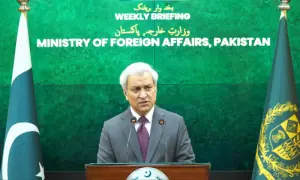
The eight Muslim countries that worked with US President Donald Trump’s administration on a plan to end Israel’s genocide and invasion in Gaza have welcomed the “steps taken by Hamas” in this connection, the Foreign Office said on Sunday.
On Friday, Hamas said it would agree to some of the terms in Trump’s plan — which was announced on Monday after a meeting between the US president and Israeli Prime Minister Benjamin Netanyahu — and seek further negotiations. While the Trump administration worked with eight Muslim countries last month to bring the Israeli invasion of Gaza to an end, reservations have been expressed from that latter’s side that the plan unveiled by the White House was not the one originally agreed upon.
Nevertheless, they see Hamas’s partial agreement to the plan as an opportunity for a ceasefire in Gaza after an onslaught of around two years.
“The Foreign Ministers of the Hashemite Kingdom of Jordan, the United Arab Emirates, the Republic of Indonesia, the Islamic Republic of Pakistan, the Republic of Turkiye, the Kingdom of Saudi Arabia, the State of Qatar and the Arab Republic of Egypt, today welcomed the steps taken by Hamas regarding US President Donald Trump’s proposal to end the war on Gaza, release all hostages, alive or deceased, and the immediate launch of negotiations on implementation mechanisms,” a FO statement said.
The foreign ministers also welcomed Trump’s call on Israel to immediately stop the bombing in Gaza and begin implementation of the prisoner-hostage exchange agreement, it added.
“They expressed appreciation for his commitment to establishing peace in the region. They also affirmed that such developments represent a real opportunity to achieve a comprehensive and sustainable ceasefire, and to address the critical humanitarian conditions facing people in Gaza Strip,” the FO statement read.
According to the FO, the foreign ministers also welcomed the announcement by Hamas of its “readiness to hand over the administration of Gaza to a transitional Palestinian Administrative Committee of independent technocrats”.
They also emphasised the need for the immediate launch of negotiations to agree on mechanisms to implement the proposal and address all of its aspects.
“The foreign ministers reiterated their joint commitment to support efforts towards the implementation of the proposal to work for the immediate end of the war in Gaza and achieve a comprehensive agreement that ensures unrestricted delivery of humanitarian aid to Gaza, no displacement of the Palestinian people, that no measures are taken that threaten the security and safety of civilians, the release of hostages, the return of the Palestinian Authority to Gaza, unifying Gaza and the West Bank, reaching a security mechanism that guarantees the security of all sides in a manner that leads to the full Israeli withdrawal […] the rebuilding of Gaza and that […] a path [is created] for just peace on basis of the two-state solution,” the statement said.
From Gaza invasion to Trump’s plan
Israeli onslaught in Gaza began in October 2023 following an attack by Hamas in Israel. Since then, more than 66,000 Palestinians have been killed, thousands injured and millions displaced.
Last month, UN investigators said that Israel was committing genocide in Gaza in a bid to “destroy the Palestinians”, accusing Israel’s prime minister and other top officials of incitement.
After multiple attempts to mediate a truce between Palestine’s Hamas and Israeli, a significant development came last month when Trump engaged eight Muslim countries, including Pakistan, to end the onslaught in Gaza.
Merely days later, the White House revealed the US president’s 20-point plan for Gaza. Simultaneously, Trump held a meeting with the Israeli prime minister and held a press conference alongside him, announcing his agreement to the proposal.
But, some Muslim countries engaged on the matter have said that Trump’s plan was not the one they originally agreed to.
Meanwhile, US news outlet Axios reported that the deal now before Hamas was significantly different than the one the US and a group of Arab and Muslim countries had previously agreed on, due to Netanyahu’s intervention.
The main stumbling block, it seems, were the last-minute edits secured by Netanyahu when he held a six-hour meeting with White House envoy Steve Witkoff and Trump’s son-in-law Jared Kushner.
These included the conditions and timetable for Israel’s withdrawal from Gaza, and the proposal ties Israel’s withdrawal to the progress of disarming Hamas, and gives Israel a veto over the process.
Even if all conditions are met and three phases of withdrawal are completed, Axios reported that Israeli forces would still remain within a security perimeter “until Gaza is properly secure from any resurgent terror threat”.
Although there was no push-back publicly, officials from Saudi Arabia, Egypt, Jordan and Turkiye were furious over the changes behind the scenes, Axios reported.
According to the report, the Qataris even tried to convince the Trump administration not to release the detailed plan on Monday due to those objections. The White House released it anyway, and pushed the Arab and Muslim countries to support the plan. The eight Muslim countries then issued a joint statement welcoming Trump’s announcement, but without expressing full support for it. The Qataris told the other countries that after the generally positive statement, they would have further discussions with the US over the details, sources told Axios.
On Monday, Qatar and Egypt shared the 20-point plan with Hamas following which Trump gave the group “three to four days” to accept the proposal or meet “a very sad end”.
Later, he gave Hamas until 2200 GMT on Sunday (3am PKT on Monday) to accept his plan for peace in Gaza, warning that the Palestinian resistance group would face “all hell” if it did not agree to the terms.
On Friday, Hamas — which had not been included in negotiations about the proposal — said it would agree to some of the terms in Trump’s plan to end the Gaza invasion, including releasing hostages, but avoided addressing more vexing issues like disarmament and said it would seek further negotiations.
Yesterday, Trump called on Israel to stop bombing Gaza immediately and he believes Hamas was ready for peace. However, reports of bombing in Gaza continue to come.