Koī kārvāñ se tuutā koī bad-gumāñ haram se
Keh amīr-e-kārvāñ meñ nahīñ ḳhū-e-dil-navāzī
— Allama Iqbal
FOR some time, most of those in their right mind have not had any doubt that all is not well with the superior judiciary. Now, even the hardiest of sceptics have been forced off the fence.
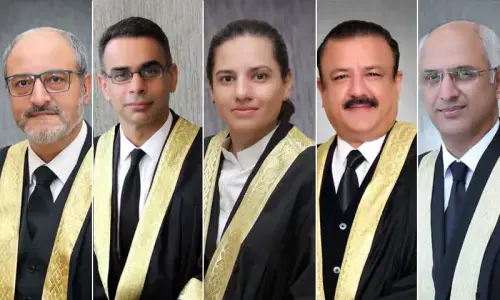
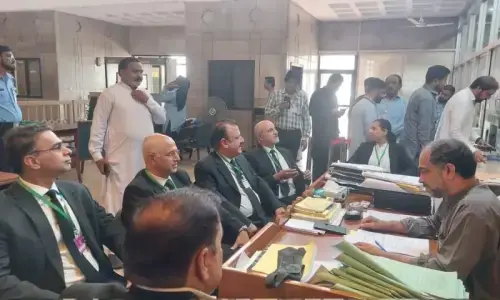
The disturbing images of five judges of the Islamabad High Court (IHC) walking through the litigants’ gate of the Supreme Court to lodge their petitions was perhaps the last straw.
Their grievances are not personal. Their complaints centre around not being allowed to perform their judicial duties in accordance with their conscience and the Constitution.
The complaint they voice is not against an imperious legislature or an executive run amok. It is against their own chief justice.
Differences of opinion between groups of judges or between them and their chief are not uncommon. At times subtle, at times strong, but seldom — if ever — uncivil, such dissensions have a long history.
The five IHC judges have only formally addressed their petition to the Supreme Court, their real appeal is to the court of the people
These are not peculiar to Pakistan either. The passions and prejudices that afflict the rest of us do not pass the judges by. Often, such disagreements are both natural and healthy. They contribute to the growth of the judiciary as a department engaged in rational discourse.
Such matters were resolved in the committee rooms of the respective high courts. However, the manner was such that it kept comity alive and the institution integrated. The images splashed across the pages of the national newspapers break with this tradition. They undermine public confidence in the administration of the IHC by its chief justice.
Critics may argue that all of this was a ‘tamasha’ — a mere show. The judges had access to an advocate-on-record, and the petitions could have been filed through him. Such criticism misses the point: there has been a breakdown of communication between the judges and their chief. They have lost faith in him and no longer regard him as someone interested in facilitating the administration of justice.
Given their recent experience, they also cannot be sanguine about the prospects of success in the Supreme Court
One may ask, then, why tilt at the windmills? In my view, being astute lawyers, they have only formally addressed their petition to the Supreme Court. Their real appeal is to the court of the people; their submissions are addressed to those who still may have a shred of faith left in the constitutional promise of a republican government.
The contents of the petitions shall be the subject of a separate essay. What is lamented here is the decline of form and manner in the IHC, at least for now. A mere glance at the petitions suffices to reveal that most of these grievances could have been redressed by the chief justice. Some give and take, an amiable discussion and a promise to reset course would have calmed things down.
The IHC chief justice may be too invested in the position he has taken. He may not have taken a leaf out of the favourite book of the father of nation: Morley on Compromise.
New to the charge, he may lack the skill required to convert rivals into a team. He may not have the hand required to steady the ship. Here, help could have been provided by the chief justice of Pakistan; a man with an enviable first-rate temperament. He is, after all, in the words of the Supreme Court, ‘paterfamilias’, or head of the judicial family.
The ruckus may have escaped his attention. He may even have continued to believe that it was a storm in a teacup till the fan got fertilised.
Even then, all was not lost. The head of the Constitutional Bench, in whose remit the matter fell, could have swiftly constituted a bench. Notices could have been issued and directions given that the matters be amicably resolved within a stated timeframe. Behind-the-scenes mediation of well-respected judges both serving and retired would have helped.
All this was not to be. The petitions have not been listed for hearing. The registry of the Supreme Court has recorded their objections to the petition and matters are now pending further consideration. If one thing is clear, in the practice of the Supreme Court it is that while the Registry can note what it perceives to be flaws in a petition, the matter must then be put up before a bench of the court to confirm the objections or overrule these and hear the case on merits.
IHC is the only high court in the country where all federal executive and legislative action can be called in question. In this respect it is unique. To allow this turmoil to continue paralyses the IHC and is a disservice to the state. These petitions ought to be heard and decided on merits immediately.
To keep them pending will deepen the malaise. By persuasion, through mediation, by gentle direction and ultimately — if necessary — through orders, the Supreme Court must nudge the IHC chief justice to take his judges into confidence, deal with them with respect and build consensus. A failure to do so would fail the nation.
Diloñ kī uljhaneñ barhtī raheñgī
Agar kuchh mashvare bāham na hoñge — Hafeez Hoshiarpuri
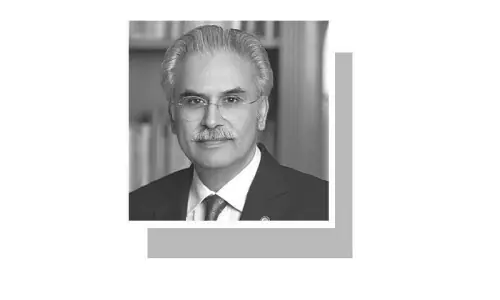
The writer is a former Attorney General for Pakistan and a distinguished lawyer
Published in Dawn, September 25th, 2025