LAHORE: In August 2023, when the Punjab government handed full control of the Lahore Fort to the Walled City of Lahore Authority (WCLA), few could have predicted the extraordinary find that awaited within its walls. Tucked away in a long-abandoned storeroom on the first floor of Kharak Singh Haveli lay a treasure trove—17,000 archival files and nearly 4,000 glass plates, negatives and photographs.
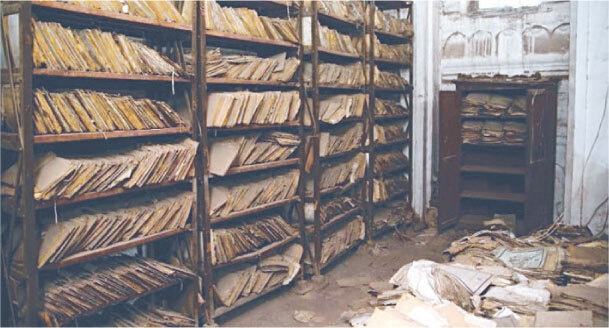
For decades, these priceless records had been left to decay under layers of dust, humidity and termite infestation and when the department previously in control of the building discarded the treasure when it vacated the building. Many documents were so fragile that they could barely be touched without crumbling. Yet what might easily have been lost forever was instead rescued by chance when WCLA began clearing the haveli for conservation.
Recognising the immense historical value of this discovery, the WCLA swiftly assembled a dedicated team of 12 archivists and historians, supported by scholars from Government College University (GCU) and the Beaconhouse National University (BNU) on a consultancy and voluntary basis. Their mission was to salvage, catalogue, digitise and ultimately share this forgotten heritage with the public. What began as a rescue operation soon evolved into one of Punjab’s most ambitious archival projects, a testament to WCLA’s determination to preserve Lahore’s cultural memory. The WCLA took two consultants on board, including Dr Tahir Kamran, for the project.
Before any physical work began, comprehensive feasibility reports and standard operating procedures were prepared to ensure that the best international practices were followed. This was not a new team. They have previously established two other successful archives in Pakistan and the first Archive Studies Department in South Asia at a public sector university of Lahore. This demonstrates a deep understanding of the science and scholarship of archival preservation.
A structured mission
Launched on Sept 11, 2023, the archival project unfolded in carefully planned phases. The first phase was retrieval and initial cleaning as the teams painstakingly recovered documents, carefully removed the dust, used dehumidifiers to reduce moisture levels, and assessed termite damage. In phase two, the files, once stabilized, were packed and moved to a designated building inside the fort. Each was recleaned, unpacked and subjected to delicate restoration. Fragile pages were handled with brushes and supports were used to strengthen brittle edges. Phase three demanded the most intellectual labour for categorization and inventory. With no prior indexing, the team created an entirely new system, studied thousands of files that had no titles and described and classified. The result was the first structured inventory of this body of material.
By the close of 2024, the archives were relocated to the conserved ground floor of Kharak Singh Haveli—a part of the historic Akbari Mahal Complex—and permanently housed there for research and public access.
A monumental achievement
More than 20,000 documents, 10, 000photographs and 4,500 glass plates were cleaned, stabilised and catalogued. A creation of a 20-category framework, including Archaeological Survey of India records, Gazette Notifications from colonial India, Punjab and Pakistan, official state visits, excavation and conservation reports, and museum records was done. Assignment of unique identification numbers to each file, with content summaries and suggested titles was carried out and catalogue of the documents or the pictures were made.
Moreover, the digitization of over two million pages using advanced scanning technology, including digital development of glass plates in color for clarity has been done. A global digital catalogue, making the collection accessible to researchers worldwide, is being developed by the WCLA. This will be the first of its kind online catalogue in the country and it will be launched by the end of September. This represents a remarkable leap forward, not only in preservation but also in access for the public at large.
Tools of preservation
The project relied on professional-grade equipment including acid-free archival boxes, dehumidifiers, specialist brushes and low-density blowers for cleaning, protective gear for staff, and high-resolution scanners, including negative and map scanners, for digitisation. Every step mirrored international standards in conservation. Moreover, scholars and experts from the Cambridge University, LUMS, BNU and other places around the world, having expertise in archives were invited in preliminary discussions, planning and later implementation. An archivist from Cambridge University was on broad throughout the whole process and he made multiple visits to review the process.
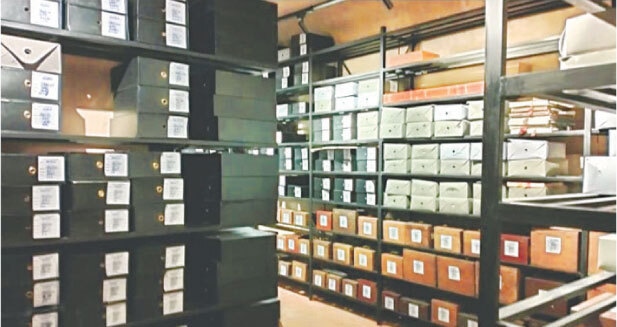
Files, micro-films and maps have been professionally cleaned, categorized, catalogued, and placed in acid-free archival boxes. These boxes are stored on non-rusting steel shelves—the global standard explicitly recommended elsewhere. No wood has been used in the room where archives are preserved.
The library section houses new and old books. These were placed on existing wooden bookshelves that were originally used by the Archaeology Department when it occupied the building. Specialized equipment to regulate temperature and humidity has been installed and is fully operational. This commitment to preserving the documents under ideal conditions is a primary goal of the project and is being met with professional-grade infrastructure.
Opening the doors to the public
It must be mentioned here that previously a library was established in the Akbari Mahal but a board was placed outside that it was not open for the public.
Equally significant is the WCLA’s emphasis on public engagement. Purpose-built seating areas have been introduced so that researchers, students and casual visitors alike can spend meaningful time in the archives. No longer has a hidden storeroom, the space been transformed into a living state of the art library, reflecting best practice in global heritage management.
The archives that were inaccessible to the public are open to the public now and students, researchers, scholars from Pakistan and all over the world are visiting the library and archives.
The library and archives of Lahore Fort now stand as a powerful example of what heritage conservation can achieve. A neglected repository, once destined for oblivion, has been systematically restored, catalogued and digitized.
The writer is Tourism and Culture director marketing at WCLA
Published in Dawn, September 13th, 2025