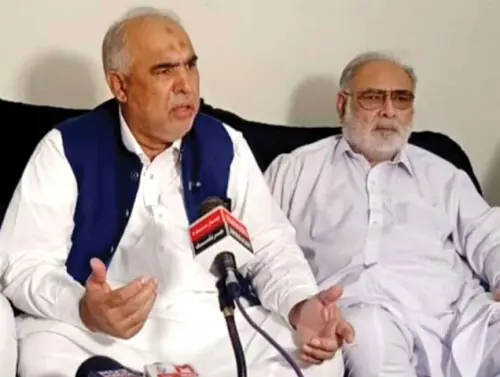
ISLAMABAD: One of the leaders of the Tehreek-i-Tahaffuz Ayeen-i-Pakistan (TTAP) opposition alliance petitioned the Supreme Court on Thursday, seeking a declaration that the Oct 31, 2024, decision of the judges’ committee under the 2023 Practice and Procedure Act — which called for fixing challenges to the 26th Amendment before a full court — was binding.
Invoking the inherent jurisdiction of the Supreme Court for the enforcement of fundamental rights under Article 184(3) of the Constitution, the petitioner Mustafa Nawaz Khokhar also pleaded for the immediate fixation of the pending challenges to the 26th Amendment before the full court, in compliance with the Oct 31 committee decision.
Filed through Advocate Shahid Jamil Khan, the petition also sought a declaration that any administrative act or explanation negating or obstructing the implementation of the committee’s order was unlawful and of no legal effect.
Mr Khokhar’s petition was filed against the backdrop of an Aug 20 letter, jointly written by senior puisine judge Justice Syed Mansoor Ali Shah and Justice Munib Akhtar, in response to the decision to make public its Oct 31, 2024, committee minutes.
Seeks enforcement of Oct 2024 decision to convene full court
Earlier, on Aug 14, two responses from Chief Justice of Pakistan (CJP) Yahya Afridi were uploaded to the court’s website, explaining why he had disregarded the committee’s decision.
The CJP argued that such a move would undermine the much-needed spirit of collegiality among judges and expose the court to public criticism, which, he said, had regrettably happened in the recent past.
Consequently, both judges wrote the joint letter stating: “The challenges to the 26th Amendment continue to remain pending and a golden opportunity to decide them at the earliest instance before the institu-tion as a whole — i.e., the full court as it then stood, has been lost, perhaps irretrievably.”
Mr Khokhar’s petition argued that under Section 2(2) of PaPA, the committee, by a majority decision on Oct 31, had directed the office to fix the challenges against the 26th Amendment before the full court on the judicial side. These directions remain lawful, valid and binding.
The petition contended that neither the registrar of the Supreme Court nor any other administrative auth-ority has the competence to dis-regard or override a lawful order of the committee.
The reasons cited by CJP in his public explanation, including informal consultation and purported jurisdictional objections, do not provide any legal basis to displace a formal decision of the committee taken by a majority under a statutory mandate, the petition contended.
Informal consultations, it argued, cannot nullify or override an official decision taken under the Practice and Procedure act.
Published in Dawn, September 5th, 2025