Murad urges political stakeholders to stop pointing finger, aid Karachi’s recovery


 0
0
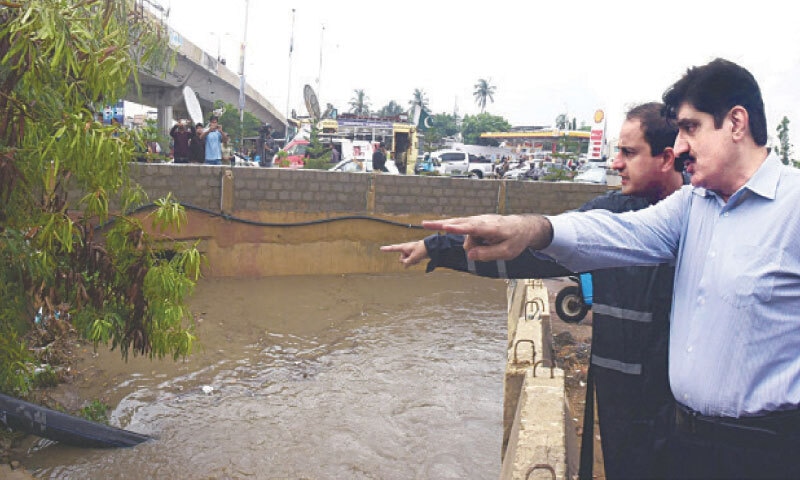
KARACHI: Expressing concern over performance of certain local bodies including towns under control of the opposition Jamaat-i-Islami (JI), Sindh Chief Minister Syed Murad Ali Shah has called upon all political stakeholders to refrain from blame games and fulfil their respective responsibilities to aid the city’s recovery.
Talking to the media and responding to a question on coordination and accountability among agencies during a visit to the city a day after heavy rain lashed the metropolis, the CM expressed concern over the performance of some local representatives, including JI’s town chairmen, particularly after the formation of town administrations, which he said had led to division and inefficiency in service delivery.
He acknowledged certain shortcomings, welcomed constructive criticism, and announced disciplinary action against officials who failed to perform.
He underlined the urgent need for modern and efficient drainage systems to mitigate the impact of extreme weather in the future, ensuring urban resilience and citizens’ safety.
CM acknowledges shortcomings in dealing with rain, vows disciplinary action against negligent officials
He said about “160 to 170 millimetres” of rain had fallen within three to four hours, aggregating to “185 to 200mm” in 12 hours — levels that naturally cause urban flooding in a densely populated city.
Despite the torrential rain, the chief minister claimed that the administration had managed to clear water from the city by late night.
Recalling the catastrophic flooding of 2020, he noted how water then had remained stagnant for over 24 hours, contrasting it with the relatively prompt drainage this time.
Addressing questions, Mr Shah said the World Bank had approved a $1.6 billion package for Karachi in 2020, with $100 million already disbursed, primarily to strengthen the Karachi Water and Sewerage Corporation.
He rejected “misleading narratives” about the funds, stressing that disbursements were phased and conditional on performance. He added that approximately Rs28 to Rs30b had been utilised transparently so far for critical water infrastructure upgrades.
Highlighting the chronic issue of fragmented road-cutting permissions issued independently by agencies such as the Cantonment Boards, KDA and KMC, he proposed establishing a “Central Road Cutting Authority” to regulate and oversee road excavation and repair, thereby preventing repeated damage to city roads.
He also pointed out that the powers of certain institutions, including the water board, had been devolved to the mayor’s office to strengthen urban governance. He praised Karachi Mayor Murtaza Wahab for enhancing resources and taking practical steps instead of merely demanding funds.
Published in Dawn, August 21st, 2025