• Chairs meeting to strengthen coordination, enhance service delivery
• Says judiciary receives only 0.3pc of Sindh’s ADP funds
KARACHI: Chief Justice of Pakistan (CJP) Yahya Afridi has asked the Sindh government to significantly enhance the budgetary allocation for the judiciary in the province to meet the requirements of a modern judicial system.
He noted that the judiciary is a fundamental pillar of the state, but its budgetary allocation in Sindh remains disproportionately low.
He observed that the district judiciary in Sindh was not only overburdened but also under-resourced in terms of logistics, infrastructure and modern facilities, and added that, as per comparative statistics of budgetary allocations for the judiciary across provinces, Sindh was lagging behind in this regard.
The CJP also underlined the need for targeted investment in judicial infrastructure, digital integration and resource enhancement, particularly in the district judiciary of Karachi, to enable faster and more efficient dispensation of justice.
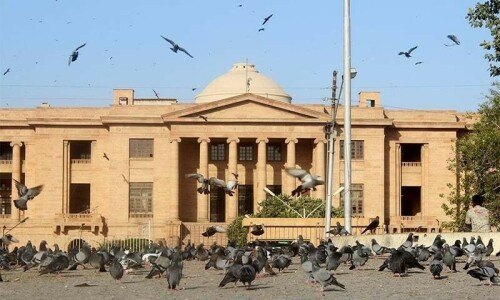
He was chairing a strategic meeting held at the Supreme Court Karachi Registry on strengthening coordination between the legal fraternity and justice sector institutions to enhance service delivery and promote participatory law and policy reforms.
Sindh High Court (SHC) Chief Justice Muhammad Junaid Ghaffar, Justice Zafar Ahmed Rajput and Justice Mohammad Iqbal Kalhoro of the SHC, Federal Law Secretary Raja Naeem Akbar, Sindh Law Minister Zia ul Hassan Lanjar, Registrar SC Mohammad Salim Khan, Chief Secretary Syed Asif Hyder Shah, Finance Secretary Fayaz Jatoi, provincial Law Secretary Ali Ahmed Baloch, Planning and Development Board chairman Sindh Najam Ahmed Shah and several other officials also attended the meeting.
According to the statements issued by the apex court, based on consultations with the district judiciary and legal fraternity, CJP Afridi identified gaps such as inadequate court facilities, insufficient solarisation and limited digital integration (including e-libraries) in certain districts of Sindh.
SHC Chief Justice Ghaffar also provided an overview of the district judiciary, highlighting existing facilities and the financial constraints it was facing, and emphasised that increasing litigation rates and population growth must be factored into budget planning to ensure adequate resourcing.
The CJP underscored that the justice sector is a fundamental pillar of the state, yet in Sindh, its budgetary allocation remained disproportionately low, amounting to only 0.3 per cent of the Annual Development Plan (ADP).
He urged the provincial government to significantly enhance this allocation to meet the requirements of a modern judicial system, noting that such a commitment must be reflected in future ADPs.
The statements also said that the CJP presented comparative statistics of budgetary allocations for the justice sector across provinces and observed that Sindh lagged behind in this regard. He also emphasised the urgent need to review and enhance the ADP allocation for the justice sector.
He further stressed that targeted investment in infrastructure, digital integration and resource enhancement, particularly in the district judiciary of the provincial metropolis, would enable faster and more efficient dispensation of justice and called upon all relevant stakeholders to collaborate in developing a comprehensive plan for the uplift of district-level judicial facilities in the province.
The CJP acknowledged the vital role of the bar in ensuring access to justice and pointed out the existing coordination gap between bar associations and the Law and Justice Commission of Pakistan (LJCP) in advancing justice sector reforms.
He also reaffirmed the LJCP’s decision to post senior-level representatives in every province, stationed at the high courts, to serve as focal points for liaison with district bar associations.
The CJP further urged the leaders of the bar to sensitise their members about these initiatives and to proactively submit proposals for infrastructure and capacity-building projects through the respective district development committees headed by district and sessions judges.
He directed that government-provided support to bar associations be streamlined, structured and duplication-free to ensure efficiency and optimal utilisation of resources.
The federal secretary law informed the meeting that allocations to bar associations were generally determined based on the number of registered lawyers.
In the case of Balochistan, the allocation has been increased from 6.3pc to 10pc, exceeding even its NFC formula share. The CJP said that the allocation for Sindh should likewise be reconsidered in light of its larger case volume and requirements.
Lawyers’ delegation calls on CJP
Meanwhile, the CJP also met with a delegation of lawyers from across Sindh comprising representatives of the Pakistan Bar Council, Sindh Bar Council and High Court Bar Association.
He also unveiled a legal aid programme designed to ensure that no litigant is left without representation.
Under this initiative, financially vulnerable litigants will be provided legal counsel at state expense at every tier of the justice system, and bar associations will be invited to nominate capable lawyers for such assignments in coordination with the judges concerned.
Published in Dawn, August 7th, 2025