Pakistan urges ceasefire, de-escalation in Russia-Ukraine war



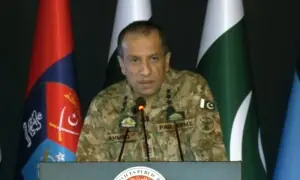
Pakistan has called for de-escalation and ceasefire in the Russia-Ukraine war and stressed that “echoes for peace must be heard” as Ambassador Usman Jadoon addressed a United Nations briefing.
“Peace in Ukraine is long overdue,” Ambassador Jadoon, deputy permanent representative of Pakistan to the United Nations, told the UN Council, which debated the situation in Ukraine on Friday after Russia invaded its neighbour in March 2022.
“The calls for ending this conflict should not be allowed to go unheard or masked by the continued drums of war,” he added, highlighting that the conflict was now four years old.
Pakistan, as a consistent advocate for peace, has called for de-escalation and giving primacy to dialogue over fighting, said Ambassador Jadoon, who at that time was chairing the 15-member meeting.
“Only a sincere and meaningful dialogue which addresses mutual security concerns of all sides, is anchored in the principles of UN Charter and international law, and respects the relevant multilateral agreements can help lead to a peace, which is durable, just and long-lasting,” the Pakistani envoy added.
“Military solution and continued escalation are akin to pursuing a dead end,” he said, adding that continued attacks have only deepened the suffering of people affected by this conflict. “Sustainable peace demands de-escalation, ceasefire, and unwavering commitment to dialogue. “
Despite the diplomatic efforts at the start of this year, including Security Council Resolution 2774 and multiple limited ceasefire understandings, Ambassador Jadoon noted that tangible progress has remained elusive.
“While prisoner exchanges and talks in Istanbul offer a glimmer of hope, it is unfortunate that the ongoing violence, death, and destruction from relentless attacks have continued to cast a shadow over the nascent and fledgling peace efforts.”
In this regard, Ambassador Jadoon underscored the need for the protection of civilians, stating that the targeting of civilians and civilian infrastructure under any pretext is unjustifiable.
“Sustainable peace demands de-escalation, ceasefire and unwavering commitment to dialogue,” he added.
Asserting that diplomacy was the only path forward, the Pakistani envoy welcomed the talks between Russia and Ukraine.
“These [talks] must translate into tangible de-escalation, and steps such as prisoner swaps should catalyse broader political negotiations, aimed at ending this conflict.”
Pakistan, he added, stands ready to support all regional and international efforts that pave the way for a peaceful resolution of the Ukraine conflict.
At the outset, a senior UN official told the Security Council that the daily barrage of Russian missiles and drones against Ukrainian cities and towns has continued to intensify, with devastating consequences for the civilian population.
Miroslav Jenca, assistant secretary-general for Europe, Central Asia and the Americas in the Departments of Political and Peacebuilding Affairs and Peace Operations, said that civilian casualties in Ukraine reached a three-year high in June, citing the Office of the United Nations High Commissioner for Human Rights (OHCHR).
According to Ukrainian authorities, Russia has launched at least 5,183 long-range munitions against Ukraine in July, including a record number of 728 long-range drones on July 9.
Recalling that delegations from both countries recently met in Istanbul for the third time in 2025, the UN official urged that ongoing diplomatic contacts be sustained.
However, he urged that they be “reinforced by genuine political will to make tangible progress towards ending the current dangerous cycle of escalation as soon as possible”.
On her part, Joyce Msuya, assistant secretary-general for Humanitarian Affairs and Deputy Emergency Relief Coordinator, said, “There is no safe place left in Ukraine,” emphasising that “the use of explosive weapons in populated areas — including long-range missiles and drones — remains a key driver of civilian harm”.
Civilians in Ukraine continue to bear the heaviest burden, struggling to access food, water, power, and healthcare. “Nearly 13 million people need assistance, but limited funding means we can reach only a fraction of them,” she reported, adding: “For many displaced women and girls, safety remains out of reach.”
She also said that the continued use of anti-personnel mines puts civilian lives and livelihoods at daily risk. She noted with alarm “the recent decree by the Ukrainian president announcing his country’s withdrawal” from the Convention on the Prohibition of the Use, Stockpiling, Production and Transfer of Anti-Personnel Mines and on their Destruction, which prohibits the use of these munitions.