0
0

The James Bond franchise has lain dormant for four years, since Daniel Craig’s swansong as 007, No Time to Die. A legal quarrel between Bond’s producers, Michael G. Wilson and Barbara Broccoli, and Amazon Studios resulted in a stalemate and production on a new Bond film has remained in limbo.
Nevertheless, speculation has been rife about which actor will next play Ian Fleming’s super-spy (the latest actor to be associated with the role is former Spider-man Tom Holland).
When news surfaced in February 2025 that Amazon MGM (Amazon purchased MGM in 2021) had effectively become Bond’s new custodians, critics and audiences alike expressed concern — to put it lightly. Many feared that Jeff Bezos was more interested in stimulating Amazon Prime membership by driving multiple content streams through spin-offs and merchandising than protecting Fleming’s legacy.
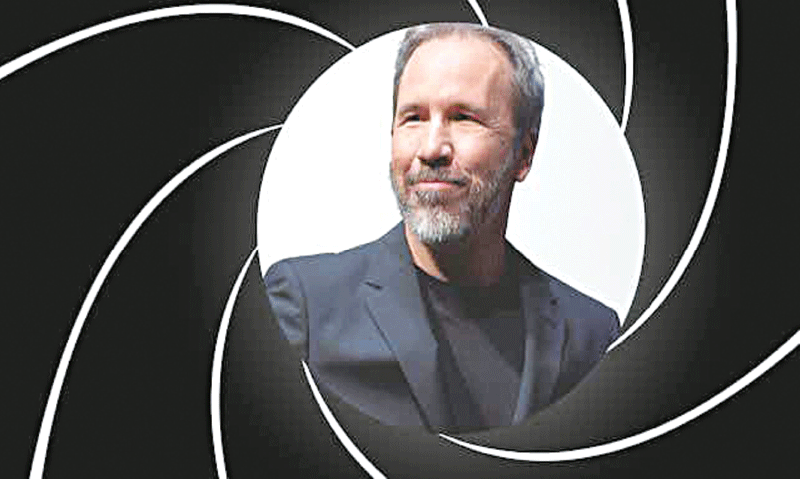
However, last week’s announcement that Denis Villeneuve has been appointed as the director of the 26th Bond film is a savvy move. It’s a declaration of intent that seeks to promote and market Amazon MGM as a safe harbour for the Bond franchise.
Dune director Denis Villeneuve will helm the next Bond film — but what will his 007 be like?
The announcement positions the next era of Bond as a prestigious exercise helmed by “a cinematic master”, not a journeyman director. Villeneuve was previously offered the opportunity to direct No Time to Die, but turned the role down because of his commitment to the Dune films.
By appointing Villeneuve, Amazon has managed to radically shift the public debate. Villeneuve is “much more than a technical director”, wrote Guardian film critic Peter Bradshaw. “He is an alpha-grade auteur in the same league as Christopher Nolan.”
Other critics have pointed to his rare ability to “combine blockbuster momentum (and ticket sales) with the finer, more nuanced sensibilities of a filmmaker always concerned with slowing down, honing in on character and theme.”
Although Sam Mendes, director of Skyfall (2012) and Spectre (2015), came with artistic status, Villeneuve is something different — a marquee name frequently described as an auteur.
Since his transition from making mostly low-key independent films in his native Canada to his arrival in Hollywood with Prisoners (2013)— starring Hugh Jackman and Jake Gyllenhaal — Villeneuve has amassed an impressively eclectic filmography.
He has proven that he is as comfortable shooting realistic crime thrillers (Sicario, 2015) and surrealist cinema that David Lynch would be proud of (Enemy, 2013), as he is with science fiction (Arrival, 2016; Blade Runner 2049, 2017; and the Dune films, 2021 and 2024).
Villeneuve’s Bond
Although Sicario may be the closest in terms of genre to the Bond films, establishing Villeneuve as a director who can expertly shoot action sequences, it is nevertheless difficult at this stage to conceptualise what a Villeneuve Bond film might be like.
Some critics have suggested that the director’s cinematic resume, eclectic as it is, might not bode well for Bond. The Hollywood Reporter’s film critic Benjamin Svetkey, for instance, worries that Villeneuve’s “lugubrious, meditative filmmaking” is sorely lacking in humour — which could be fatal for 007. “A certain amount of wit and winking is critical to the character,” he claims.
It is early days for Amazon MGM and Villeneuve. As yet, there is reportedly no treatment, no script, no writer and — more pointedly — no actor appointed to the role. Whatever happens, the 26th Bond film is likely to be a hard reboot that wipes the slate clean (again) after the fate of 007 in No Time to Die.
Although Villeneuve has said that he intends to honour tradition and that Bond is “sacred territory” for him, Bond’s capacity for revision and regeneration has been key to the franchise’s longevity.
As sociologists Tony Bennett and Janet Woollacott argue in their seminal study, Bond and Beyond, the figure of Bond has, over the past six decades, “been differently constructed at different moments”, with “different sets of ideological and cultural concerns.”
So what kind of Bond film Villeneuve ends up directing largely depends on the story and whichever actor is anointed as the next James Bond. It is doubtful that audiences will expect a campy pantomime Bond such as Roger Moore, or a Bond with an invisible car, such as Pierce Brosnan in the cartoonish Die Another Day (2002). Villeneuve’s choice of Casino Royale as his favourite 007 may provide a clue. But it is also unlikely that the director will be satisfied with slavishly repeating the past.
The writer is an Associate Professor in Popular Culture at Bournemouth University in the UK
Republished from The Conversation
Published in Dawn, ICON, July 13th, 2025