THE Constitutional Bench’s most recent decision is an attempt to provide legal closure, but it may just engender another crisis. On Friday, the bench overturned the Supreme Court’s earlier judgement in the reserved seats case, effectively foreclosing the possibility of correcting the imbalance created by the ECP’s controversial decisions during the conduct of the last general election.
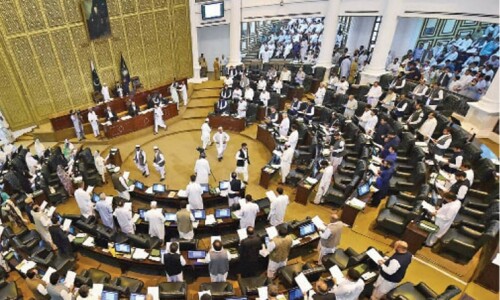
Holding the Sunni Ittehad Council ineligible for reserved seats, the bench has paved the way for these to be divided among other parties. Consequently, the ruling coalition will control more than two-thirds of the National Assembly, solidifying its grip on power. An unfortunate precedent has been set, however.
The efforts of a high-powered Supreme Court bench to restore political rights, which were denied as a consequence of the ‘bat symbol’ judgement, have been undone by a fresh set of judges. Many will criticise the ruling for focusing too narrowly on technicalities while overlooking the broader constitutional and political context.
There is much that continues to be unpacked about why and how the reserved seats became an issue, and the judiciary’s role in precipitating the electoral crisis that led to this point will long be debated.
Still, in their judgement in the original case, even the Supreme Court judges who had disagreed with the majority verdict had conceded that the ECP acted illegally when it blocked a major political party from contesting the elections as a single entity and forced its candidates to run as independents.
But even though the illegality of this action was well established, the Commission circumvented the law once again by refusing to execute the restorative measures ordered.
One would have expected the ECP to be chastised for its conduct, but instead, the Constitutional Bench — whose formation and constitution are perceived as having been enabled by stakeholders who directly benefited from the ECP’s wrongful actions — has now granted legal cover to this misconduct. Questions will be raised.
With the government now having enough lawmakers on its benches to do as it pleases, the elected representatives can breathe easy. Those not aligned to the ruling coalition no longer need to worry about harassment, threats and abductions whenever the Constitution needs to be rewritten, as was seen in the passage of the 26th Amendment.
It also seems worth recalling some of the warnings from that time, which, in retrospect, seem to have been justified. The Constitutional Bench, one of the amendment’s most visible by-products, has, since its inception, endorsed military trials for civilians, executive interference in judicial appointments, and, most recently, the perversion of the electoral process. With the balance of power becoming ever more skewed, the Pakistani people should worry about being sidelined from their right to have a say in their own destiny.
Published in Dawn, June 29th, 2025