India rejects SCO document over Pahalgam ‘snub’


 0
0
• New Delhi wanted concerns on terrorism reflected in joint statement, but ‘walked away’ after exclusion of held Kashmir attack from communiqué
• Pakistan claims diplomatic success, says India faces isolation; China downplays ‘breakdown’ of consensus
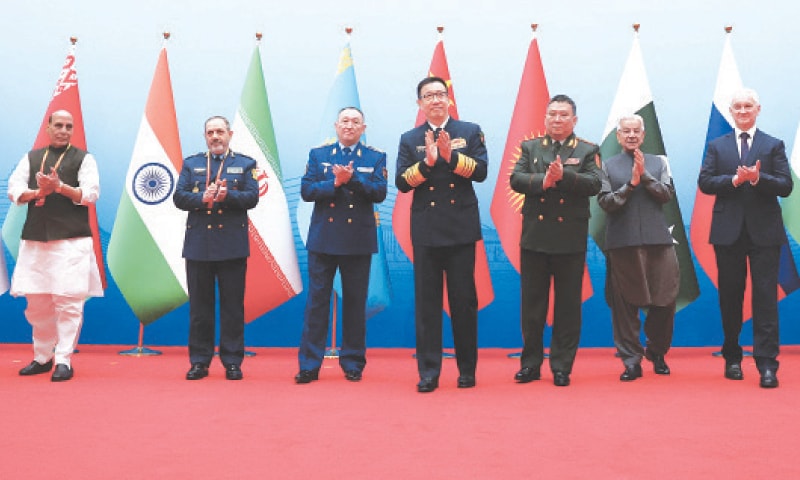
ISLAMABAD: What was expected to be the Shanghai Cooperation Organisation’s (SCO) routine annual reaffirmation of commitment to collective security, regional stability and cooperation, ended in discord on Thursday.
The defence ministers of the 10-member Eurasian bloc failed to adopt a joint communiqué — a rare outcome for a group that prides itself on consensus-based decision-making.
The stumbling block was a deepening rift between India and Pakistan, with New Delhi refusing to sign the statement over exclusion of language referring to the April 22 Pahalgam attack in occupied Kashmir, which led to a military escalation between the two countries in May.
The meeting in Qingdao, hosted by China, aimed to project strength and cohesion ahead of the SCO Heads of State Summit later this year. Instead, it exposed fault lines that have long simmered beneath the surface, particularly between India and some of the other members of the group, but are now increasingly impossible to paper over.
In his address at the SCO meet, Indian Defence Minister Rajnath Singh mentioned that a terror group, The Resistance Front (TRF), had carried out a “dastardly and heinous attack” on innocent tourists at Pahalgam. India claims TRF is a proxy of the United Nations-designated Lashkar-e-Taiba and that the group had claimed responsibility for the attack.
“Peace and prosperity cannot co-exist with terrorism and proliferation of weapons of mass destruction in the hands of non-state actors and terror groups. Dealing with these challenges requires decisive action,” Mr Singh said.
“It is imperative that those who sponsor, nurture and utilise terrorism for their narrow and selfish ends must bear the consequences. Some countries use cross-border terrorism as an instrument of policy and provide shelter to terrorists. There should be no place for such double standards. SCO should not hesitate to criticise such nations.”
Randhir Jaiswal, spokesperson for India’s Ministry of External Affairs, also confirmed the impasse. “We understand that the member countries could not reach consensus on certain issues and hence the document could not be finalised,” the spokesperson said in New Delhi.
“India wanted concerns on terrorism reflected in the document, which was not acceptable to one particular country. As such, the joint statement was not adopted.”
‘Diplomatic isolation’
Pakistan avoided a direct response. Instead, an official, asking not to be named, triumphantly declared: “India faced diplomatic isolation at the Shanghai Cooperation Organisation meeting, where Pakistan achieved significant success.”
He added, “India failed to link the Pahalgam incident to Pakistan in the joint communiqué, declined to sign the communiqué to cover its embarrassment, received no support from any member state on the Pahalgam issue, and also stood alone in its differing stance on Israeli aggression against Iran.”
China, the host and current chair, tried to downplay the rupture. “China is willing to work with all SCO member states to adhere to the original aspiration of the organisation, carry forward the ‘Shanghai Spirit,’ firmly safeguard international fairness and justice, jointly address security challenges, and promote steady and far-reaching defence and security cooperation,” Chinese Defence Minister Dong Jun said diplomatically, making up for the absence of the communique.
What makes this breakdown more striking is that just days earlier, the SCO’s National Security Advisers’ meeting, held in Beijing, had reportedly achieved consensus on the very issues that later proved divisive. According to diplomatic sources, that internal (and unpublished) document, agreed upon by the NSAs, acknowledged both the Pahalgam attack and foreign involvement in the insurgency in Balochistan, notably the Jaffar Express attack.
The understanding at the NSA level was clear, as per which both countries’ concerns would be reflected in parallel, avoiding blame-casting while recognising regional security threats. But when it came to the public-facing defence ministers’ document, Pakistan objected to the mention of the Pahalgam incident, fearing it would be seen as criticism, and India walked away.
India’s decision to break ranks at Qingdao was not an isolated act.
Almost a fortnight ago, India had declined to endorse an SCO statement condemning Israeli airstrikes on Iran, also an SCO member, just because it explicitly named Israel as the aggressor. Last year, Indian PM Narendra Modi skipped both the summit in Kazakhstan and the heads of government meeting in Islamabad.
In 2023, India pulled out of the group’s 2030 Economic Development Strategy, calling it too China-centric.
These moves reflect India’s overall approach to the SCO. New Delhi is increasingly sceptical of the organisation’s utility, seeing it as a China-dominated platform with limited room for Indian influence.
It had primarily joined the bloc to build ties with Central Asian states, but is uncomfortable with the prospect of being seen as endorsing positions that could alienate Western partners like the United States and Israel or not serve its own interests.
The cost of this alienation is growing. The SCO operates on consensus, with everyone agreeing to a common language. India’s repeated refusal to compromise risks isolating it within the group, lowering its standing in the bloc and raising questions about its commitment to Eurasian multilateralism.
For Moscow and Beijing, who see the SCO as a cornerstone of their vision for a multipolar world order, India’s behaviour is a source of frustration. Russia, already bogged down in Ukraine and dependent on multilateral forums for diplomatic legitimacy, relies on the SCO to show it still matters. China, which sees the bloc as a strategic tool for advancing its interests in Central Asia and pushing back against Western influence, cannot afford repeated disruptions.
Our correspondent in New Delhi also contributed to this report
Published in Dawn, June 27th, 2025