Pope Francis’ funeral draws thousands, cardinal says his legacy must survive



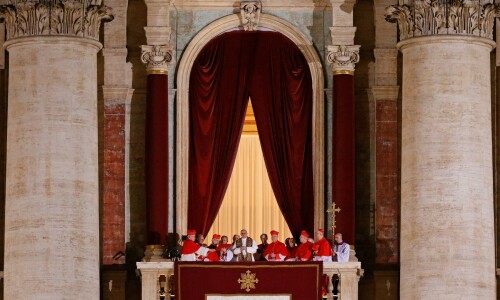
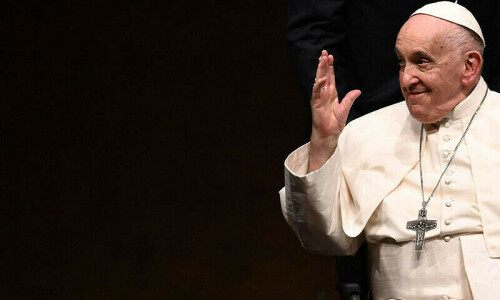
Presidents, royalty and a multitude of simple mourners bade farewell to Pope Francis on Saturday at his funeral, where a cardinal said the pontiff’s legacy of caring for migrants, the downtrodden and the environment must not die with him.
On one side of Francis’ coffin in the vast St. Peter’s Square sat US President Donald Trump, who had clashed with the pope on those issues.
“Rich in human warmth and deeply sensitive to today’s challenges, Pope Francis truly shared the anxieties, sufferings and hopes of this time,” said Italian Cardinal Giovanni Battista Re, who presided over the funeral Mass.
The Argentine pope, who had reigned for 12 years, died at the age of 88 on Monday after suffering a stroke.
The crowd, who crammed the square and the roads around, broke into applause when Re spoke of Francis’ care for immigrants, his constant pleas for peace, the need for negotiations to end wars and the importance of the climate.
They clapped loudly again at the end of the service when the ushers picked up the casket and tilted it slightly so more people could see, the church bells tolling in the background.
The coffin was placed on an open-topped popemobile and driven through the heart of Rome to St. Mary Major Basilica, with thousands of people lining the route.
Francis, who shunned much of the pomp and privilege of the papacy during his 12-year reign, had asked to be buried there rather than in the crypt of St. Peter’s, which is the traditional resting place for popes.
“Thank you, thank you, thank you,” one woman in the crowd shouted.
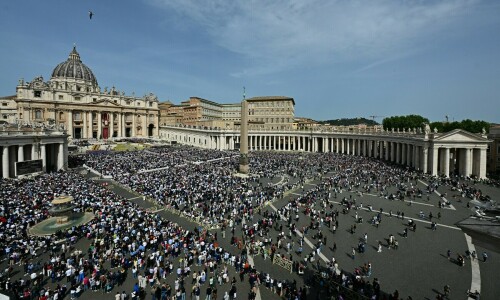
Aerial views of the Vatican during the funeral showed a patchwork of colours — black from the dark garb of the world’s leaders, red from the vestments of some 250 cardinals, the purple worn by some of the 400 bishops and the white worn by 4,000 attending priests.
Choirs sang Latin hymns and prayers were recited in various languages, including Italian, Spanish, Chinese, Portuguese and Arabic, reflecting the global reach of the 1.4-billion-member Roman Catholic Church.
The Vatican estimated more than 250,000 people attended the ceremony, which lasted two hours.
Among the heads of state who flew into Rome were the presidents of the United States, Ukraine Argentina, France, Gabon, Germany, the Philippines and Poland, together with the prime ministers of Britain and New Zealand, and many royals, including the king and queen of Spain.

Francis’ death ushered in a meticulously planned period of transition, marked by ancient ritual, pomp and mourning. Over the past three days, around 250,000 people filed past his body, laid out before the altar of the cavernous basilica.
The faithful hurried to the Vatican from the early hours while many camped out to try to secure spots at the front of the crowd.
“When I arrived at the square, tears of sadness and also joy came over me. I think I truly realised that Pope Francis had left us, and at the same time, there is joy for all he has done for the Church,” said a French pilgrim, Aurelie Andre.
Breaking tradition
Francis, the first non-European pope for almost 13 centuries, battled to reshape the Roman Catholic Church, siding with the poor and marginalised, while challenging wealthy nations to help migrants and reverse climate change.
“Francis left everyone a wonderful testimony of humanity, of a holy life and of universal fatherhood,” said a formal summary of his papacy, written in Latin, and placed next to his body.
Traditionalists pushed back at his efforts to make the Church more transparent, while his pleas for an end to conflict, divisions and rampant capitalism often fell on deaf ears.
The pope carried his desire for greater simplicity in the papacy into his funeral, having rewritten the elaborate, book-long funeral rites used previously.
He also opted to forego a centuries-old practice of burying popes in three interlocking caskets made of cypress, lead and oak. Instead, he was placed in a single, zinc-lined wooden coffin, which was sealed closed overnight.
In a further break with the past, he will be the first pope to be buried outside the Vatican in more than a century, preferring St. Mary Major, some 5.5 kilometres from St. Peter’s.
His tomb has just “Franciscus”, his name in Latin, inscribed on the top. A reproduction of the simple, iron-plated cross he used to wear around his neck hangs above the marble slab.
Italy mounted one of the biggest security operations the country has seen since the funeral of John Paul II. It closed the airspace over the city and called in extra security forces, with anti-aircraft missiles and patrol boats guarding the event.
As soon as Francis is buried, attention will switch to who might succeed him.
The secretive conclave to elect a successor is unlikely to begin before May 6, and might not start for several days after that, giving cardinals time to hold regular meetings beforehand to sum each other up and assess the state of the Church, beset by financial problems and ideological divisions.