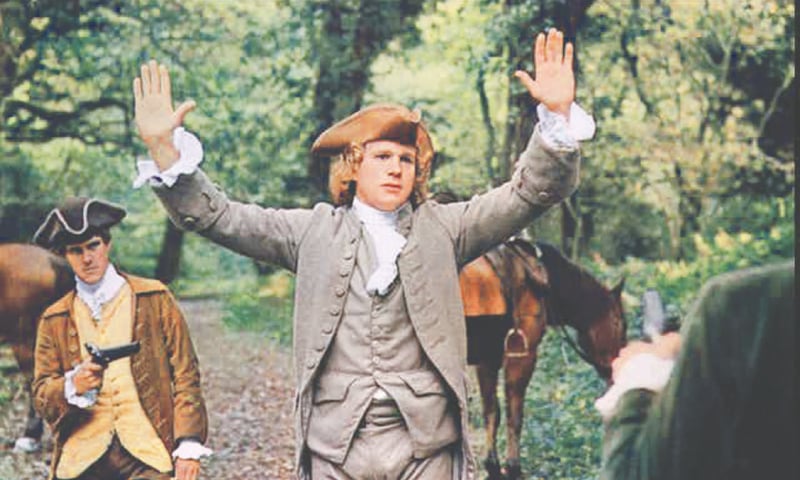
Stanley Kubrick’s Barry Lyndon, which marks its 50th anniversary this year, struggled at the box office when it was released. It remains one of the director’s most under-appreciated films.
Unlike 2001: A Space Odyssey or The Shining, which have been endlessly dissected in books and essays, Barry Lyndon has received relatively little scholarly attention — just a single book.
Perhaps its cool reception can be traced to its slow, contemplative pacing, its meticulously crafted but emotionally restrained storytelling, or its three-hour runtime. It also arrived at an inopportune moment, in the same year as Jaws, a film that would reshape Hollywood forever.
Yet, Barry Lyndon deserves a second look, not only as one of Kubrick’s most visually striking films but also as an intensely personal project that offers rare insight into the director himself.
Barry Lyndon came out 50 years ago. It may be Stanley Kubrick’s most overlooked masterpiece and deserves another viewing
The film follows the rise and fall of Redmond Barry, an ambitious Irishman who reinvents himself as Barry Lyndon in his pursuit of wealth and status. After fleeing his homeland following a duel, Barry navigates the treacherous world of 18th-century Europe.
He serves as a soldier, a gambler and ultimately marries into aristocracy. However, his social ascent is marred by personal missteps, betrayals and the cold realities of high society.
The project was born out of failure. Kubrick had spent years preparing for a grand epic about Napoleon, amassing an enormous archive of research and developing meticulous pre-production plans. But no studio was willing to finance the project. Unwilling to abandon his obsession with the late 18th century, he turned instead to The Luck of Barry Lyndon, a lesser-known 1844 novel by William Makepeace Thackeray.
The choice of Thackeray was in keeping with his taste for English writers such as Arthur C. Clarke (2001) and Anthony Burgess (A Clockwork Orange). But this was a leap.
Those previous writers were contemporaries and, Paths of Glory and Spartacus apart, nearly all of Kubrick’s previous films took place in the recent past, near present, or the future. Now he would try his hand at what would essentially be a costume drama. He would be recreating the past rather than creating the future.
Some saw Barry Lyndon as a mere consolation prize. The film critic Alexander Walker called it a project “born on the rebound”, while production designer Ken Adam described it as a “dress rehearsal” for Napoleon. But Kubrick’s fascination with the Napoleonic era was evident in the film’s DNA.
Thackeray himself had been fascinated by the French emperor, incorporating him into his novel Vanity Fair, and writing The Second Funeral of Napoleon in 1841. Barry Lyndon draws heavily from the same historical themes, exploring the illusions and brutal realities of social ambition.
What captivated Kubrick about Thackeray was his ability to expose the cruelty beneath the polished facade of aristocratic life. The rigid etiquette of the 18th century — a period described variously as an age of gentility, sensibility and enlightenment — demanded an emotional detachment that fascinated the director.
Thackeray was, in many ways, a 19th-century sociologist, dissecting the class system, conspicuous consumption and the mercenary nature of marriage. These themes resonated deeply with Kubrick, whose films often explored power structures, status and manipulation.
An outsider’s perspective
Some critics have noticed a similarity between Kubrick and his lead character. As an American Jew living in north London, married to a German woman, Kubrick felt one step removed from the society around him, perhaps even somewhat of a social pariah. Ryan O’Neal’s casting as Barry was largely a commercial necessity — Kubrick needed a bankable star — but it also added a personal layer.
Like Kubrick, O’Neal’s Barry is an outsider, the lone American in a European cast, a social climber forever out of place. The novel’s narrator observes that “those who’ve never been out of their country…” lack a certain perspective. It was something that Kubrick, a Bronx-born autodidact who had taught himself everything from chess to classical music, could surely relate to.
This theme of the outsider striving for greatness runs through much of Kubrick’s work. In 1960, he spoke admiringly of “the outsider who is passionately committed to action against the social order”, whether criminals, maniacs, revolutionaries or dreamers.
From Johnny Clay in The Killing to Colonel Dax in Paths of Glory, and from Spartacus to Alex DeLarge in A Clockwork Orange, Kubrick’s protagonists are often men on the fringes of society. Barry Lyndon fits this mould perfectly, though his ambitions ultimately lead to his downfall.
But Barry Lyndon is also, unexpectedly, one of Kubrick’s most emotional films. For all its detachment, it contains what might be his most heartbreaking scene, namely Barry’s devastation at the death of his son. In this moment, the film’s rigid, painterly compositions soften, revealing a rare vulnerability in Kubrick’s work.
Ultimately, Barry Lyndon was more than a historical exercise. It was a deeply personal film, pursued at great financial and artistic risk. Kubrick created a film that is as much about social mobility and exile as it is about 18th-century Europe.
If 2001 is a space odyssey, Barry Lyndon is a spatial odyssey, a film that turns the past into something mesmerising yet achingly real.
The writer is a Professor of Film Studies at Bangor University in the UK
Republished from The Conversation
Published in Dawn, ICON, April 20th, 2025