0
0
While expressing optimism about the results of policies that the government has implemented in agreement with the International Monetary Fund (IMF), Finance Minister Muhammad Aurangzeb said, “We remain committed to staying the course and continue to execute structural reforms with respect to taxation, energy and state-owned enterprises to put our country on the trajectory of sustainable productivity and export-led growth.”
The country’s economy grew by a paltry 1.7 per cent during the second quarter of this fiscal year, propelled mainly by the services sector, with productive sectors — agriculture and industry — facing severe challenges.
Moreover, the average growth rate during the first half of the fiscal year, an analyst notes, stood at approximately 1.5pc, far below the population growth, highlighting concerns regarding the economy’s ability to generate sufficient jobs to address the expanding youth labour force.
Approximately 1.3m better-educated young Pakistanis enter the labour market each year. The World Bank’s recent report ‘From Swimming in Sand to High and Sustainable Growth’ notes that “Pakistan’s inability to allocate all its talent and resources to the most productive uses has stunted economic growth.”
The World Bank, it may be worth mentioning here, announced on March 26 to shift its regional management teams from Washington to hub offices around the world, a move aimed at helping the bank respond better and more quickly to local needs.
Prime minister reiterates the need for Pakistan to break free from its IMF reliance, stating that countries ‘do not prosper’ under the Fund’s programme
An IMF mission is reportedly scheduled to visit Pakistan in early May for the finalisation of the budget for FY26, including taxation measures and curtailing unbridled expenditures.
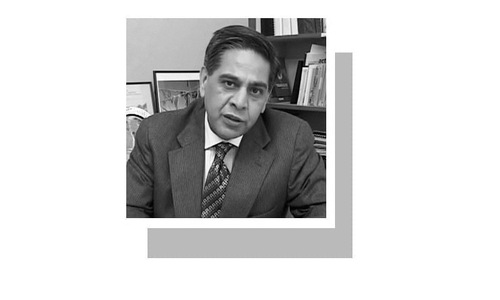
While welcoming the government’s decision to allocate a sum of £190 million released by the Supreme Court of Pakistan for investment in emerging technologies, Dr Ishrat Husain notes that this amount is earmarked for setting up a new university covering 100 acres in Islamabad.
Universities are not known for their brick-and-mortar development and expanse, he argues, but for their contribution to society and the economy. Pakistan, fortunately, has at least a dozen or more leading universities in these fields. These universities have facilities, faculty, and research students who can contribute to the goals specified for the new university. But they are starved of operational funds.
Approximately 1.3m better-educated young Pakistanis enter the labour market each year
Dr Husain spells out a more cost-effective, firmly anchored and sustainable model to use earmarked funds, based on better resource utilisation, that aims to spread the fixed costs of existing universities over larger variable costs through the provision of competitive research grants.
Thus, the underutilised capacity of these universities, due to the paucity of funds, can be optimised with quick results; the incremental capital costs would be negligible. The setting up of a brand new university involving huge upfront costs of constructing a campus, recruiting faculty and purchasing, installing and operationalising equipment would take at least four to five years.
Addressing the launching ceremony of the PM Digital Youth Hub in Islamabad, the prime minister reiterated the need for Pakistan to break free from its reliance on the IMF, stating that countries “do not prosper” under the IMF’s programme. It may be added here that despite the slowing down of the release of refunds, the tax shortfall widened by Rs725 billion during the first nine months of the current financial year.
And the international environment for economic growth is getting worse. Pakistan’s hard-won macroeconomic stability is a short distance from a deeper crisis, says a Dawn editorial on the agreement reached with the IMF mission.
That said, some are pinning hope on a ‘silent revolution’ that is gradually but fundamentally changing political life throughout the Western world (and also in Pakistan).
Published in Dawn, The Business and Finance Weekly, April 7th, 2025