ISLAMABAD: While militant attacks dropped by seven per cent in September, the third quarter of 2024 saw a sharp increase in fatalities with 90 per cent surge in violence.
These are the crux of two security reports released by Conflict and Security Studies (PICSS) and Centre for Research and Security Studies (CRSS).
According to PICSS monthly report, the country’s security situation showed a relative improvement in September compared to August. The report indicates a seven per cent reduction in militant attacks, alongside a significant 56 per cent drop in fatalities.
However, there was a slight seven per cent increase in the number of injured individuals.
According to the database, militants carried out 77 attacks across the country in September this year, resulting in 77 fatalities. These included 38 security personnel, 23 civilians, and 16 militants. Additionally, 132 people were injured, including 78 civilians and 54 security personnel.
State writ over vast parts of Balochistan, KP has considerably deteriorated, PICSS, CRSS reports say
In response, the country’s security forces neutralised 34 suspected militants and arrested 16 others.
Khyber Pakhtunkhwa remained the most affected region, accounting for the bulk of militant activity, with 47 reported attacks. These incidents resulted in 54 deaths and 79 injuries.
The former Federally Administered Tribal Areas (Fata), now merged into KP, were particularly hit the hardest. The region witnessed 26 militant attacks, resulting in 37 fatalities and 70 injuries. This marked a noticeable rise from August when 16 attacks resulted in 32 deaths in the same area.
Mainland KP, meanwhile, saw 21 attacks that claimed the lives of 17 people and left nine injured. Compared to August, the pattern of violence remained largely consistent in this part of the province.
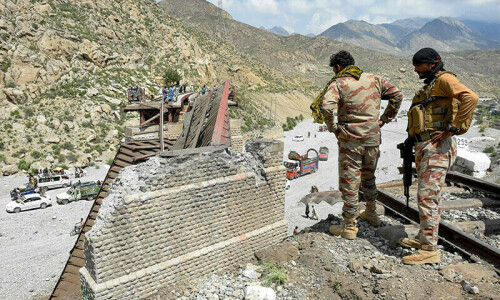
Balochistan saw a significant reduction in militant activity following a surge in August. In September, the province witnessed 27 attacks, leading to 22 deaths and 48 injuries.
This represents a substantial decrease from the 43 attacks, 125 deaths, and 77 injuries recorded in August.
The downward trend in Balochistan offers a glimmer of hope after a particularly violent period the previous month.
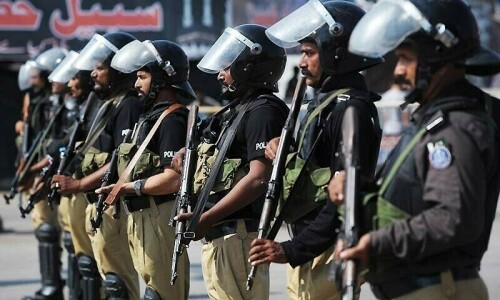
Punjab, although relatively quieter in terms of attacks — with only three incidents reported — faced mounting threats from militants. This escalation has kept the Counter-Terrorism Department (CTD) of Punjab Police on high alert, especially in districts bordering southern KP, such as Mianwali and Dera Ghazi Khan, which are experiencing increased militant pressure.
Notably, no militant attacks were reported in Sindh, Islamabad, Azad Jammu and Kashmir, or Gilgit-Baltistan in September 2024.
According to report of CRSS, third quarter of 2024 saw a sharp increase in fatalities of terrorist violence and counter-terrorism campaigns, with a 90pc surge in violence.
A total of 722 people were killed, including civilians, security personnel, and outlaws, while 615 others were wounded in as many as 328 incidents recorded during the period under review.
Nearly 97pc of these fatalities occurred in Khyber Pakhtunkhwa and Balochistan, marking the highest percentage in a decade, and over 92pc of these terror attacks and security forces’ operations were recorded in the same provinces.
The total fatalities from three quarters of this year have now surpassed the total deaths recorded for the entire 2023; the number of fatalities rose to at least 1,534 in the first three quarters compared to 1,523 in 2023.
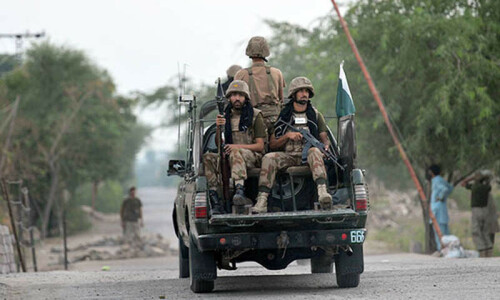
Despite the security forces’ continued anti-terror campaign, on an average at least 112 intelligence-based operations daily (as claimed by ISPR chief Maj Gen Ahmed Sharif on July 22), the state writ over vast swaths of Balochistan and KP has considerably deteriorated, with staggering numbers of victims — both security officials and civilians.
Open outrage by political leaders, people at large and even police — particularly in Lakki Marwat, Bannu and Swat — against the increasing incidents of target killings and the helplessness of the civilian law enforcement also underscores the aggravating security situation, with police increasingly expressing distrust in the military’s control of anti-terror operations.
This has invariably eroded the state authority and widened the wedge between the public and the security apparatus.
Meanwhile, terrorist groups continue to reorganise and beef up their ranks. Unverified reports indicate that the number of militant groups aligned with the banned Tehreek-i-Taliban Pakistan (TTP) has swelled to 60, with the latest addition being members of the Naeem Bukhari group from Lashkar-i-Jhangvi, based in Karachi.
While Punjab and Sindh witnessed a decline in attacks and fatalities, violence in KP and Balochistan surged dramatically, recording a 77pc and 159pc respective increase in violence.
Published in Dawn, October 2nd, 2024