0
0

While pursuing structural reforms to remove macroeconomic imbalances, the federal government is simultaneously trying to step up the pace of economic growth critical for improving the economy’s fundamentals on a durable basis.
The overriding challenge in sluggish economic growth and development — along with rising inequality and poverty — is the all-pervasive, confrontationist and divisive politics that have been created.
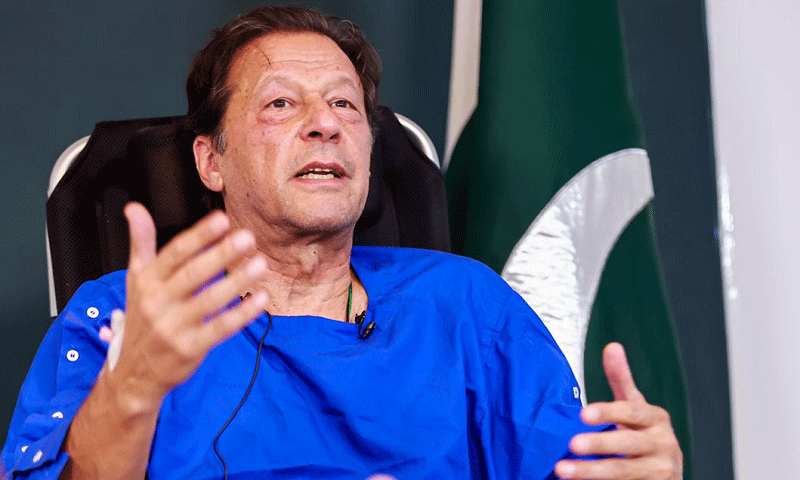
“Foreign and local investors are afraid of investing in Pakistan because of political instability,” Punjab Chief Minister Mariam Nawaz said on April 6. On the same day, former prime minister Imran Khan told newsmen he was willing to meet anyone since the country was passing through a difficult phase. “Some PTI leaders,” he added, “are still in contact with the establishment”.
In the international arena, the negative global economic trends triggered by international geopolitics indicate that the world will remain in a low growth trap. “How much growth we can get is definitely less than in the past,” says Dani Rodrik, an economist whose research revolves around globalisation, economic growth and development, and political economics.
Changes in supply chains, trade, and tech have upset export-led growth models, inducing poor nations to search for new ways to gain wealth, wrote Patricia Cohen of The New York Times in a recent news analysis. It may be noted here that the US and China have agreed to hold “intensive exchanges on balanced growth in joint efforts to stabilise rocky ties between the two economies.”
Pakistan is in dire need of unified efforts of disagreeing parties along with international cooperation to catalyse national transformational change
“We have a much clear understanding of our common interests to forge a new era of cooperation at the global scale,” wrote Jaffrey D. Sachs in the chapter ‘Guiding Globalisation in the Twenty-First Century’ in his book The Ages of Globalisation: Geography, Technology and Institutions.
He elaborated, “Our common fate means a global society strengthened by distinctive cultures in a world made safe for diversity. Interdependence obliges us to think of one world with a common plan — for dealing with environmental and social problems which cannot be resolved by unilateral actions on the part of individual countries.”
To discover the correction course, there is also a strong view that ‘adversarial collaboration’ should embrace all kinds of organisations. Indeed, one may add, views challenging the outdated ideas hindering future progress are often unjustifiably suppressed.
Nobel Prize winner, the late Daniel Kahneman, insisted on the value of working together with those we disagreed. That is especially true in the midst of political campaigns, he argued, when the whole point is to win.
Within organisations of all kinds — including corporations, non-profits, think tanks and government organisations — the eminent scholar believed sustained efforts should be made to lower the volume by isolating points of disagreement and specifying tests to establish what is right.
Harvard professor Cass R. Sunstein, who authored Noise along with Mr Kahnerman and Oliver Sibony, wrote in the Times, “The idea of adversarial collaboration has never been more important.”
‘It is time to let every institution work within its constitutional mandate — let each do his own work’
Asking how a disagreement might actually be resolved tends to turn enemies, who are focused on winning and losing, into teammates who are focused on truth.
Amidst disagreements, a Pakistani consultant (who does not want to be identified) who advises a firm on how to improve its operations says the two sides partially succeeded in evolving a common approach, resulting in an increase in productivity.
On a macro level in Pakistan, the Business Recorder re-emphasised the need for “greater dialogue among all stakeholders, including the country’s establishment, without any loss of time” in an editorial titled ‘Quest for Higher Economic Growth.’
In search of political stability, defence and security, analyst Shahzad Chaudhry says, “It is time to let every institution work within its constitutional mandate. People should be the final arbitrator to determine if they (politicians) fail. It is time to trust their collective wisdom. Let each do his own work.”
To quote Mr Sachs, “It is best to provide public goods at the most local level of governance feasible.” He points out that local governance enables more local participation by the people directly affected, paying local attention to local conditions.
While human capital is recognised as a critical factor for enhancing productivity and economic growth, Pakistan has become the poorest-income country with a low human development rating of 164, according to Samuel Rizk, the Resident Representative of the United Nations Development Programme (UNDP) in Pakistan. He sees inequality expanding.
The UNDP’s Human Development Index measures three aspects of human development: a long and healthy life, access to education and a reasonable standard of living.
Pakistan is facing a growing human development crisis, with most indicators of literacy, education, health and other aspects of human welfare deteriorating in recent years, says Dr Asad Sayeed, Senior Research Associate at Collective for Social Science Research.
There is a growing realisation that international cooperation, free from hegemonic pursuit, is required to rapidly adopt of the latest technologies and innovative ideas to serve as a catalyst for transformational change.
Published in Dawn, The Business and Finance Weekly, April 15th, 2024