Pacific nation Nauru cuts ties to Taiwan, switches to China

The South Pacific nation of Nauru announced on Monday it was severing diplomatic ties with Taiwan and would instead recognise China.
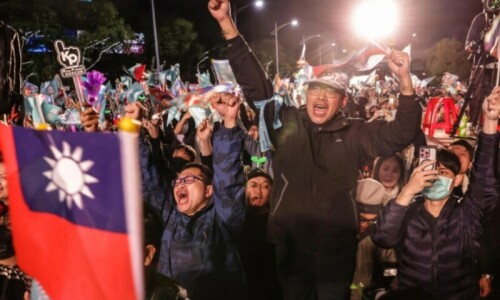
The announcement came days after Taiwan elected the independence-leaning Lai Ching-te as its next president
In a media release, the Nauru government said it would no longer recognise Taiwan “as a separate country” but “rather as an inalienable part of China’s territory”.
China claims democratic, self-ruled Taiwan as its own territory and has vowed to one day seize it, by force if needed.
Nauru said it would “sever diplomatic relations” with Taiwan immediately, and “no longer develop any official relations or official exchanges with Taiwan”.
Following the switch, Taiwan in turn said it was ending diplomatic relations with Nauru “to safeguard our national dignity”, said Taiwan’s deputy foreign minister Tien Chung-kwang.
Taiwan’s Presidential Office also accused Beijing of “diplomatic repression”.
“While the whole world is congratulating Taiwan on successfully completing the election, Beijing launched such a diplomatic repression that is a retaliation against democratic values and a blatant challenge against a stable international order,” said a statement from Presidential Office spokeswoman Olivia Lin.
Nauru’s decision will likely be seen as a major coup for Beijing — the island nation was one of the few countries left that officially recognised Taiwan on a diplomatic basis.
“This change is in no way intended to affect our existing warm relationships with other countries,” the Nauru government statement said.
“Nauru remains a sovereign and independent nation and wants to maintain friendly relations with other countries,” it added.
Taiwan and China have engaged in a diplomatic tug-of-war to lure allies in the Pacific region, offering generous aid packages and assistance in agricultural and educational development.
Diplomatic ‘step change’
Veteran politician David Adeang was elected Nauru’s president in October last year.
Lowy Institute Pacific analyst Mihai Sora suspected Adeang’s ascension to the country’s top job might explain its unexpected sharp turn in foreign policy.
“It’s surprising because Nauru, typically in the last few years anyway, it’s been quite vocal in its criticism of China,” he told AFP.
“So it’s quite a step change for them,” he said.
Nauru is the latest Pacific country to turn its back on a longstanding relationship with Taiwan.
In a shock announcement made in 2019, Solomon Islands announced that it would also officially recognise China.
That decision fuelled concern among Western allies that Beijing might seek to establish an increased military footprint in the strategically important Pacific region.
Only 12 states, including the Holy See, now fully recognise Taiwan.
In Africa, only Eswatini officially recognises Taiwan, while in Latin America, seven states have full diplomatic ties with the island, including Belize, Guatemala, Haiti and Paraguay.
Taiwan also cut its 17-year diplomatic relationship with Nauru in July 2002. But the two countries patched things up in 2005, when Nauru switched back to Taiwan.
The island microstate population 12,500 — is one of the world’s smallest countries and lies about 4,000 kilometres northeast of Sydney.
China says ‘welcomes’ Nauru decision to cut ties with Taiwan
China said it welcomed Nauru’s decision to cut ties with Taiwan.
“As a sovereign and independent nation, Nauru has announced […] that it has severed its so-called ‘diplomatic relations’ with Taiwan and is willing to restore relations with China,” a spokesperson for Beijing’s foreign ministry said.
“China appreciates and welcomes the Nauru government’s decision,” the spokesperson added.
“There is only one China in the world, and Taiwan is an inalienable part of it,” the ministry spokesperson said.
“The Nauru government’s decision to resume diplomatic ties with China fully demonstrates once again that the One China Principle reflects the sentiments of the people and is in line with the general trend,” the spokesperson added.
“China is willing to open a new chapter in bilateral ties with Nauru on the basis of [this] principle.”