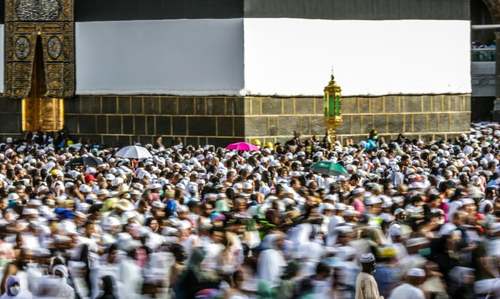
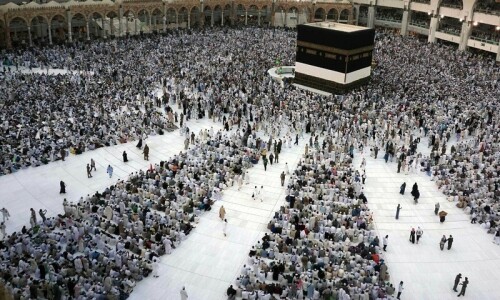
Vast crowds of worshippers hurled pebbles in the “stoning of the devil” ritual Wednesday as the biggest Haj pilgrimage since the Covid-19 pandemic draws to a close in Saudi Arabia.
From dawn in Mina, hundreds of thousands of Muslim pilgrims began pelting three concrete monoliths representing Satan under soaring temperatures before heading to Makkah for a final “tawaf” — circling the Kaaba, the giant black cube at the Grand Mosque.
More than 1.8 million people are taking part in the first unrestricted Haj since Covid-19 struck in 2020. About 2.5m, the most on record, joined the pilgrimage in pre-pandemic 2019.
As well as crowds at every turn, the visitors have had to contend with ferocious temperatures at the Haj, which currently coincides with the Saudi summer.
Temperatures peaked at 48 degrees Celsius on Tuesday, when the pilgrims prayed for hours at Mount Arafat. The mercury hit 47 degrees on Wednesday.
In Mina, some sought shelter from the sun by lying under parked trucks, while civil defence volunteers inspected tents to check on pilgrims.
“I will not think of doing Haj again until it takes place in winter,” said Farah, a 26-year-old Tunisian who did not want to give her full name.
“My body is melting,” she said.
As helicopters buzzed overhead, pilgrims flooded the streets around Mina.
In Makkah, the Grand Mosque was packed from the early morning with circling pilgrims, who loudly congratulated each other on completing the rituals.
Deadly history
This year’s attendance figure, announced by Saudi officials on Tuesday, falls well short of their predictions of beating the 2019 record, possibly because of the heat or the cost, at around $5,000 per person just to attend.
The overwhelming majority of the 1.8m pilgrims — more than 1.6m — are foreigners, coming from about 160 countries.
The Haj is a major revenue-earner for Saudi Arabia, which is trying to pivot its oil-reliant economy in new directions including tourism. The kingdom makes an estimated $12 billion a year from the Haj and year-round umrah pilgrimages.
Saudi Arabia’s King Salman issued a message wishing “wellbeing and prosperity on our country, on Muslims and the world” and announced he would pay for sacrificial animals for nearly 5,000 of the poorest pilgrims.
Wednesday’s devil-stoning marks the start of the three-day Eidul Azha holiday, celebrated by Muslims by buying and sacrificing livestock to commemorate Prophet Ibrahim’s willingness to sacrifice his son.
Mina’s walkways have proven deadly in the past: in 2015, a stampede killed up to 2,300 worshippers in the worst Haj disaster ever. A similar incident killed 364 in 2006.
Other stampedes were reported in 2004, 1998 and 1994. In 1990, the failure of a tunnel ventilation system triggered a huge rush that killed 1,426 pilgrims, mainly from Asia.
There have been no major incidents since 2015, and the site has been extensively remodelled with a multi-storey bridge to allow the pilgrims to access the monoliths safely.
‘Very exhausted’
The scorching conditions have been perhaps the biggest challenge for this year’s worshippers, including many elderly after a maximum age limit was scrapped.
In recent years the Haj, which follows the lunar calendar, has fallen in the Saudi summer, at a time when global warming is making the desert climate even hotter.
Experts have warned that temperatures of 50 degrees Celsius could become an annual occurrence in Saudi Arabia by the end of the century.
As protection from the heat, many pilgrims have been walking with umbrellas to shield themselves from the sun, while others carry their folded prayer blankets above their heads.
One security guard was seen fanning a seated pilgrim, apparently overcome by the heat at Mina. According to official figures, at least 287 people have been treated for heat exhaustion and heatstroke.
Sitting under a white umbrella, Shahinar Mustafa said enduring the heat only gave more weight to her prayers.
“I don’t dwell on whether its hot or cold,” said the 57-year-old Egyptian school teacher.
“The hotter the weather, the better my deeds” appear in the eyes of God, she said.
The rituals started on Sunday at Makkah’s Grand Mosque, Islam’s holiest site, before an overnight stay in tents and then the prayers on Mount Arafat, where the Prophet Muhammed (Peace be Upon Him) delivered his final sermon.