AFTER KP and Islamabad were rocked by episodes of militant violence over the past few days, Balochistan experienced a bloody weekend when security personnel as well as non-combatants were subjected to acts of terror.
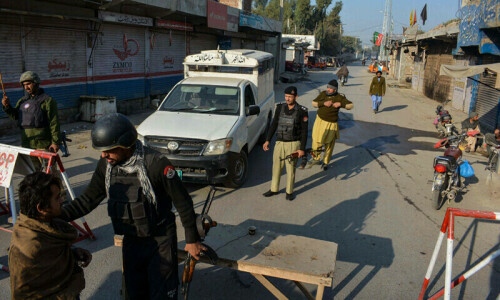
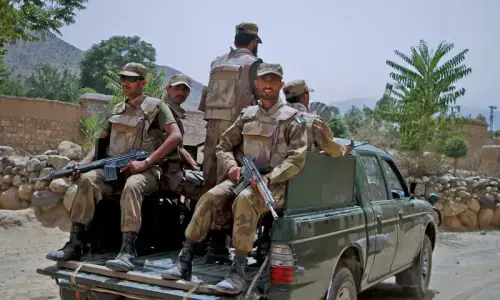
Two incidents occurred on Saturday, in which at least five security men belonging to the FC and Levies were martyred in Turbat and Chaman, respectively. The banned TTP took responsibility for the Chaman attack.
Sunday — which was the Quaid’s birthday as well as Christmas — saw even more violence, as at least six security men were martyred.
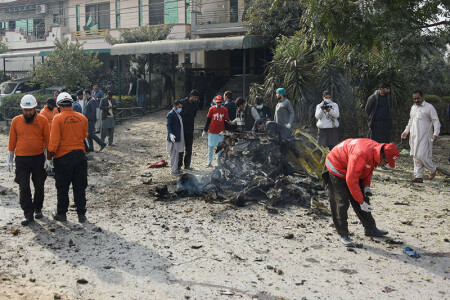
The bloodiest incident occurred in Kohlu’s Kahan area, when five army troops, including a captain, lost their lives in an IED blast. The proscribed BLA has claimed responsibility for the attack.
Meanwhile in Zhob, another soldier was martyred, while security men as well as civilians, including children, were injured in attacks in Quetta, Hub and Kalat.
It can be assumed that Dec 25 was chosen by the attackers for its symbolism, as earlier the Ziarat Residency, where Pakistan’s founding father had stayed before his death, was targeted by Baloch separatists in June 2013.
However, an equally troubling aspect that has emerged from the recent incidents is the possibility of TTP and Baloch militants working together. There have been such reports in social and mainstream media, although nothing conclusive has emerged.
The weekend violence affected both Pakhtun- and Baloch-majority areas of Balochistan. There are reports that some Baloch separatists have decided to join hands with the TTP, though observers say this decision has not been made by major separatist groups, but may represent the choices of individual militants.
The prospect of TTP and Baloch militants combining forces would be a particularly disturbing one for the state, as it would present an even greater security challenge.
Religiously inspired militancy has a history in Balochistan; after all, one of the most lethal chapters of sectarian terror group Lashkar-i-Jhangvi at one time operated out of the province, claiming hundreds of lives during its multiple campaigns of terror. Though LJ has been relatively quiet in Balochistan of late, militants belonging to this group would be natural allies of the TTP.
Meanwhile, the porous border with Afghanistan means that armed groups of all persuasion can come and go with relative ease.
The state needs to quickly address the emerging threat, lest Balochistan slip back into large-scale violence.
If there is an emerging nexus between the TTP and Baloch militants, it must be broken, while if there is evidence that the Baloch separatists are finding refuge in Taliban-controlled Afghanistan, this needs to be taken up with Kabul’s rulers.
Years of policies led by the establishment to pacify Balochistan have failed. Therefore, along with kinetic action, the state must also look at why it has been unable to bring socioeconomic uplift to this resource-rich, but appallingly poor province.
Published in Dawn, December 27th, 2022