Turkiye's President Erdogan, Azerbaijan counterpart vow unity after tensions
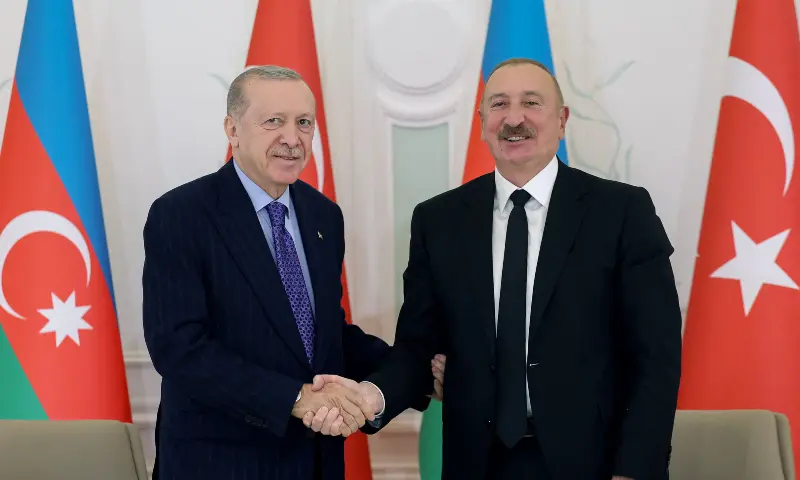
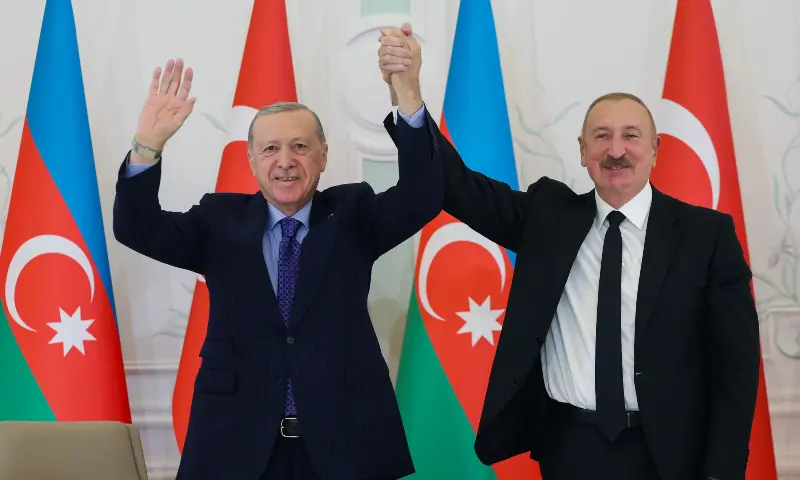
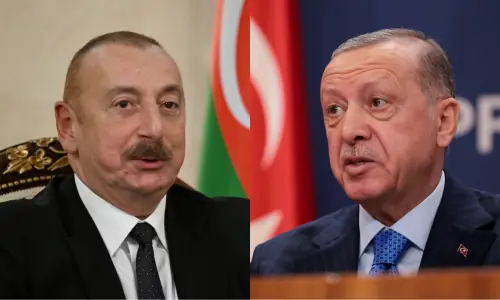
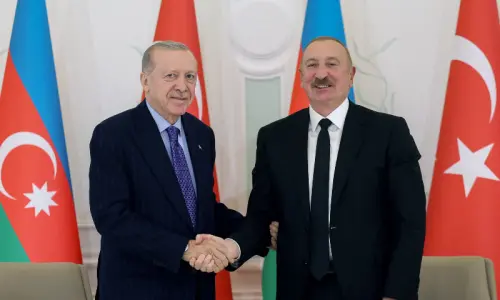
Turkiye’s President Recep Tayyip Erdogan and Azerbaijan’s President Ilham Aliyev vowed on Sunday that their countries’ alliance would remain solid, in a show of unity aimed at overcoming a public rift between the close neighbours.
Tensions flared in September, when Baku revised school uniform regulations to prohibit clothing deemed incompatible with secular education, effectively barring Islamic headscarves in classrooms.
Erdogan’s government has dismantled restrictions on hijabs in Turkiye.
Azerbaijan’s move sparked protests at home and drew criticism from Erdogan’s Justice and Development Party (AKP). Presidential adviser Oktay Saral demanded that Azerbaijan reverse the restrictions.
Aliyev’s ruling party, Yeni Azerbaijan, denounced the comments as “interference in Azerbaijan’s internal affairs”.
Baku also declared 31 Turkish nationals, including an opposition lawmaker and party leaders, persona non grata over critical social media posts.
Erdogan subsequently dismissed Saral, but Aliyev stayed away from an Oct 30 summit of Turkic leaders in Ankara — despite a personal invitation from Erdogan. Instead, he sent Foreign Minister Jeyhun Bayramov.
On Sunday, as Azerbaijan marked Victory Day commemorating a 2020 war with Armenia, Erdogan arrived in the country’s Fuzuli district, which Baku recaptured from Armenian forces six years ago.
A guard of honour lined up at the airport, where Aliyev and First Lady Mehriban Aliyeva welcomed Erdogan and his wife Emine.
“With the permission of Almighty God, our unity will endure forever,” Erdogan told a joint press conference with Aliyev.
“This unity of hearts, which we describe with the motto ‘One Nation, Two States,’ is an everlasting torch that draws strength from our shared past and illuminates our future.”
Aliyev said the alliance — “an important factor across a vast geographical area” — remained unshaken.
“Together, Azerbaijan and Turkiye are even stronger,” he said, adding that Erdogan’s visit “shows the whole world our unity”.
“I am confident that this unity will last forever.”
‘Deeper rift’
Analysts say the quarrel reflects deeper unease over Baku’s diplomatic independence and its close ties to Israel.
“Azerbaijan-Turkiye tensions stemmed from the fact that Baku does not see itself as the younger brother in this alliance and insists on relations between equal partners,” Elkhan Shahinoglu, head of the Baku-based Atlas Research Centre, told AFP.
“The hijab dispute is a symptom of a deeper rift,” Gonul Tol, an analyst at the Washington-based Middle East Institute, wrote on X.
“Tensions have long simmered over a number of issues including Azerbaijan’s sovereignty, Ankara’s influence in Baku, diverging policies toward Israel, and Turkiye’s rapprochement with Armenia.”
Baku has forged strong military and economic ties with Israel, which supplied Azerbaijan with weapons during its 2020 war with Armenia over the breakaway Karabakh region.
This angered Turkiye, which has grown increasingly hostile towards Israel over the Gaza conflict. Erdogan has accused Israel of genocide.
Turkiye is also seeking to normalise relations with Armenia, whose border it closed in the 1990s in solidarity with Azerbaijan, while linking progress to Armenian-Azerbaijani peace efforts.
Nov 8 marks Azerbaijan’s capture of the city of Shusha in Karabakh during its war with Armenia, a victory achieved with Turkish backing.
The Turkic-speaking allies describe their relationship as “one nation, two states” and, despite the friction, remain closely bound by military and energy ties.
Turkiye serves as a key transit route for Azerbaijani oil and gas exports to Western markets.
An ex-Soviet republic, Azerbaijan is a mainly Shia Muslim country, but after decades of Soviet rule it emerged as one of the most secular states in the Muslim world.