Road to a province


 1
1

THE issue of Gilgit-Baltistan’s political status and its merger with Pakistan is once again a part of active discussions, as it has been, periodically, over the past two years. It picked up pace after Prime Minister Imran Khan’s visit to Gilgit in November 2020 on the anniversary of GB’s independence from Dogra rule. The PM announced a provisional provincial status for GB. The following month, he constituted a 12-member committee to give recommendations for GB’s future status. The federal law ministry prepared a draft constitutional amendment proposing a provincial assembly for GB, representation in the national legislature, replacing the Chief Court with a high court and extending the Supreme Court’s jurisdiction to GB.
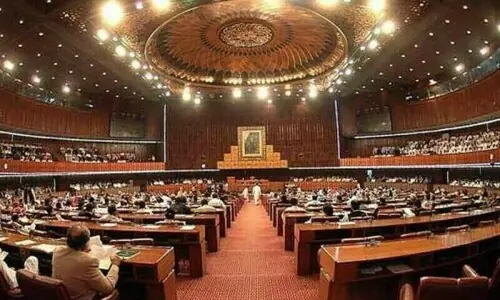
Last month, four Balochistan Awami Party senators dramatically submitted a private member’s bill to the Senate Secretariat seeking a provisional constitutional status for GB at a time when a parliamentary committee comprising GB lawmakers was already working on a transitional plan and on suggestions for constitutional amendments. The bill was an embarrassment for the PTI government which appeared unaware of the move although the BAP is a PTI ally. There was a swift backlash from GB’s lawmakers and the public. The bill suggested an amendment to Article 1 of the Constitution, a long-standing demand of the people but GB Assembly members condemned the move and a GB parliamentary committee rejected the document as it was prepared without consulting the relevant stakeholders. A communique called for stopping work on the status of a provisional province until the bill was withdrawn.
The GB diaspora settled in urban areas in the country also reacted. Awareness seminars, students’ study circles and discussions were organised in different cities. Many young people used social media to express their concerns. Although various circles and some of GB’s leaders were already critical of the provisional province status, the BAP catalysed the debate on the provisional province.
The crisis of GB’s future status must be addressed by the centre.
GB’s nationalist leader and elected assembly member from Ghizer, Nawaz Khan Naji, termed the provisional province as closer to a KP district. Naji’s statement takes us back to the late 1940s when Gilgit, after its independence, was brought into the administrative structure of the then NWFP by the government of Pakistan, the Frontier Crimes Regulation was imposed and a political agent was sent to Gilgit with administrative, judicial and legislative powers. Zafar Iqbal in his book Gilgit-Baltistan in Constitutional Limbo writes about a proposal sent to Pakistan’s foreign ministry by Khan Abdul Qayyum Khan, then NWFP chief minister, to bring Gilgit Agency under the NWFP administration. Since Pakistan wanted to secure GB’s vote bank in anticipation of a possible UN plebiscite, it maintained GB as part of the maharaja’s state of Jammu and Kashmir and hence this proposal was rejected by the Foreign Office.
GB’s intelligentsia is questioning the legitimacy of a provisional province on the pretext of GB being a disputed territory. Their arguments stem from apprehensions that the state might be trying to exploit the area’s resources including land, minerals etc. due to the absence of an empowered local assembly. There is an inferred fear of demographic changes. There are also questions about whether the GB Assembly would have enough legislative powers, autonomy and rights over GB’s resources and whether the new set-up would recognise the distinct identity of GB, grant representation to it in the NFC Award, continue the wheat subsidy and provide socioeconomic guarantees.
These concerns need to be addressed by the government of Pakistan prudently. Although the mainstream political parties of GB appear to be in favour of a provisional province, the proposed amendments should be debated in the GB Assembly. Making it public, and evaluating the merits and demerits while taking major stakeholders including the nationalist parties on board, would be pivotal in gaining the public’s trust.
It seems that the GB parliamentary committee and federal officials are part of the consultation process and working for constitutional redress. Merely giving seats in the National Assembly and Senate won’t be enough. It was in the 2020 GB election that the slogan ‘haq-i-hakimiyat’ and ‘haq-i-milkiyat’, right to rule and right to ownership, became popular. It is possible that the proposed amendments may not be directed at Article 1 of the Constitution as that would compromise Pakistan’s position on Kashmir. However, the demand of transferring internal autonomy and legislative powers to the GB Assembly are in the light of the UNSC resolutions on Kashmir. With growing awareness in GB regarding autonomy and political rights, it is imperative that the Pakistani government take wise steps in determining the future status of GB.
The writer is lecturer at the School of Economics and Social Sciences, IBA Karachi.
Twitter: @saj_ahmd
Published in Dawn, March 13th, 2022