0
0

THE Dec 18 sewerage line blast in the vicinity of Shershah in Karachi saddened us all. Seventeen people died and many more were injured, some of them critically. The scale of the blast and damage led officialdom to respond — in their usual way. An inquiry under the commissioner was ordered. There will be many more inquiries. Since some of those who died had connections in the corridors of power, greater scrutiny in investigation might be observed.
However, it should be pointed out that similar events in the past have been forgotten, as have the pain and anguish of the affected families. In this society, life is cheap and no lessons are learned.
We commonly find buildings and structures erected on potentially hazardous sites. Our government agencies only respond to emergencies of a certain scale and seriousness. When will they realise that the creation and management of a safe and secure built environment is a primary government responsibility? Pakistani cities have laws and rules to oversee the construction and utilisation of land in different categories and to monitor and regulate these. Despite these legal prescriptions, inefficiency and inadequacy of the monitoring agencies, adulterated construction material, lack of technical know-how regarding ordinary built structures, errors and discrepancies in the supply chain of materials and building services, and the failure of users to report defects are some common handicaps noticed commonly in Karachi. Building tragedies in the Gulbahar area and other locations are examples. The existence of shoddily constructed buildings and poor infrastructure is nothing short of a ticking bomb that can suddenly explode, kill and maim. There are many such bombs in Karachi and beyond.
Close observation of such accidents have revealed many patterns that demand a deeper analysis. For instance, the violation of fundamental zoning principles and incomplete construction have often been killer factors. Karachi has over four dozen major natural drains, some of which pass through our neighbourhoods. City plans have advised that these natural drains be kept pristine as they are meant to serve as conduits for the smooth discharge of rainwater. Unfortunately, almost all such drains have become sewage carriers in the absence of an integrated sewerage network. In many cases, muscles have been flexed by local strongmen to build profit-making structures in connivance with officials. Even the basic prerequisites of safety are violated in such shoddy enterprises. The accumulation of gases in the absence of proper ventilation arrangements leads to accidents. This is seen across the metropolis.
Urban dangers lurk in every corner of Karachi.
There are other types of hazards too. Many fringe squatter settlements are used as parking lots for heavy vehicles. As the dwellings are congested, young children are forced to play in the streets. They continue to fall victim to these vehicles that are more often than not recklessly driven. Whenever the residents of the area have tried to persuade the operators of these vehicles to take the latter elsewhere, they are met with refusals and told that no secure place has been allotted to them for parking their trucks, buses and vans.
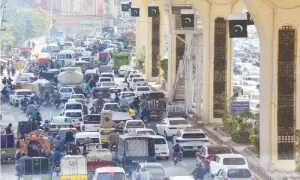
Extensive road development works were carried out at the time of the City District Government Karachi. These interventions increased the possibility of accidents. For instance, the widening of roads led to the disappearance of footpaths in many locations. On some of the busiest streets, pedestrians can be found walking in the same direction as the vehicles that are being driven. Given our erratic driving behaviour, accidents occur on a routine basis. Motorbikes and even cars can be found screeching and being driven in the wrong direction. Wherever footpaths exist, they are encroached upon. Open gutters, unfinished trenches for pipes, hanging wires and cables, falling debris from construction activities and uneven surface levels are constant threats in walking spaces. Sidewalks built on storm drains now carry sewage. If there is no vent for the gases, they will accumulate and may cause an explosion.
Safety concerns demand that the concerned authorities do careful planning. A comprehensive land use survey of Karachi division must be carried out by the government to assess the utilisation pattern of various categories of land. Right of way accommodating the critical infrastructure of the city must be earmarked for freedom from encroachments. A back-up rehabilitation plan must be prepared to adjust the affected of such ventures. It must be ensured that such relocations are across the board without distinction between the powerful and powerless. Active community engagement and mobilisation must be brought into action to make this exercise people-friendly and acceptable to the masses.
The writer is an academic and researcher based in Karachi.
Published in Dawn, December 23rd, 2021