Pakistan to have coherent national security policy by year end: Moeed


 39
39

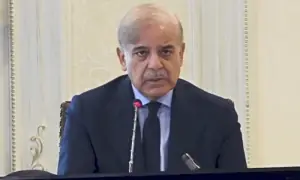
LAHORE: Prime Minister’s Special Assistant on National Security Division and Strategic Policy Planning Moeed Yousuf on Sunday said Pakistan is going to have a coherent national security policy with an inclusive economic diplomacy by the end of this year, ensuring security in all respects for every Pakistani.
He was speaking at a session on Defining National Security at the Afkar-i-Taza ThinkFest here at Alhamra. Journalist Ejaz Haider moderated the session.
Mr Yousuf explained salient features of the planned policy and termed it a paradigm shift, saying it would include all sectors, including health, education and climate change. The new policy, he added, would not deal with national security only, but all aspects of the country with multiple level inputs. It would not produce results overnight, he said.
He said including education in the overall national security policy did not mean deploying guards outside schools. It would mean securing society by educating people and giving them jobs. The economic diplomacy was the basic element of the government’s planned inclusive foreign policy.
Replying to a question about the prime minister’s decision of not going to Malaysia to attend a summit, he said it was good and made in the best national interest. “We are going to drive our foreign policy wherever we can. We are working on how to keep external walls out of Pakistan,” he said.
He said in the government’s view, division in the Muslim world was not good and it would try its level best to stop this wherever it could. But while doing so, he said, the government would watch the best national interests. The prime minister did not go to Malayasia with this objective in mind, he explained.
“The decision did not affect Pakistan’s relations with Malaysia or Turkey. The prime minister is visiting Malaysia next month. We are the only Muslim country which can talk to every Muslim country. Turkey, Malaysia and Saudi Arabia are in our camp,” he said.
Mr Yousuf said right now, Pakistan was talking of de-escalation of tensions and both Iran and Saudi Arabia were its friends.
Talking of Kashmir, he said the Kashmir freedom movement was indigenous and it would be continued merely by the Kashmiris themselves. He said Pakistan looked towards the UN for the resolution of the Kashmir issue because it had through its resolutions recognised it as a dispute. This was for the first time the West was taking note of the Indian atrocities in the held Kashmir, he said.
The session on “Poor are Excluded from Social Mobility” began with a documentary explaining the issue.
Mr Asad Javaid presented five institutional evidences to show how the poor were excluded from social mobility, and how in some cases they were paying more than the rich.
Ms Tooba Syed discussed Ramsha Maseeh Colony where people living in a katchi abadi in Islamabad were shifted. The people living in the colony did not have even the basic health and water facilities. And the newcomers were asked to return to their own colony.
Mr Usama Khawar disliked rapid urbanisation in Pakistan. With the price of property skyrocketing in the last five years, he linked the problem to the massive acquisition of land by the government and the official bottlenecks.
In another session on Simon Wolfgang Fuchs’ book “In a Pure Muslim Land, Shi’ism between Pakistan and the Middle East”. The author from Germany and Mr Ali Usman Qasmi of LUMS talked on ethnographic history of Shia sect and its religious competitors in the region.
Mr Fuchs said the notion of Pakistan as the pinnacle of modern global Muslim aspirations forms a crucial component of this history. It has empowered Shias, who form about 20 percent of Pakistan’s population, to advance alternative conceptions of their religious hierarchy while claiming the support of towering grand ayatollahs in Iran and Iraq.
He explained how Pakistani preachers and scholars indiginised the Iranian revolution and formulated their own ideas for fulfilling the original promise of Pakistan.
Published in Dawn, January 13th, 2020