Aurat-Azadi March heralds a new age of feminist politics


Islamabad’s F-6 sector reverberated with calls for Azadi (liberation) on Friday as hundreds of women and dozens of men chanted slogans, made speeches and sang feminist songs as part of the ‘Aurat Azadi March’ marking International Women’s Day.
The otherwise grey, overcast afternoon was brought alive with colour, as protesters waved purple and red flags and held up brightly coloured placards with messages both witty and hard-hitting. The mood was at times celebratory and at others charged with fury as speakers brought up instances of honour-killing and gender-based violence and the recent murder of activist Afzal Kohistani.
Many veteran activists who have been involved in organising marches and movements for decades agreed that Friday’s march is the biggest the capital has seen since the 1990’s.

Feminist poet Kishwar Naheed congratulated the organisers for managing to bring together disparate groups under one banner.
“With marches in cities across Pakistan, including Quetta and Peshawar, the 2019 International Women’s Day was historic in its success,” she said.
Human rights activist Tahira Abdullah said: “Having participated in Women’s Day events for four decades, the huge response to Islamabad’s 2019 march was heart-warming and inspiring. Especially seeing the diversity of our new feminist movement – three generations of women, men, girls, boys, transgender people, minorities and persons with disabilities from various socio-economic and political backgrounds marching together, holding up thought provoking placards, chanting slogans and singing and dancing, speaking out bravely and confidently.”

Ending Violence Against Women and Girls (EVAWG) Alliance Chairperson Ambreen Ajaib, who has been marching for women’s rights in the capital for the last 20 years, said: “Since the 90’s women’s movements had become dominated by NGOs, which are becoming increasingly project-oriented at the expense of politics of resistance. But Friday’s march brought out students and young people in large numbers, which signals the beginning of a new wave of activism.”
“Senior politicians including Sherry Rehman attended without any formal invitation or coaxing from the organisers, which is rare,” she added.
Co-moderator for the march Shazia Shaheen who, along with Women Democratic Front’s (WDF) Alia Amirali, spent most of the afternoon raising slogans from the back of the pick-up van leading the march, said a day later that she was still intoxicated from the passion she witnessed on Friday.
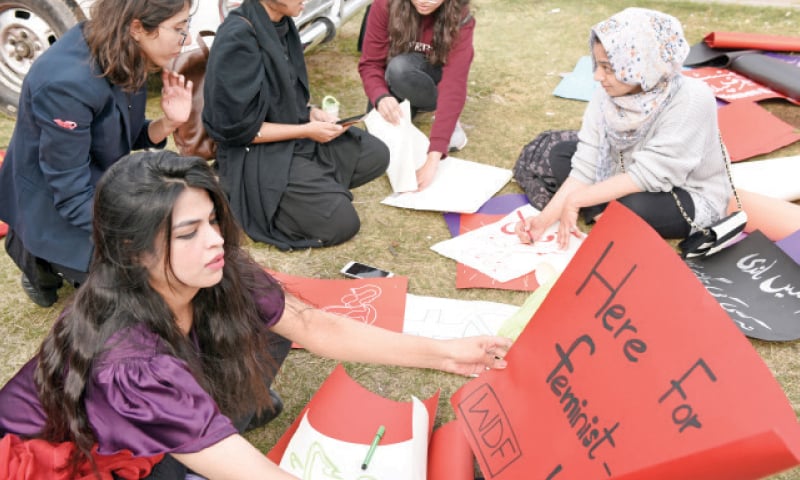
“For me, Friday marked the dawn of a new age where young people are not only taking the mantle but also breaking class barriers and ensuring women’s movements are ethnically and socially inclusive,” she said.
While Deputy Commissioner Hamza Shafqaat attended the march to express solidarity, Ms Shaheen criticised the district government’s refusal to allow the protesters to march the traditional route to Constitution Avenue. “Marching to the parliament is symbolic, as we are demanding our constitutional rights,” she said.
WDF’s Tooba Syed, a force behind this year’s march, said her experience of organising the march was uplifting. “But trying to push against being titled as a civil society or NGO-centric march and gaining recognition as an act of feminist politics was challenging,” she added. Another active member of the organising committee, Barrister Benazir Jatoi, also spoke about the challenges of cementing people from different movement, forums and networks and working through disagreements.
“But the turnout at the march showed that it was worth it. The crowd was huge and so charged. Our sleepy little capital made me proud,” she said.
Published in Dawn, March 10th, 2019