2
2
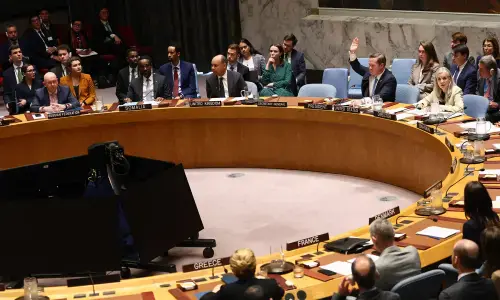
UNITED NATIONS: The United Nations General Assembly elected Indonesia, Germany, Belgium, South Africa and the Dominican Republic as members of the Security Council on Friday for a two-year term starting on Jan 1 next year.
The 15 member council is the only UN body that can make legally binding decisions and has the power to impose sanctions and authorise the use of force.
Indonesia outscored the Maldives 144-46 in the race for a solitary Asia-Pacific seat, while the other four candidates ran unopposed. Candidates running unopposed need to win more than two-thirds of the overall General Assembly vote to be elected.
There were 190 ballots in Friday’s vote.
Germany received 184 votes, Belgium 181, South Africa 183 and the Dominican Republic 184 after the first round of voting.
In a typical year, the General Assembly elects five new members, which join the five elected the previous year and the five permanent, veto-powers — the United States, Britain, France, China and Russia.
The five members giving up their seat at the end of this year will be the Netherlands, Sweden, Ethiopia, Bolivia and Kazakhstan.
AFP adds: There are 15 members on the UN Security Council, including the five permanent ones — Britain, China, France, Russia and the United States — and 10 non-permanent members, half of which are elected each year.
Just before taking up their duties, the elected states get intense training about Security Council protocol and customs.
The ambassadors will each preside over the council for a month during their mandate.
Belgium and Germany obtained the two seats for the Western Europe and Others Group after Israel dropped out of the competition.
As part of a deal at the African Union, the Africa slot went to South Africa, while the Dominican Republic took up Latin America’s spot after a similar consensus in that group.
Each regional bloc has its own process for Security Council candidates. For some, “it’s first come, first served,” and countries often seek a seat very early on, a diplomat said, speaking on condition of anonymity.—AFP
Published in Dawn, June 9th, 2018